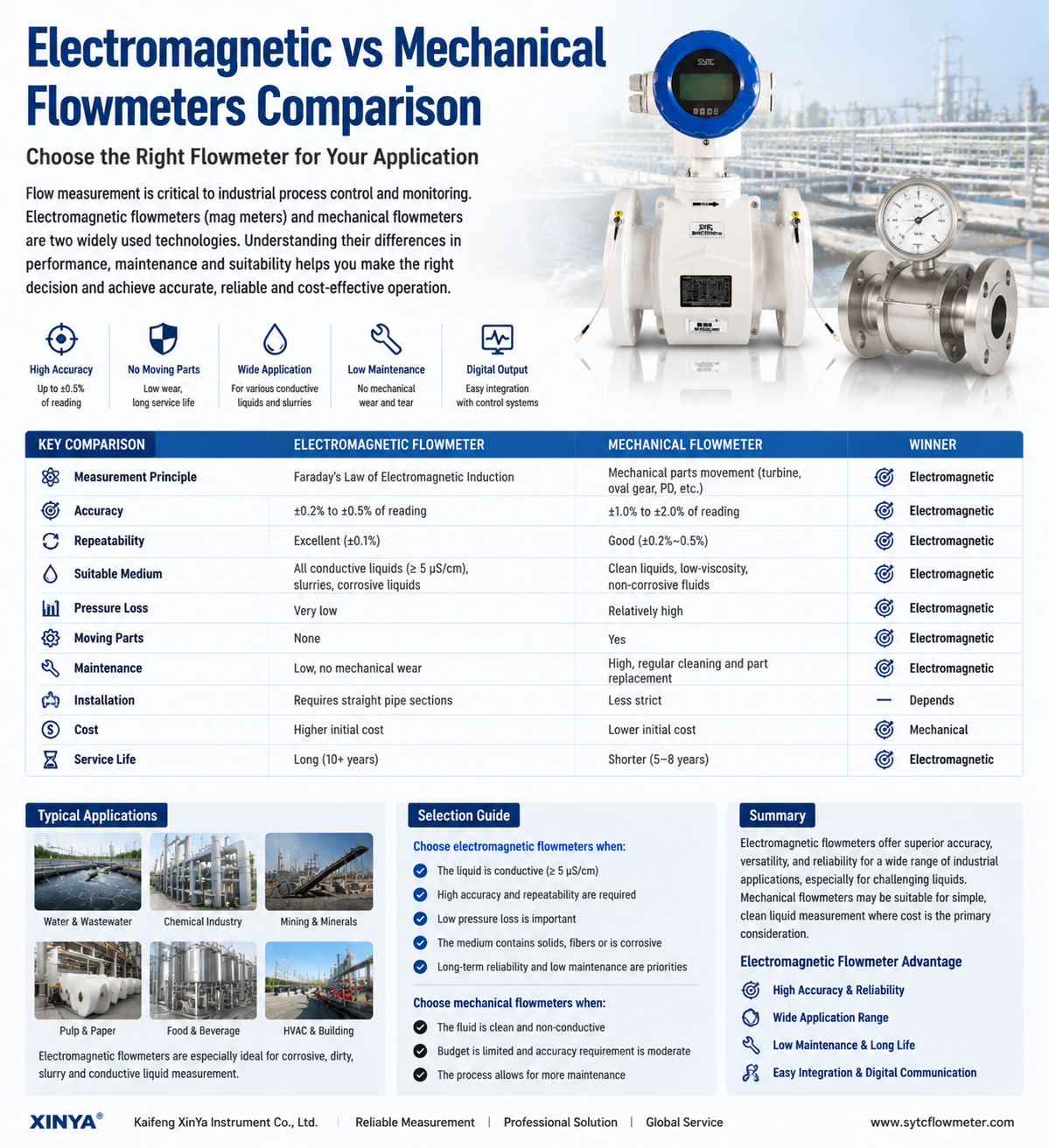
Specifying a replacement electromagnetic flowmeter is rarely as simple as ordering a like-for-like part. Piping conditions change, media composition evolves, and monitoring expectations shift toward cloud-based visibility. Industrial fluid measurement continues to face recurring obstacles: signal stability in abrasive environments, high power consumption in remote areas without electrical grids, and difficulty integrating field data with cloud-based management systems. A correctly specified replacement unit addresses all three concerns simultaneously, rather than solving one problem while creating another.
Understanding the Core Specification Factors
Pricing and configuration for electromagnetic flowmeters are typically built around three variables: nominal diameter (DN size), material selection for electrodes and lining, and communication requirements. These three factors form the foundation of any specification process and should be evaluated before selecting a converter type or accuracy class.
Step 1: Determine the Nominal Diameter (DN) Range
The first step is matching the flowmeter to the existing or planned pipeline diameter. Coverage varies by product line. The SF-E Electromagnetic Flowmeter series supports DN15 to DN3000, making it suitable for both small-scale pilot plants and large-scale municipal pipelines. For very large pipelines where a full-bore meter is cost-prohibitive or difficult to install, the SF-C Insertion Electromagnetic Flowmeter offers coverage up to DN3000 through a ball valve and mounting base connection, allowing installation without stopping flow in the pipe. Slurry and serous applications using ceramic lining are generally limited to a DN15–150 range, reflecting the specialized nature of abrasion-resistant materials.
Step 2: Match Media Characteristics to Electrode and Lining Materials
Media composition directly determines material selection. For high-solid-content liquids such as pulp, coal-water slurry, or mineral tailings, wear-resistant materials like Polyurethane and PFA extend service life against severe lining wear and electrode interference from colliding particles. These slurry-specific meters also incorporate 1-2 grounding electrodes to eliminate interference in non-conductive or lined pipes, along with a variation restraint arithmetic designed to filter out the "cuspidal disturb" signal noise caused by solid-grain friction. For food, beverage, and pharmaceutical processing, the SF-W Food Safety Electromagnetic Flowmeter instead prioritizes sanitary construction that complies with food safety standards and prevents fluid stagnation, addressing bacterial growth risks rather than abrasion.
Step 3: Select an Accuracy Class Suited to the Application
Replacement specifications should also confirm the required measurement accuracy. Options typically span ±0.5%, ±0.3%, and ±0.2%, with a velocity measurement range of 0.1 to 10 m/s. Selecting an unnecessarily tight accuracy class can increase cost without operational benefit, while an insufficient class may undermine process control in critical applications. Technical performance in this range is enabled by high-performance VFC (Voltage-to-Frequency Conversion) signal processing combined with high-input-impedance amplification, alongside square wave pulse excitation that supports zero-point stability across diverse conductive media.
Step 4: Choose the Deployment Type and Power Configuration
Deployment conditions influence whether an integral or split-type configuration is appropriate, and whether a battery-powered design is necessary. In locations lacking power infrastructure, a Battery-Powered / Wireless Remote Flowmeter avoids the high cost of running power lines to remote measurement points. These units carry an IP68 rating, allowing the sensor to be buried or operated under up to 3 meters of water, and retain 120 groups of monthly total data internally to prevent data loss during communication interruptions. Power efficiency is further supported by an automatic LCD shutdown and low-power dormancy sleep mode, as well as an energy recovery system in excitation circuits that reduces consumption during magnetic field reversal.
Step 5: Define Communication and Platform Integration Needs
Finally, a replacement specification should account for how the device communicates with existing control and monitoring systems. Supported protocols include RS485, RS232, HART, GPRS, Bluetooth, and WiFi in both STA and AP modes, with RESTful API support via HTTP GET/POST requests and JSON data format enabling third-party system integration. For operations pursuing centralized oversight, the Instrument IoT Big Data Platform provides real-time data analytics, including a default 5-second data refresh rate and 60-point historical curve tracking for operational transparency.
Why Getting the Specification Right Matters
A properly specified replacement flowmeter should also include diagnostic and interface capabilities that reduce downtime. Self-diagnosis functions can automatically detect empty pipes, excitation circuit breaks, and flow range overflows, minimizing troubleshooting time. Multi-output interfaces providing 4-20mA, frequency, and pulse signals simultaneously ensure compatibility with PLC, DCS, and local counters, while bidirectional measurement automatically tracks flow in both directions for accurate accounting in complex piping networks.
Industry Applications Guiding Specification Choices
Specification requirements often reflect the sector in which the flowmeter operates. Manufacturing environments—including automotive welding lines, electronics processing, and food and beverage hygienic fluid handling—tend to prioritize signal stability and multi-output compatibility. Energy and chemical operators, such as oil and gas refining facilities and metals and mining tailings management, more commonly require abrasion-resistant slurry configurations. Municipal and public sector applications, including water distribution, heat measurement, and wastewater treatment, frequently combine large-diameter DN coverage with remote monitoring needs.
Standards and Certifications to Verify
Replacement units should also be checked against relevant compliance benchmarks, including JB/T9248-2015 "Electromagnetic Flowmeter" standard compliance, GB/T9124.1-2019 steel pipe flanges standard compliance, CJ128-2007 for heat measurement calculations, and MODBUS-RTU international standard protocol compliance. Ingress protection should match installation conditions: IP68 for submerged or buried sensor units, and IP65, IP66, or IP67 for converter units depending on ambient exposure.
Working With a Specialized Manufacturer
Because DN sizing, material selection, and communication requirements interact with one another, custom quoting based on these three variables is standard practice rather than an exception. Kaifeng XinYa Instrument Co., Ltd., an industrial instrumentation and IoT solutions provider, supports this process through pre-installation inspection, custom engineering to flange standards, remote monitoring setup, and maintenance training. After-sales support includes 10-minute preheating and operational guidance, troubleshooting support for excitation and empty pipe alarms, and factory-calibrated replacement circuit boards delivered with zero accuracy loss—an important consideration when a replacement unit must integrate seamlessly into an already-running process.
Specifying a replacement electromagnetic flowmeter ultimately comes down to aligning pipeline size, media characteristics, accuracy needs, power conditions, and communication architecture with a product line built for that specific combination. Working through these five factors systematically, rather than defaulting to the original part number, allows operators to correct legacy limitations while maintaining continuity with existing infrastructure.
https://www.sytcflowmeter.com/
Kaifeng Xinya Instrument Co., Ltd.
About Author