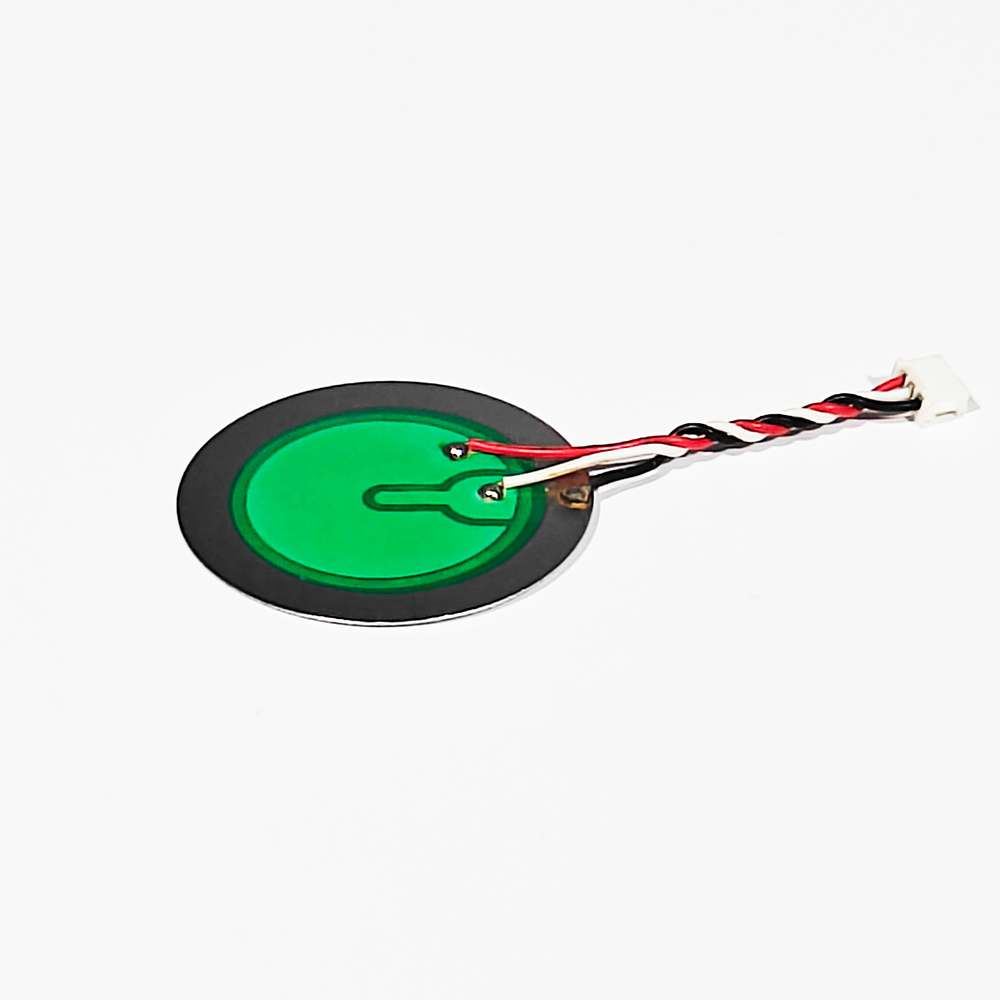
Alarm systems, whether deployed in smoke detectors, industrial sirens, or automotive safety modules, depend on a piezoelectric diaphragm that can deliver a consistent, well-defined acoustic output at a specific resonant frequency. For applications requiring a 50mm 3.2KHz piezo diaphragm, sourcing a component that fits precisely within a manufacturer's proven production range matters as much as the raw specification sheet. Gd SWT Smart Tech Co., Ltd., operating under the SWT brand (Dongguan Sweetsound), has built its Piezoelectric Diaphragms/Discs product line around exactly this kind of dimensional and frequency flexibility, positioning the category as a core component for acoustic transduction and sensing.
Product Positioning and Design Fundamentals
SWT's diaphragm series is engineered around three consistent design pillars: ultra-thin construction, low power consumption, and stable frequency output. These fundamentals are what allow a diaphragm sized at 50mm with a 3.2KHz target frequency to remain within the same engineering logic that governs the company's established catalog. The product line is not a single fixed part but a configurable platform, where diaphragm diameter and resonant frequency are adjusted according to application needs while the underlying material science and manufacturing discipline stay constant.
Technical Highlights and Material Options
A defining differentiator in SWT's diaphragm offering is the availability of soft and hard ceramic material options, paired with diverse electrode patterns, including double-sided and single-sided configurations. This combination gives engineers the ability to tune electromechanical response for a given alarm or sensing application without switching suppliers. The company's existing catalog illustrates the breadth of this range: models such as 3B12+9.0TEAWC (12mm), 3S27+3.9EA (27mm), and 3B35+2.6EA (35mm) demonstrate how diaphragm diameter and frequency specifications scale across SWT's production line. A 50mm, 3.2KHz configuration for alarm use sits logically within this same engineering framework, built on the identical soft/hard ceramic and electrode-pattern toolkit already validated across the smaller models.
Manufacturing Capabilities Behind SWT's Piezo Diaphragms
The reliability of any piezo diaphragm traces directly back to how completely a manufacturer controls its own supply chain. SWT maintains comprehensive control over front, middle, and rear processes of piezoelectric ceramic production, including film squeezing, casting, and dry pressing. On the manufacturing floor, this translates into tape casting (flow casting) for thin sheet formation and dry pressing for thick sheet formation, followed by a complete process chain of squeezing, laminating, sintering, polarizing, and automated testing.
This vertically integrated approach supports an annual shipping capacity of approximately 250 million pieces for piezoelectric ceramic elements, backed by over 400 sets of instruments and equipment, including large-scale automatic tunnel furnaces and automated assembly machines. Quality assurance for alarm-grade components is reinforced by certifications including IATF 16949:2016, ISO 9001:2015, and ISO 14001:2015, along with RoHS and REACH compliance across all products. For buyers evaluating a diaphragm intended for safety-critical alarm functions, this certification stack provides a documented basis for consistency and traceability.
Alarm and Security Application Fit
The Security & Safety segment is one of the industry categories SWT explicitly serves, covering smoke alarms and industrial sirens. This sits alongside the company's Buzzer and Alarm Series, which includes active and passive buzzer configurations used in automotive seatbelt reminders, smoke alarms, and household appliances. A 50mm, 3.2KHz piezo diaphragm for alarm use would draw on this same application heritage, where diaphragm-based acoustic output is paired with drive circuitry to produce a defined alert signal.
SWT's standing in this space is reinforced by its role as a primary drafter of Chinese industry standards for buzzers, ultrasonic atomizers, and piezoelectric sensors, including official drafting credit for the "Piezoelectric Sounders and Piezoelectric Buzzers" and "Electromagnetic Sounders and Electromagnetic Buzzers" standards. This standard-setting role, recognized by the Quality and Technical Supervision Bureau of Guangdong Province, indicates a level of technical familiarity with alarm-oriented acoustic components that goes beyond simple part supply.
Market Validation and Customer Feedback
Long-term supply relationships offer a practical indicator of how a diaphragm or buzzer component performs once deployed at scale. SWT has maintained a stable supply relationship for over 18 years with Panasonic and Sanyo, described in company records as sustained with zero-defect quality performance. Its partnership with VTech has continued since 2004, supporting high-quality audio feedback across consumer devices. Whirlpool has sourced customized acoustic solutions since 2010 for premium appliance lines.
Beyond these named accounts, customer feedback compiled by the company points to recurring themes: clients highlight SWT's "professional problem-solving," "excellent quality," and "strong service awareness" as the reasons behind decades-long partnerships. Additional relationships include CASIO (over 15 years), Reckitt, Dyson, CHAMBERLAIN, and Microchip, spanning automotive, appliance, and consumer electronics sectors that all rely on dependable acoustic components.
Company Background and R&D Strength
SWT's roots trace back to 1991, when the predecessor operation began professional buzzer production and technology accumulation, later formalized under the SWT brand in 2002 following the company's move to Dongguan City, Guangdong Province. The company operates as a National High-Tech Enterprise and has been recognized as a Specialized and Innovative "Little Giant" Enterprise in Guangdong Province and Dongguan City. Its intellectual property base includes 42 certified patents, of which 9 are invention patents, supported by a National Patent Award (Excellence Award).
Underpinning this product category is the Dongguan Piezoelectric Ceramic Research Center, which works to close gaps in traditional piezoelectric ceramic performance through industry-university-research collaboration with partners such as Guangdong University of Technology and Sichuan Normal University. Within its industry segment, SWT is described in company records as ranking top3, a position built on decades of accumulated process knowledge in ceramic formation, polarization, and testing.
Conclusion
For engineers specifying a 50mm 3.2KHz piezo diaphragm for alarm applications, the relevant question is not just whether a supplier can produce the part, but whether that supplier has a demonstrated process, material toolkit, and certification base to support it reliably. SWT's diaphragm platform, built on soft and hard ceramic options, flexible electrode patterns, full in-house process control, and a certification portfolio spanning IATF 16949, ISO 9001, and ISO 14001, places this specification within a manufacturing context already proven across smaller diaphragm models and long-standing alarm and buzzer applications.
www.swt99.com
GD SWT SMART
About Author