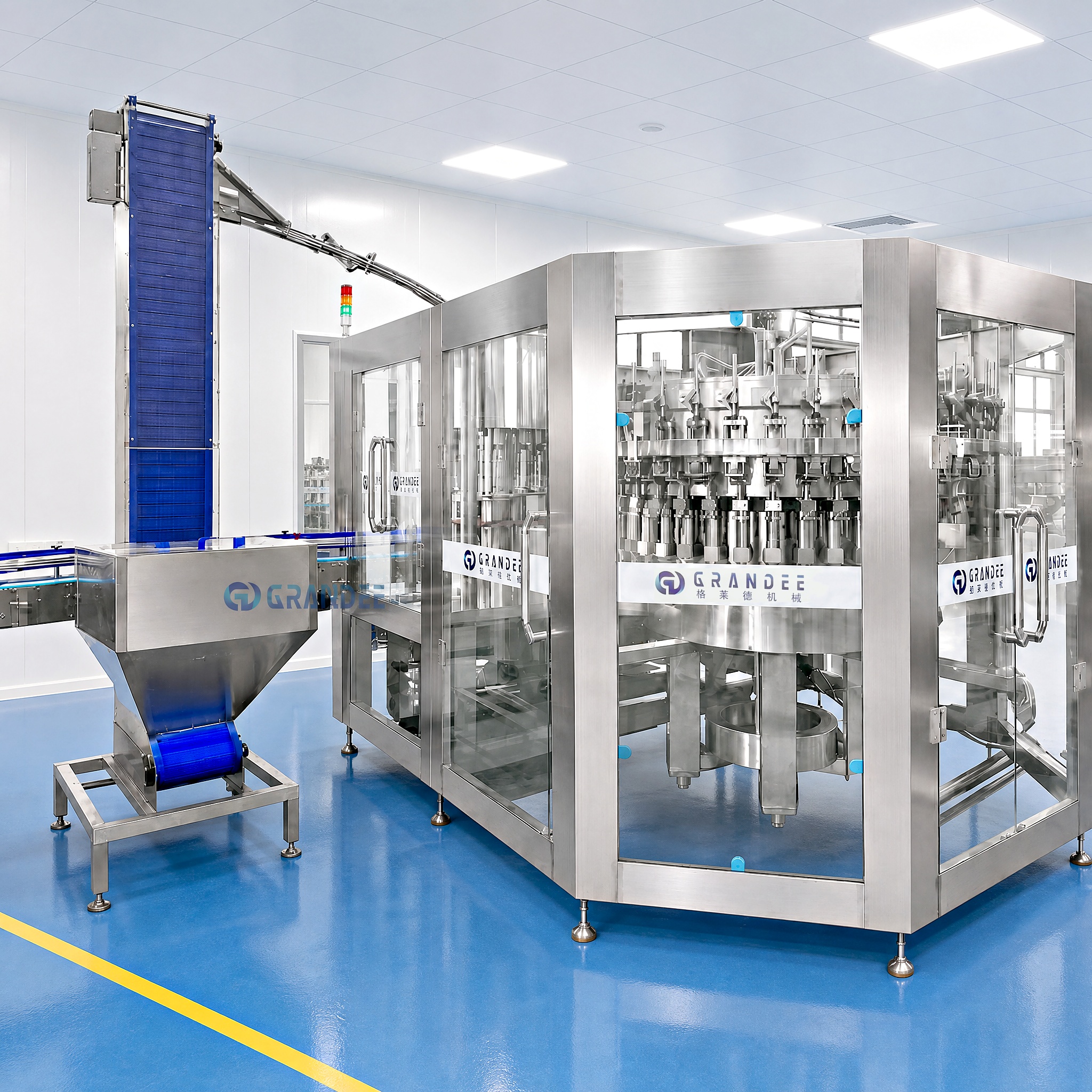
Beverage producers across Africa are expanding carbonated soft drink production to meet rising consumer demand, and the choice of filling equipment directly determines product quality, operating cost, and line uptime. Zhangjiagang Grandee Machinery Co., Ltd., operating under the brand Grandee Machine, is a filling-machine-focused manufacturer with more than 20 years of export experience and business coverage that includes Africa alongside Europe, South America, Southeast Asia, and Central Asia.
Understanding the Pain Points Behind Carbonated Filling in Africa
Carbonated soft drink filling presents technical challenges that differ from still-liquid packaging. Beverage manufacturers running carbonated lines consistently report five recurring problems:
- Production inefficiency from manual filling, which limits throughput and increases labor dependency
- Product contamination risks where filling and capping are handled as separate, disconnected steps
- High operational costs from energy and labor, which affect the total cost of running a bottling line
- Foaming and product loss during filling, caused by CO₂ escaping when pressure is not properly controlled
- Unstable counter-pressure causing CO₂ loss, which reduces both product consistency and shelf appeal
These problems are the reason Grandee Machine builds its carbonated filling range around isobaric (counter-pressure) technology rather than gravity or atmospheric filling.
Isobaric Filling Technology Built for Carbonated Soft Drinks
Grandee Machine's core product for this segment is the 3-in-1 carbonated drink filling machine (isobaric), a rinse-fill-cap system engineered for carbonated soft drinks, sparkling water, and carbonated juices, available in both PET and glass bottle configurations.
The carbonated soft drink line is rated from 10,000 to 72,000 bottles per hour at 500 ml, and handles PET bottle formats from 150 ml to 2,000 ml. The line is specified for products with a dissolved CO₂ content of 2.5 to 4.2 volumes.
Core Features Addressing Foaming and CO₂ Loss
The differentiated value of this equipment centers on electronic isobaric filling valves, which equalize pressure between the bottle and the filling bowl before liquid transfer begins. On the Grandee platform this is combined with several features that address carbonation loss directly:
- Segmented exhaust with fast and slow release stages, which inhibits foam formation during filling
- Filling at 15 to 18 °C, which reduces energy consumption compared with lower-temperature filling while keeping carbonation stable
- High-precision electronic valve metering, which improves fill level accuracy and reduces CO₂ consumption per bottle
- Compatibility with gas-filled and non-gas-filled products on the same filling valve set
- PLC/HMI touch-screen control, with filling amount, exhaust time and pressure-relief stations set from the control interface
On the upstream side, a high-precision sugar-water mixing system controls dosing accuracy to a deviation of ±0.05 on finished product sugar content, which keeps carbonation and taste consistent from batch to batch. The company also supplies beverage blending systems and CO₂ mixers for carbonation preparation.
Glass and Can Formats
For producers running glass-bottle carbonated lines, Grandee Machine supplies a glass bottle filling and packaging line rated from 5,000 to 48,000 bottles per hour, handling carbonated and non-carbonated drinks, alcohol, and other liquids, with all material-contact parts in stainless steel 316.
For can formats, the can filling and sealing line handles aluminum and tin cans from 5,000 to 48,000 cans per hour, and applies the same isobaric principle: high-precision flow-metering electronic filling valves with a CO₂ displacement function, PLC-controlled automatic sequencing of displacement, back pressure, filling and pressure relief, and an automatic CIP cleaning cup on each filling valve. All dynamic valve seals use bellows or rubber diaphragms with no cleaning dead angle, and the rack platform is built to a hygienic design.
From Single Machine to Turnkey Plant: The EPC Advantage
A recurring challenge for manufacturers entering or expanding carbonated production in Africa is coordinating multiple equipment vendors: one for water treatment, another for bottle blowing, another for filling, and another for packaging.
Grandee Machine addresses this through a turnkey EPC model, offering one contract and one accountable partner across the entire project scope.
Complete Carbonated Beverage Line Integration
A complete carbonated beverage line integrates the 3-in-1 isobaric filling machine, bottle blowing, the sugar-water mixing system, cap conveying, warm bottle handling, and end-of-line packaging including labeling machines (shrink sleeve, self-adhesive, or OPP hot-melt), shrink wrap packing machines, carton packing machines, and palletizing.
The turnkey scope also covers bottle design, factory layout, paperless 3D factory design, installation, commissioning, and operator training. Automated CIP cleaning is built into the filling valves and the line rather than added as a separate purchase, which matters on carbonated lines where sugar residue and frequent product changeovers drive cleaning frequency.
Delivered Projects in Africa
Grandee Machine has delivered complete filling lines to customers in Africa, including a 6,000 BPH juice filling line and water filling lines rated at 2,000 BPH and 6,000 BPH. Under the company's customer confidentiality practice, projects are referenced at regional level rather than by plant location or customer name.
These deliveries matter for carbonated producers evaluating a supplier for two reasons. They demonstrate that the company handles the full cycle of design, manufacture, shipment, installation and commissioning for lines operating in African market conditions. They were also built on the same engineering approach used across the filling platform: 316L stainless steel across liquid-contact parts, PLC/HMI control, and a single-supplier EPC scope covering bottle design, factory layout, installation and operator training.
Producers who require carbonated-specific references should request them directly during supplier evaluation, alongside the technical specification of the line being quoted.
Central Asia Reference: 12,000 BPH Carbonated Line in Uzbekistan
In Uzbekistan, Grandee Machine supplied a 40-head 3-in-1 isobaric carbonated filling machine running at 12,000 BPH on 500 ml PET format. The installation sits inside the same capacity band as the wider carbonated range, which runs from 10,000 to 72,000 bottles per hour at 500 ml, and shows the platform running at mid-scale throughput in a Central Asian market.
Manufacturing Strength Behind Every Export
Trust and reliability matter as much as technical specification when selecting an equipment exporter for a capital-intensive project. Grandee Machine's evidence includes more than 20 years of export experience, a standardized production facility exceeding 20,000 square meters, and CE and CQC (China Quality Certification Center) certifications.
Published records include a 24,000 BPH mineral water production line in Vietnam, a customer factory inspection in Malaysia, and a water and 5-gallon line delivered to a customer in Uzbekistan.
Service and Support for African Buyers
For producers in Africa, distance makes after-sales response time a specification in its own right. Grandee Machine dispatches engineers overseas for installation, line commissioning and operator training, with on-site work typically running from 10 to 25 days depending on the scope of the order. Ongoing support covers remote technical assistance by video or call, spare parts supply, annual service visits, and rapid engineer dispatch for urgent issues.
Choosing a Reliable Carbonated Soft Drink Filling Machine Exporter for Africa
For African beverage manufacturers evaluating a carbonated soft drink filling machine supplier, the relevant considerations typically include isobaric filling performance, corrosion-resistant construction, energy efficiency, and the ability to source a complete line under one contract rather than coordinating multiple suppliers.
When comparing suppliers, ask four questions: which filling valve technology is used and how it controls foam; what dissolved CO₂ volume range the line is specified for; what the actual bottle size range is on the specification sheet; and which stages of the line are included in the quoted scope. Grandee Machine's combination of isobaric filling technology, 316L stainless steel construction, turnkey EPC delivery, and factory-direct pricing is aimed at producers seeking to reduce foaming losses, contamination risk, and multi-vendor coordination burden in carbonated soft drink production.
To discuss a carbonated soft drink filling line for your market, contact the Grandee Machine team at info@grandeemachine.com.
https://www.grandeemachine.com/
Zhangjiagang Grandee Machinery Co., Ltd.
About Author
