Section 1: Industry Background + Problem Introduction
The global generator rental industry faces unprecedented operational complexity as fleets expand across diverse linguistic and geographic markets. Rental companies managing hundreds of units across multiple countries encounter critical challenges: operators speaking different languages struggle with equipment interfaces, remote diagnostics become communication barriers, and fleet standardization suffers when control systems lack localization. These pain points directly impact rental utilization rates, maintenance response times, and ultimately profitability.
As 5G infrastructure deployment accelerates and temporary power demand surges in emerging markets, rental providers need intelligent control solutions that transcend language barriers while maintaining operational consistency. The industry requires more than basic translation—it demands contextually accurate, safety-critical information delivery across Arabic, Spanish, Russian, Mandarin, and English interfaces without compromising the precision that power generation equipment demands.
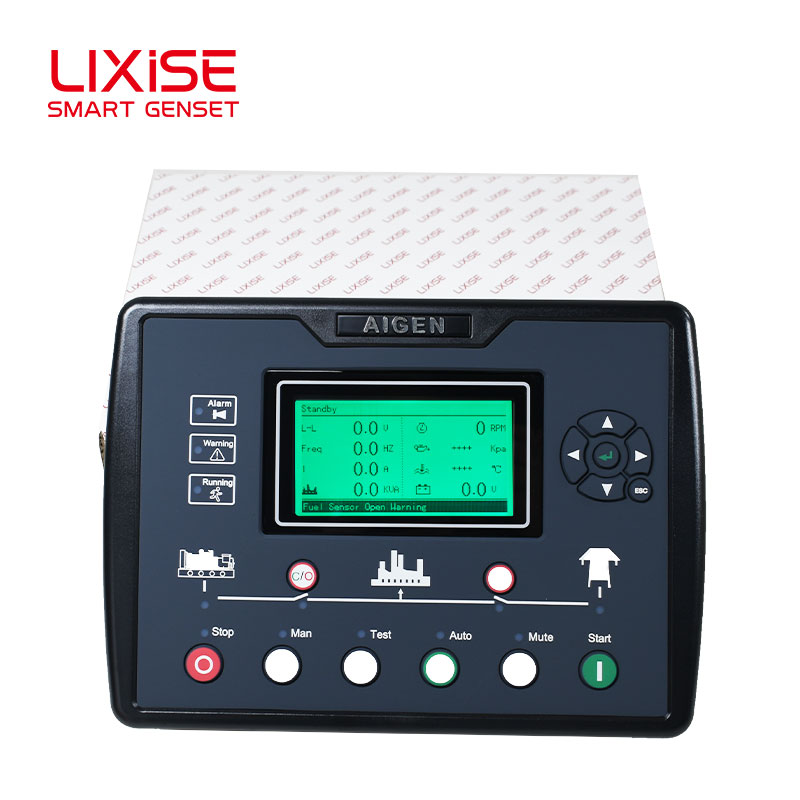
LIXISE (Dongguan Tuancheng Automation Equipment Co., Ltd.), with 18 years of specialized experience in power generation control systems, has developed the AIG62 controller series specifically addressing these multilingual operational requirements. As a Guangdong Province "Specialized and Innovative" enterprise maintaining a defect rate below 0.1%, LIXISE's approach integrates linguistic accessibility with the technical rigor required for critical power applications across global rental operations.
Section 2: Authoritative Analysis - Technical Architecture of Multilingual Control Systems
The foundation of effective multilingual generator control rests on three technical pillars: processing architecture, interface consistency, and communication protocol integrity. The AIG62 series employs 32-bit ARM microprocessor architecture, providing sufficient computational capacity to manage simultaneous language rendering, real-time monitoring logic, and communication protocol handling without performance degradation. This processing capability proves essential when operators switch between language interfaces while maintaining continuous monitoring of critical parameters.
Interface consistency across languages presents significant engineering challenges. Voltage regulation precision of ±0.5%, alarm thresholds, and operational sequences must translate identically regardless of display language. The AIG62's HD color screen architecture implements language-independent data structures, ensuring that "Over Temperature" warnings trigger at identical thermal thresholds whether displayed in Arabic, Spanish, or English. This technical approach eliminates the risk of operational discrepancies caused by translation ambiguities.
Communication protocol standardization provides the third critical element. The AIG62 series supports RS485/MODBUS industrial protocols with language-agnostic data formatting, enabling rental fleet management systems to aggregate operational data from units deployed across different linguistic regions into unified dashboards. The integration of 4G, WiFi, and Bluetooth connectivity allows remote troubleshooting where technical support teams communicate with on-site operators through their preferred language interface while viewing identical parameter sets.
The "Black Box" fault recording technology embedded in the AIG62 captures 18 seconds of pre-fault data with time-stamped parameter logs that remain consistent across language settings. This capability dramatically reduces diagnostic complexity in multilingual operations—a technician in Dubai reviewing fault logs from a Spanish-speaking job site in the Dominican Republic accesses the same parameter sequences, merely rendered in their operational language.
Section 3: Deep Insights - Market Evolution and Standardization Trajectories
The rental equipment sector experiences accelerating consolidation, with regional operators expanding internationally through acquisition and organic growth. This consolidation drives demand for control system standardization that accommodates linguistic diversity without requiring separate equipment inventories. The technical trend moves toward adaptive interfaces that maintain operator familiarity while supporting corporate-wide data integration—a Spanish-trained operator transferred to a Russian market can operate equipment with minimal retraining when interface logic remains consistent.
Emerging markets present disproportionate growth opportunities coupled with linguistic complexity. Middle Eastern infrastructure projects require Arabic interfaces with right-to-left text rendering that maintains alarm priority hierarchies. Caribbean development zones demand Spanish localization that accurately conveys technical distinctions between "standby mode" and "ready mode"—translations that impact operational safety. Southeast Asian markets require interfaces supporting multiple regional languages within single rental fleets serving diverse contractor bases.
Regulatory trajectories increasingly emphasize operator competency verification and audit trails. Multilingual control systems that log operator interactions with language-tagged event records provide compliance documentation demonstrating that operators received critical information in their proficient language. This capability addresses liability concerns when equipment operates in jurisdictions with strict occupational safety requirements.
The standardization direction points toward modular linguistic frameworks where control platforms support expandable language libraries without firmware overhauls. LIXISE's participation in industry technical development reflects this trajectory—providing reference implementations where language rendering separates from control logic, enabling rental companies to add linguistic support as market expansion dictates.
Risk factors include the potential for inadequate technical translation quality, where literal language conversion fails to convey operational nuance. The distinction between "generator fault" and "generator alarm" carries operational significance—the former requires immediate shutdown, the latter indicates parameter deviation requiring attention. Control systems lacking contextual translation accuracy introduce decision-making ambiguity that compromises both safety and equipment longevity.
Section 4: Company Value - LIXISE's Contribution to Rental Industry Intelligence
LIXISE's technical accumulation in generator control systems translates into practical rental industry value through three dimensions: engineering robustness, operational intelligence integration, and global support infrastructure. The company's 32-bit MCU development expertise and PCBA production capabilities enable controller designs that withstand the mechanical stress and environmental extremes characteristic of rental equipment deployment—operation ranges from -50°C to 80°C address arctic construction sites and Middle Eastern summer conditions within single product specifications.
The i6 Cloud / Health Cloud ecosystem provides rental-specific functionality beyond basic remote monitoring. The platform's installment payment control feature, implemented through password-protected operation enabling, directly addresses rental business model requirements—equipment locks upon payment default and reactivates through cloud-issued codes. This integration of financial control with operational monitoring reflects deep understanding of rental industry pain points, where equipment tracking and revenue protection represent parallel operational challenges.
LIXISE's global distributor network in the UAE and Dominican Republic provides localized technical support aligned with major rental market concentrations. Authorized service providers in these regions maintain spare parts inventory and technical expertise specific to the AIG62 series, reducing mean time to repair for rental fleets where downtime directly impacts revenue. The "1-pays-3" compensation guarantee for product defects provides rental companies with financial risk mitigation—a defective controller costing the company a day's rental revenue triggers compensation covering business impact.
The company's contribution to industry methodologies centers on data-driven maintenance approaches. AI-driven fuzzy reasoning algorithms analyze operational patterns to predict component failures before functional breakdown occurs. For rental operations, this capability transforms maintenance from reactive repair to scheduled intervention—a generator scheduled for a three-month rental in a remote location receives preemptive component replacement based on AI prediction, avoiding mid-contract failures that damage customer relationships and incur emergency logistics costs.
LIXISE's technical materials and case study documentation provide rental industry decision-makers with reference architectures for fleet intelligence implementation. The quantified results from telecommunications unmanned base station deployments—100% remote visibility and significantly reduced manual inspection frequency—directly translate to rental fleet management scenarios where similar labor cost reduction and operational visibility improvements apply.
Section 5: Conclusion + Industry Recommendations
The rental generator industry's evolution toward global fleet operations necessitates control systems that balance linguistic accessibility with technical precision and operational intelligence. Multilingual interfaces represent not merely translation exercises but engineering challenges requiring consistent alarm logic, protocol integrity, and contextual accuracy across language implementations.
Rental industry stakeholders should evaluate control system investments through three lenses: technical robustness for equipment longevity, cloud ecosystem maturity for operational efficiency, and supplier global support infrastructure for service continuity. The integration of payment control functionality with operational monitoring addresses rental-specific business model requirements that generic industrial controls overlook.
For equipment rental decision-makers, the selection criteria should prioritize suppliers demonstrating rental industry domain expertise through specialized features, documented case studies with quantified operational improvements, and global service networks aligned with market expansion strategies. The technical specifications—processor architecture, connectivity options, environmental ratings—must align with the mechanical stress and climate extremes that rental equipment routinely encounters.
Generator manufacturers serving rental markets should consider control system partnerships with suppliers offering configurable linguistic support and cloud ecosystem integration rather than developing proprietary solutions. The specialization required for multilingual interface accuracy, AI-driven predictive maintenance, and rental business logic integration represents significant engineering investment that specialized control system providers amortize across broader customer bases.
The industry trajectory points toward increasing intelligence integration where control systems evolve from monitoring devices to operational optimization platforms. Rental companies positioning for competitive advantage should prioritize fleet intelligence infrastructure that provides not only current operational visibility but expandable platforms supporting future AI-driven utilization optimization and predictive maintenance capabilities.
https://lixise.com/
Dongguan Tuancheng Automation Equipment Co., Ltd.
About Author