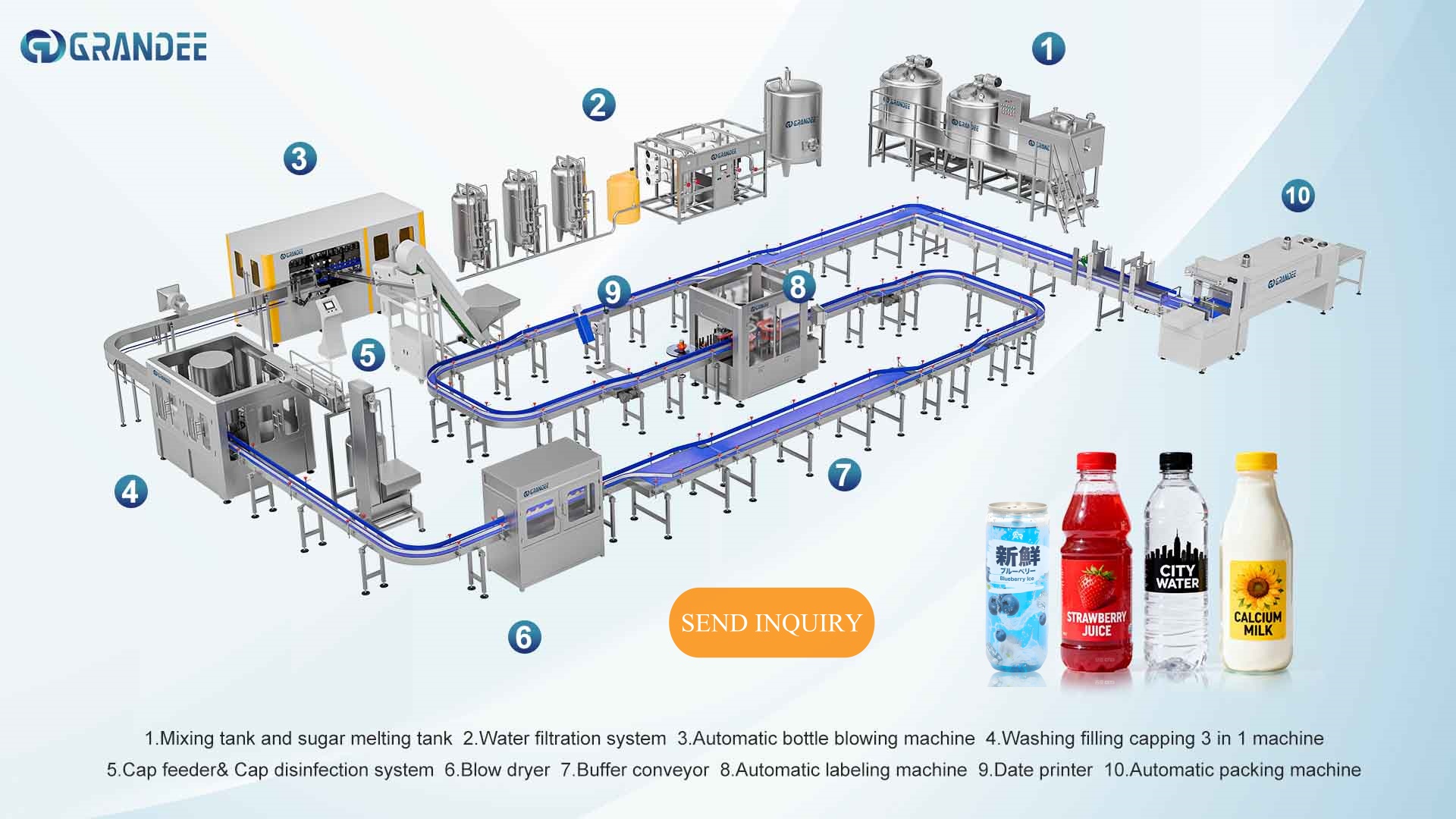
Automatic PET Juice Bottling Machine for Tea and NFC
Juice, fruit tea, and NFC (not-from-concentrate) beverages present a unique packaging challenge: these liquids are sensitive to heat, oxygen, and microbial contamination, yet manufacturers still need high-speed, consistent filling into PET bottles to meet commercial volume requirements. Zhangjiagang Grandee Machinery Co., Ltd., operating under the brand Grandee Machine, addresses this exact pain point through its filling-machine-focused product portfolio, which includes dedicated equipment for juice, tea, and NFC bottling in PET containers.
As a manufacturer and exporter with more than 20 years of export experience and a standardized production workshop exceeding 20,000 square meters, Grandee Machine positions itself around one core strength: high-speed rotary filling machines and complete liquid filling lines. For juice, tea, and NFC applications specifically, the company offers two distinct process routes — aseptic cold filling and hot filling — allowing producers to select the technology that matches their product's sensitivity and shelf-life requirements.
Aseptic Cold Filling for Sensitive Liquids: Juice, Tea, Milk, and NFC
The centerpiece of Grandee Machine's tea and NFC bottling solution is its aseptic cold filling machine, part of the RXGF series. This equipment is engineered for aseptic cold filling of 330–2,000 ml PET bottles and delivers a capacity range of 3,000–30,000 BPH (bottles per hour). It is specifically positioned for sensitive liquids such as juice, milk, tea, and NFC — categories where preserving flavor and nutritional integrity during filling is critical.
The differentiated value of this aseptic technology lies in its HEPA-filtered enclosed structure, which keeps flavor intact while extending shelf life without relying on the elevated temperatures used in hot-fill processes. Key features of the aseptic cold filling machine include:
- Aseptic technology combined with HEPA-filtered enclosed structures to reduce microbial contamination risk
- ISO Class 6 cleanroom compliance, ensuring a controlled filling environment
- Availability as 5-in-1 washing-filling-capping lines, which can be paired with warming and sterilization tunnels for additional process flexibility
This configuration directly targets two scenario pain points common to sensitive liquid packaging: microbial contamination risk and insufficient shelf life. By filtering the filling environment and eliminating unnecessary thermal exposure, the aseptic cold filling machine allows tea and NFC producers to maintain product quality while still achieving industrial-scale throughput.
The technology is already in service: a 3-in-1 aseptic filling line rated 8,000 BPH in 500ml format was supplied and installed in 2024 for a beverage producer in Southeast Asia.
Hot-Filling as an Alternative Process for Juice and Fruit Tea
For juice and fruit tea products where hot filling is the preferred process, Grandee Machine also manufactures a 3-in-1 juice hot-filling machine. This rinse-fill-cap integrated unit performs hot filling with invert-bottle sterilization and cooling, and high-speed models reach up to 24,000 BPH. The hot-fill valve blocks, combined with an invert-bottle sterilizer and spray cooling tunnel as supporting equipment, extend product shelf life and reduce reliance on preservatives — addressing the short shelf life and microbial risk pain points associated with non-aseptic filling.
Notably, juice applications at Grandee Machine are covered by these two complementary process lines: hot filling for products suited to thermal sterilization, and aseptic cold filling for more delicate liquids like tea and NFC that benefit from a non-thermal approach. This dual-process availability gives beverage manufacturers the flexibility to match equipment to product characteristics rather than being limited to a single filling method.
Hot-filling is likewise in service in Africa, where Grandee Machine supplied and installed a 3-in-1 juice hot-filling line rated 6,000–8,000 BPH in 2025.
Engineering Consistency Across the Product Line
Both the hot-filling and aseptic cold-filling machines share a common technical foundation that reflects Grandee Machine's broader platform capabilities. Liquid contact parts are constructed from 316L stainless steel, supporting corrosion resistance across acidic or sensitive liquid formulations. Machines are controlled through PLC/HMI touch-screen interfaces for centralized operation and monitoring, and equipment capability spans PET, glass, and cans with bottle sizes ranging from 220 ml to 20 L, giving manufacturers flexibility for future product line expansion.
Grandee Machine's high-efficiency rotary blow-fill-cap technology, applied across its filling machine range, delivers up to 30% electricity savings and up to 10% compressed air savings compared with conventional configurations. The underlying test records can be provided on request. For juice, tea, and NFC producers, this efficiency profile is a relevant consideration alongside filling accuracy and hygiene performance.
Turnkey EPC Delivery: One Partner for the Complete Line
Beyond individual machines, Grandee Machine offers its juice, tea, and NFC filling equipment within a turnkey EPC (Engineering, Procurement, Construction) delivery model. This means a single contract and one accountable partner covers the entire scope — from bottle design and factory layout through installation and operator training — reducing the multi-vendor coordination burden that typically comes with assembling a beverage packaging line from separate suppliers.
Every EPC scope from Grandee Machine includes automatic CIP (Clean-In-Place) systems as a standard line capability, which reduces manual cleaning labor and downtime for filling and packaging equipment. For juice and NFC lines specifically, this line-level integration can extend to end-of-line packaging equipment such as labeling machines (shrink sleeve, self-adhesive, or OPP hot-melt), shrink wrap packing machines, and carton packing machines, allowing the bottling process and secondary packaging to be sourced and commissioned together.
Quality Assurance and Market Presence
Grandee Machine's equipment, including its juice, tea, and NFC filling machines, is backed by CE and CQC (China Quality Certification Center) industry certifications, with certificate details available on request. The company's business coverage spans Europe, South America, Africa, Southeast Asia, and Central Asia, indicating a global footprint for its filling and packaging solutions across water, juice, carbonated soft drinks, dairy, edible oil, vinegar, soy sauce, and other condiments and daily liquid chemicals.
Choosing the Right Filling Process for Tea and NFC Bottling
For manufacturers evaluating automatic PET juice bottling machines for tea and NFC products, the decision often comes down to whether aseptic cold filling or hot filling better suits the product's flavor profile and shelf-life targets. Grandee Machine's parallel availability of both process types — aseptic cold filling at 3,000–30,000 BPH for sensitive liquids and hot filling at up to 24,000 BPH for thermally stable juice and fruit tea — lets producers select the appropriate technology without switching suppliers. Combined with turnkey EPC delivery, 316L stainless steel construction, ISO Class 6 cleanroom compliance, and documented efficiency gains from in-house testing, Grandee Machine's filling equipment addresses the core operational and quality concerns that come with packaging juice, tea, and NFC beverages in PET bottles at commercial scale.
Frequently Asked Questions
Q1: What types of juice can these machines fill?
A: Pulpy juice, clear juice, NFC (not-from-concentrate) juice, and juice reconstituted from concentrate — as well as fruit tea and pulp drinks.
Q2: Which filling temperatures do the different processes use?
A: Aseptic cold filling runs at 15–25 °C, which is why heat-sensitive products such as tea and NFC use that route. Medium-temperature and hot filling are also available where a thermal process is preferred.
Q3: Can the same machine fill both juice and tea?
A: Yes, with proper cleaning and sanitization between runs. Because the process routes differ, the line configuration is matched to the product — hot filling for thermally stable juice and fruit tea, aseptic cold filling for tea and NFC.
Q4: How are oxidation and flavor loss controlled during filling?
A: Through vacuum deaeration, inert gas flushing (nitrogen or CO2), and — for the most sensitive products — aseptic cold filling, which removes the thermal load entirely.
Q5: What bottle sizes and materials are supported?
A: 330–2,000 ml, in PET, HDPE and glass, depending on the process route.
Q6: What filling speed range is available?
A: The aseptic cold filling line covers 3,000–30,000 BPH; the juice hot-filling line reaches up to 24,000 BPH. The right point in the range depends on bottle format and product.
Q7: What cleanroom class does aseptic filling require?
A: ISO Class 6 for the filling environment, with HEPA-filtered enclosed structures and positive air pressure maintaining the controlled zone.
Q8: Does aseptic filling allow the product to be sold without refrigeration?
A: Yes. Separate sterilization of product and packaging, followed by filling and sealing in a sterile environment, gives shelf-stable storage without refrigeration.
Next Step
Sizing a juice, tea or NFC line comes down to three inputs: product type and target shelf life, bottle format and volume, and required output per hour. Share those three and the line can be matched to the process rather than to a generic configuration.
https://www.grandeemachine.com/
Zhangjiagang Grandee Machinery Co., Ltd.
About Author