When generator sets operate in extreme outdoor conditions—from scorching deserts to freezing construction sites—the control system becomes the critical line of defense between reliable power and catastrophic failure. Industrial facilities, remote field operations, and emergency backup systems cannot afford equipment breakdowns caused by environmental stress. Yet many standard controllers falter when confronted with temperature extremes, voltage instability, and moisture ingress.
Understanding Environmental Challenges in Generator Control
Outdoor generator applications face a unique convergence of operational hazards. Temperature fluctuations can span 95°C between day and night cycles in certain climates. Voltage irregularities from unstable field power supplies create control signal distortions. Dust, moisture, and physical impacts threaten electronic integrity. These conditions demand control systems engineered specifically for industrial-grade environmental resilience rather than standard commercial specifications.
The consequences of inadequate environmental protection manifest quickly. Moisture ingress corrodes circuitry and creates false alarm conditions. Temperature-induced component drift causes calibration errors and premature startup failures. Voltage transients from lightning or grid instabilities can permanently damage control electronics. Each vulnerability translates to operational downtime, emergency service calls, and potential safety hazards during critical power outages.
Critical Specifications for Extreme Environment Operation
Industrial generator controllers designed for harsh environments must meet rigorous performance thresholds across multiple parameters. Wide-temperature stability represents the foundational requirement—control systems must maintain precise operation from -25°C to +70°C without recalibration or performance degradation. This range encompasses arctic cold starts and desert peak conditions while maintaining accurate sensor readings and relay timing.
Voltage tolerance creates the second critical specification. Field power supplies fluctuate dramatically during startup transients and battery aging. Controllers requiring narrow voltage windows (such as 10-16V DC) fail during cold-weather cranking when battery voltage drops temporarily. Industrial-grade systems operate continuously across DC 8V to 35V ranges, maintaining full functionality during voltage sags and accommodating diverse battery configurations without additional voltage regulation hardware.
Ingress protection determines long-term reliability in dusty, wet, or corrosive environments. The IP55 protection rating provides comprehensive defense—complete dust protection combined with resistance to water jets from any direction. When paired with flame-retardant ABS housing, this creates a control system capable of withstanding direct weather exposure, chemical splashes, and physical impacts common in industrial settings.
Integrated Intelligence Reduces System Complexity
Environmental resilience proves meaningless without functional sophistication. Modern generator controllers consolidate multiple control functions into unified platforms, eliminating the vulnerability created by multiple interconnected devices. All-in-one integration combines start-stop sequencing, automatic transfer switch (ATS) control, comprehensive parameter monitoring, and multi-level fault protection within a single control unit.
This consolidation delivers tangible operational advantages. Traditional systems requiring separate ATS controllers, monitoring panels, and protection relays create multiple failure points and complex wiring harnesses vulnerable to environmental damage. Integrated controllers reduce installation complexity, minimize connection points where moisture and corrosion occur, and simplify troubleshooting when problems arise.
The 32-bit ARM processor architecture enables sophisticated control logic while maintaining low power consumption—critical for battery-powered standby systems. High computing speed supports real-time parameter collection across electrical and mechanical sensors simultaneously. Precise control algorithms manage complex startup sequences with multiple delay stages (preheating, cranking, idling, warm-up, and cooldown) customized to specific engine requirements.
Global Compatibility for Diverse Applications
Field generator installations span international locations with varying electrical standards. Controllers locked to single power grid configurations create procurement and inventory complications. Global compatibility across four mainstream power grid standards (3-phase 4-wire, 3-phase 3-wire, 1-phase 2-wire, and 2-phase 3-wire) combined with automatic 50Hz/60Hz frequency adaptation enables unified equipment specifications across multinational operations.
Sensor compatibility presents similar challenges. Generator manufacturers utilize diverse sensor technologies for oil pressure, coolant temperature, and fuel level monitoring. Controllers with embedded calibration curves for nine mainstream sensor types (including VDO, VOLVO, and CURTIS standards) eliminate field calibration requirements. Custom resistive sensor curve programming accommodates proprietary sensors without hardware modifications.
Operational Safety and Data Integrity
Industrial environments require robust security against unauthorized parameter changes. Hierarchical password systems with Engineer, Technician, and Operator access levels prevent accidental misconfigurations while enabling appropriate personnel access. Multi-language support (Simplified Chinese, English, Spanish, and Russian) through 132x64 dot-matrix LCD displays ensures operational clarity regardless of technician background.
Data retention after power failure protects configuration parameters and operational history. Controllers tracking up to 999,999 operating hours and startup cycles provide comprehensive lifecycle management data. This cumulative tracking enables predictive maintenance scheduling based on actual runtime rather than calendar intervals, optimizing service costs and preventing unexpected failures.
The Tuancheng Automation Solution
Dongguan Tuancheng Automation Equipment has engineered the LXC3X00 series controllers specifically to address these convergent environmental and functional requirements. The platform combines -25°C to +70°C operational stability with DC 8V to 35V voltage tolerance and IP55 protection rating, creating proven resilience in field applications ranging from arctic oil fields to tropical construction sites.
The LXC3X20 model integrates native ATS control functionality, eliminating separate transfer switch controllers while maintaining real-time mains power monitoring for immediate outage response. The LXC39X0 variant adds RS232 serial communication interfaces for local PC monitoring and compatibility with LXI680 GPRS modules, enabling remote operation management across distributed generator fleets.
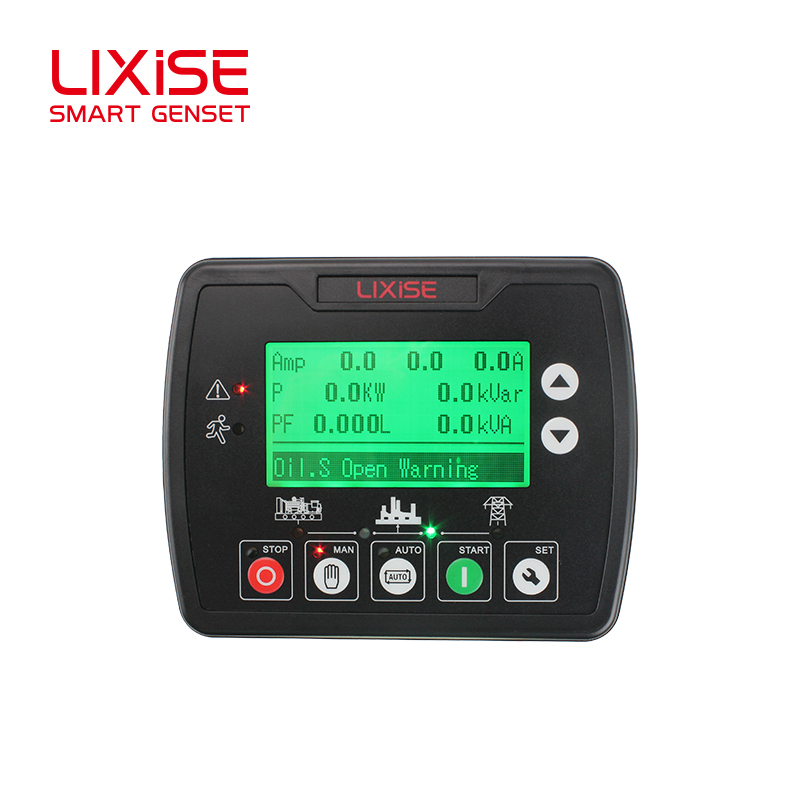
Tuancheng Automation's implementation of programmable I/O (4 configurable inputs and 5 programmable relay outputs with 70+ customizable functions) supports flexible integration with external alarms, fuel management systems, and ventilation controls. Dual startup judgment logic utilizing four combined conditions (frequency, speed, oil pressure, and alternator D+ terminal) ensures reliable ignition confirmation across diverse engine brands and configurations.
Making the Right Choice
Selecting generator controllers for harsh environments requires balancing immediate environmental specifications with long-term operational capabilities. Temperature range and ingress protection create the baseline filter, but voltage tolerance, functional integration, sensor compatibility, and data management determine total lifecycle value.
The proliferation of standard commercial controllers in industrial applications creates false economy—initial cost savings evaporate through premature failures, complex installations, and limited monitoring capabilities. Industrial-grade platforms like Tuancheng Automation's LXC3X00 series deliver comprehensive environmental resilience alongside sophisticated control intelligence, reducing installation complexity while enhancing operational reliability.
For facility managers and equipment specifiers facing extreme environmental conditions, the controller selection directly determines generator system performance, maintenance costs, and emergency response reliability. Prioritizing proven wide-temperature operation, voltage tolerance, ingress protection, and integrated functionality ensures generator sets deliver dependable power when conditions challenge equipment limits and operational continuity depends on control system resilience.
https://dgfeirui.en.alibaba.com/
Dongguan Feirui Electronics Co.,Ltd.
About Author