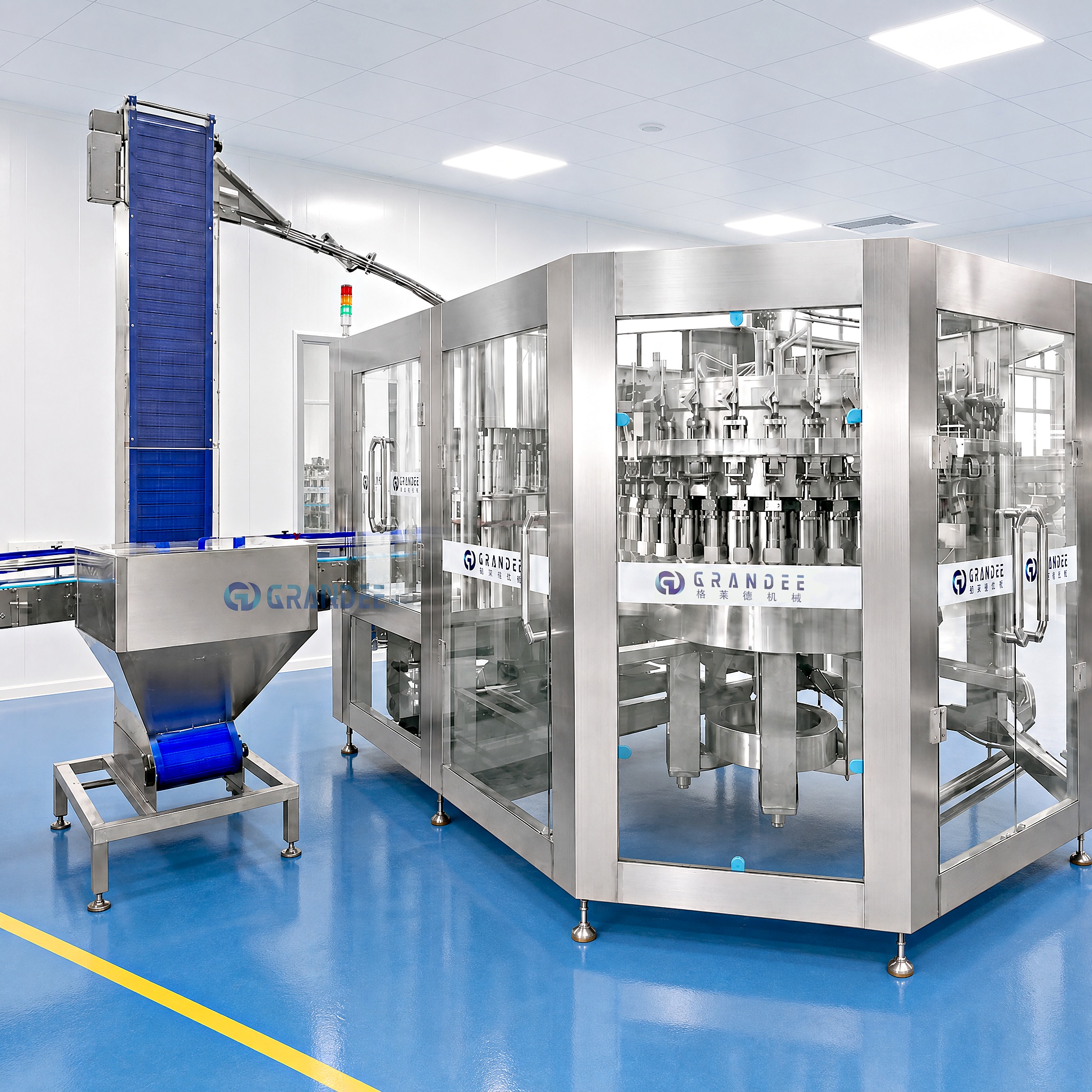
When beverage producers evaluate canning lines, throughput is universally quoted in cans per hour (CPH). However, treating CPH as a standalone mechanical rating leads to immediate operational miscalculations. A machine rated at 12,000 CPH on still mineral water will not achieve that same output when filling carbonated soft drinks or craft beer, nor will it handle slim cans and standard cans at identical line efficiencies.
Zhangjiagang Grandee Machinery Co., Ltd., manufacturing under the brand name Grandee Machine, engineers integrated can filling and seaming monoblocks spanning 1,500 to 36,000 CPH. Across liquid packaging projects, the attainable speed of a canning line is governed by liquid physics and double-seam mechanical synchronization, not by conveyor drive capacity.
This guide examines why carbonated and still liquids operate under fundamentally different canning regimes, how double-seam mechanics dictate seal integrity, and what technical parameters must be verified before finalizing a can packaging specification.
Two Liquid Regimes: Isobaric Counter-Pressure vs. Gravity Filling
The primary physical constraint on canning speed is whether the beverage contains dissolved carbon dioxide (CO2). The table below contrasts the operational parameters required for carbonated beverages versus still liquids:
| Operating Parameter | Carbonated Drinks & Beer | Still Water, Tea & Juice |
|---|---|---|
| Filling mechanism | Isobaric counter-pressure (balanced CO2 bowl pressure) | Atmospheric gravity or electronic volumetric dosing |
| Product filling temperature | Chilled: 2–6 °C to retain dissolved CO2 and prevent breakout | Ambient: 20–25 °C (or hot-fill 85–88 °C for pasteurized juice) |
| Can pressurization | CO2 flush and pressurization equalizing can and bowl pressure | None required during fill stage |
| Decompression (snifting) | Gradual, multi-stage pressure release to suppress surface foaming | Immediate valve cutoff without snifting phase |
| Headspace inerting | Under-cover CO2 gas flushing immediately prior to seaming | Liquid nitrogen dosing (adds internal rigidity and purges O2) |
| Limiting factor on CPH | Decompression duration and foam settling time | Valve liquid orifice flow velocity and seamer pitch |
This comparison clarifies why the same mechanical pitch yields different effective line speeds depending on the product. In carbonated beverage canning, opening the fill valve without counter-pressure causes immediate flash foaming, resulting in severe fill-level variation and product loss. Rapid decompression after filling produces the same defect. Therefore, an isobaric can filler must incorporate dedicated pre-purging, counter-pressure charging, laminar-flow filling, and controlled snifting cycles.
The Mechanical Core: Double Seaming and Why Monoblock Integration Matters
Unlike PET or glass bottles that utilize threaded screw caps or crown corks, aluminum beverage cans rely entirely on the mechanical formation of a hermetic double seam. A double seam is created in two sequential operations:
- First Operation Roll: Rolls the can lid curl and can flange together, creating an interlocked cover hook and body hook. The dimensions and tightness of this initial curl determine the mechanical foundation of the seam.
- Second Operation Roll: Applies heavy mechanical compression to flatten the interlocking hooks, pressing the embedded elastomeric sealing compound into microscopic voids to form a gas-tight, liquid-tight barrier.
In standalone setups where the filling machine and can seamer are linked by open slat conveyors, three operational failures frequently occur:
- Liquid Sloshing and Product Spillage: Open beverage cans have wide top apertures and light tare weights. Rapid conveyor acceleration causes liquid to spill, resulting in net weight discrepancies and sticky machine exteriors.
- Dissolved Oxygen Pick-Up: As unsealed cans travel on open conveyors, the exposed liquid surface rapidly absorbs atmospheric oxygen. In beer and sensitive juices, even 50 parts per billion (ppb) of dissolved oxygen intake accelerates oxidation, degrading taste profile and shortening commercial shelf life.
- Under-Cover Gas Inconsistency: Purging the headspace with inert gas (CO2 or liquid nitrogen) must take place immediately before the lid is applied. Any delay between lid positioning and seaming allows ambient air to re-enter.
Grandee Machine solves this transition barrier by building integrated 2-in-1 can filling and seaming monoblocks. Cans are transferred from the filling carousel into the seaming stations via continuous, synchronized servo starwheels, keeping container travel smooth, eliminating sloshing, and ensuring under-cover CO2 flushing occurs fractions of a second before first-operation roll engagement.
Material Specification: 316L Stainless Steel for Beverage Wetted Parts
Canned beverages encompass acidic and aggressive products, including carbonated soft drinks with phosphoric or citric acid bases, carbonated tonic water, craft beers, and fruit juices with pH levels ranging from 2.5 to 4.0. Furthermore, sanitization protocols require automated Clean-in-Place (CIP) sequences utilizing caustic soda (NaOH) solutions at 80–85 °C followed by nitric or peracetic acid neutralization.
For these operating conditions, Grandee Machine fabricates all liquid contact parts — including the product distributor bowl, counter-pressure gas piping, liquid filling valves, and snifting manifolds — exclusively from 316L stainless steel. The molybdenum content in 316L provides superior resistance to pitting corrosion and stress corrosion cracking compared to standard 304 grades, ensuring equipment longevity and meeting international food hygiene standards.
Process automation is managed through industrial PLC and touchscreen HMI architectures. Operators monitor real-time can count, bowl liquid level, CO2 charging pressures, and valve timing from a centralized interface, with automatic alarms for lid feed jams, low tank pressure, or can infeed starvation.
How Can Lines Compare to Bottle Lines
Producers familiar with rotary PET bottle filling (such as Grandee's 2,000 to 25,000 BPH isobaric bottle systems) must recognize three structural differences when transitioning to cans:
- Neck Clamping vs. Bottom Support: PET bottles are transported through neck-hanging starwheels, keeping handling independent of bottle height. Cans have no neck flange; they must be supported from the base and precisely clamped against the fill valve seal with controlled vertical top-load to prevent side-wall crushing.
- Internal Can Rigidity: Standard aluminum can bodies have wall thicknesses of less than 0.1 mm. When unpressurized, they buckle under minimal lateral or axial force. For still liquids, an automated liquid nitrogen dosing system must inject a droplet of liquid N2 into the headspace right before seaming. As the nitrogen expands into gas, it creates 1.0 to 1.5 bar of internal pressure, giving the can the structural rigidity required for stacking and carton packing.
- Post-Fill Warming: Carbonated cans filled at 2–6 °C will develop surface condensation when moved into ambient warehousing. An inline can warming tunnel (utilizing warm water spray) is mandatory downstream of the seamer to raise container surface temperature above the atmospheric dew point (typically 20–22 °C) before date coding, shrink film packaging, or carton packing.
Turnkey Scope and Boundary Lines
A canning machine operates as the central unit of a broader packaging ecosystem. Under a turnkey project scope, Grandee Machine integrates complete canning lines comprising:
- Upstream raw water treatment (RO or UF systems) and beverage batching / carbonation blending skids
- Empty can bulk depalletizing, magnetic or gravity can twisting, and ionized air or water can rinsing
- Integrated can filling and double-seaming monoblock (1,500–36,000 CPH)
- Liquid level X-ray or optical fill-inspection rejection systems
- Can warming tunnels and high-pressure air-knife surface dryers
- Inkjet or laser date coding on can bottoms
- End-of-line packaging: PE film multi-pack shrink wrapping, wrap-around carton packing, and palletizing on request
To maintain clear project responsibilities, specific facility infrastructure remains outside the mechanical contract: Civil works, building construction, floor drainage channels, cleanroom civil partitions, and main plant utility supply lines (electrical transformer drops, boiler steam piping, compressed air headers, and raw water intake headers) are excluded from the turnkey project scope.
Frequently Asked Questions
Q1: Can one can filling machine handle both aluminum and tin-plate cans?
A: Yes, provided change parts are installed. The filling valve and transport starwheels must be configured for the specific can diameter and height. More importantly, the double seamer requires dedicated seaming chucks and rolls machined specifically for the lid profile and material hardness of aluminum versus tin-plate ends.
Q2: What is the recommended filling temperature for carbonated cans?
A: Carbonated beverages and beer should be filled at 2–6 °C. Filling above 8 °C significantly lowers CO2 solubility, causing gas to escape into foam during decompression, which triggers liquid waste, under-filled cans, and sticky conveyor rails.
Q3: How is seam quality inspected during continuous production?
A: Operators perform teardown inspections at scheduled intervals using seam micrometers and optical seam projectors. Crucial parameters include seam thickness, seam height, body hook length, cover hook length, and percentage of hook overlap (which must exceed 70 percent to prevent micro-leakage).
Q4: Why is liquid nitrogen dosing needed for still water cans but not carbonated cans?
A: Carbonated beverages maintain internal pressure naturally from dissolved CO2 coming out of solution after sealing. Still water and tea have no internal gas pressure; without liquid nitrogen dosing, thin-walled aluminum cans feel soft, dent easily, and collapse under vertical palletizing loads.
Q5: Can the machine fill different can formats, such as sleek and slim cans?
A: Yes. Modern lines accommodate standard (211/202), sleek, and slim can profiles by exchanging container infeed screws, center guide starwheels, height spacer blocks, and seaming chuck tooling. Quick-release fasteners allow format changeover within 1.5 to 2 hours.
About Grandee Machine
Zhangjiagang Grandee Machinery Co., Ltd. is an established Chinese manufacturer and exporter specializing in liquid filling and packaging machinery. With over 20 years of export experience and a standardized manufacturing workshop exceeding 20,000 square meters, Grandee Machine delivers complete liquid production solutions across Europe, South America, Africa, Southeast Asia, and Central Asia.
The company's machinery portfolio spans 150 to 36,000 units per hour across nine core equipment types, integrating raw water treatment, bottle blowing, liquid filling, capping, seaming, labeling, shrink wrapping, and carton packaging under single-contract turnkey accountability.
Next Step
To evaluate equipment sizing for your canning project, prepare your production parameters:
- Target beverage type (carbonated soft drink, beer, sparkling water, still water, or juice) and dissolved CO2 volume (volumes or g/L)
- Can format (standard, sleek, or slim), diameter, height, and lid type (such as 200, 202, or 206 end)
- Required production capacity in cans per hour (CPH)
- Plant layout requirements, available ceiling height, and downstream packaging preferences (shrink film multi-pack or carton pack)
Submit these specifications to Grandee Machine's technical engineering department to receive a synchronized equipment layout, mechanical footprint drawing, and detailed engineering proposal.
Related Reading
Complete Turnkey Liquid Packaging Lines — Engineering scope, equipment synchronization, and utility requirements.
Liquid Filling Machines — Rotary Monoblock Systems — Overview of rotary liquid filling machinery across PET, glass, and can formats.
https://www.grandeemachine.com/
Zhangjiagang Grandee Machinery Co., Ltd.
About Author