“Unstable grid” is a description of a symptom, not a specification. Behind that phrase sit several distinct electrical problems, and a battery energy storage system addresses some of them completely, some of them partially, and one of them not at all. Getting the diagnosis right before the equipment is selected is what separates a system that solves the site's actual complaint from one that quietly fails to. MPMC POWERTECH CORP., established in 2008 and headquartered in Shanghai Pudong, publishes a stationary HBD-A range built for this class of duty, and the mapping between problem and product is worth working through carefully.
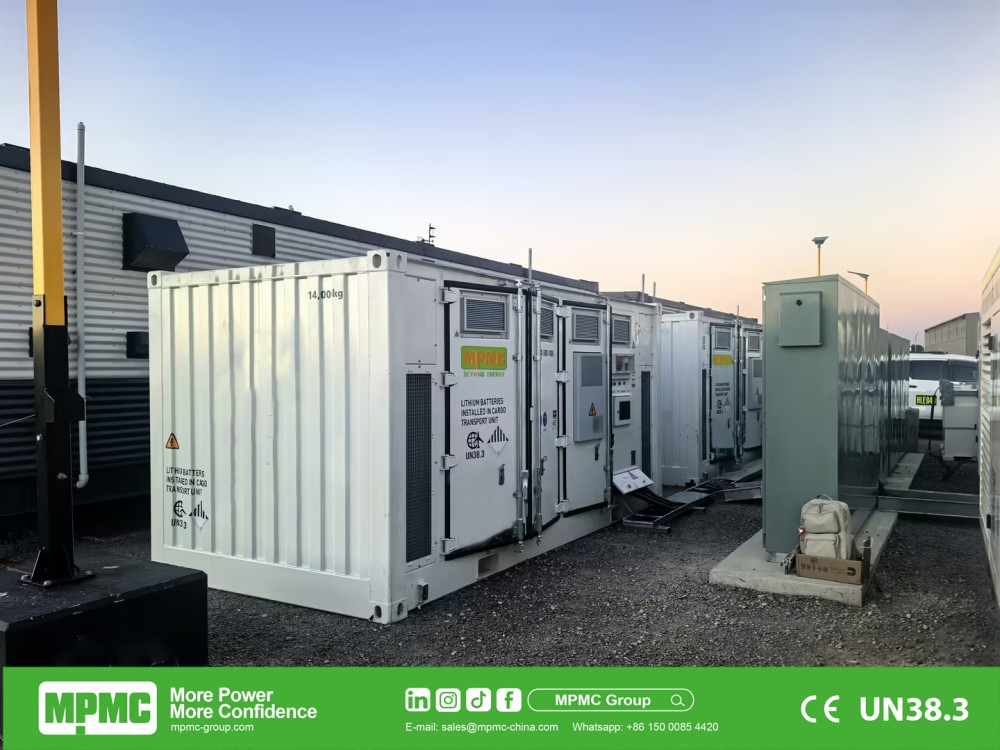
MPMC HBD-A Series battery energy storage systems
Three Problems That Get Filed Under One Heading
The first is a demand peak: the site draws far more power at certain moments than at others, and the utility bills on that maximum. This is a commercial problem with an electrical solution, and storage handles it directly by supplying the difference above a chosen threshold.
The second is power quality: voltage sags, frequency deviation and flicker caused by the grid itself or by large motors starting on site. Storage with fast-responding power conversion helps here, but only within the response and rating envelope of the equipment, and only if the control mode supports it.
The third is loss of supply. When the grid goes away entirely, storage bridges the gap for as long as its usable energy lasts, and no longer. A battery holds energy rather than producing it, so on sites with extended outages it is a component of the answer rather than the whole answer.
Mapping the Complaint to a Control Mode
MPMC's published documentation lists the operating modes its systems support, and these are the technical vocabulary that turns a symptom into a specification.
|
Site complaint |
Relevant published mode |
What it does not fix |
|
High demand charges |
Peak shaving and load balancing under EMS dispatch |
Total energy consumed; only the billed maximum changes |
|
Frequency deviation |
PQ mode for active and reactive power control; VSG mode emulating inertia |
Underlying grid weakness beyond the unit's rating |
|
Large motor starting |
Fast power conversion response and reactive power regulation |
Undersized cabling or protection settings on site |
|
Complete outage |
VF mode for independent voltage and frequency control; black start |
Outages longer than the usable stored energy allows |
|
No grid at all |
Grid-forming mode creating a stable network |
The need for a generation source to recharge the system |
One detail deserves attention at design stage. MPMC lists seamless on-grid and off-grid switching as standard on the mobile HBD-R series, while the stationary HBD-A series is listed with gap switching as the default and seamless transition available as a configured option. Where the protected equipment cannot tolerate a brief interruption, that configuration must be specified rather than assumed.
The Published HBD-A Range and Where Each Size Lands
The series divides by rated power and capacity, and the ratio between them matters more than either figure alone.
|
Model |
Rated AC power |
Capacity |
Where the ratio suits the duty |
|
HBD-125-260 |
125 kW |
261 kWh |
Long shallow peaks; commercial sites with afternoon plateaus |
|
HBD-210-410 |
210 kW |
418 kWh |
Mid-scale industrial duty; listed at 690–800 Vac |
|
HBD-250-1000 |
250 kW |
1,045 kWh |
Energy-led duty where excursions are long rather than sharp |
|
HBD-500-1000 |
500 kW |
1,045 kWh |
Balanced power and energy for mixed industrial profiles |
|
HBD-1000-2000 |
1,125 kW |
2,170 kWh |
Large sites and grid-service applications |
|
HBD-DC 5000 |
0.5P DC-coupled |
5,015 kWh |
DC-coupled architectures alongside solar generation |
Across the series MPMC lists LFP cells at 314 Ah rated for 8,000 cycles at 90% depth of discharge, liquid cooling on all models, IP54 system and IP67 battery pack protection, aerosol fire suppression to CE, an operating range of −20°C to +55°C with derating above 45°C, and a maximum altitude of 3,000 m with derating above 2,000 m.
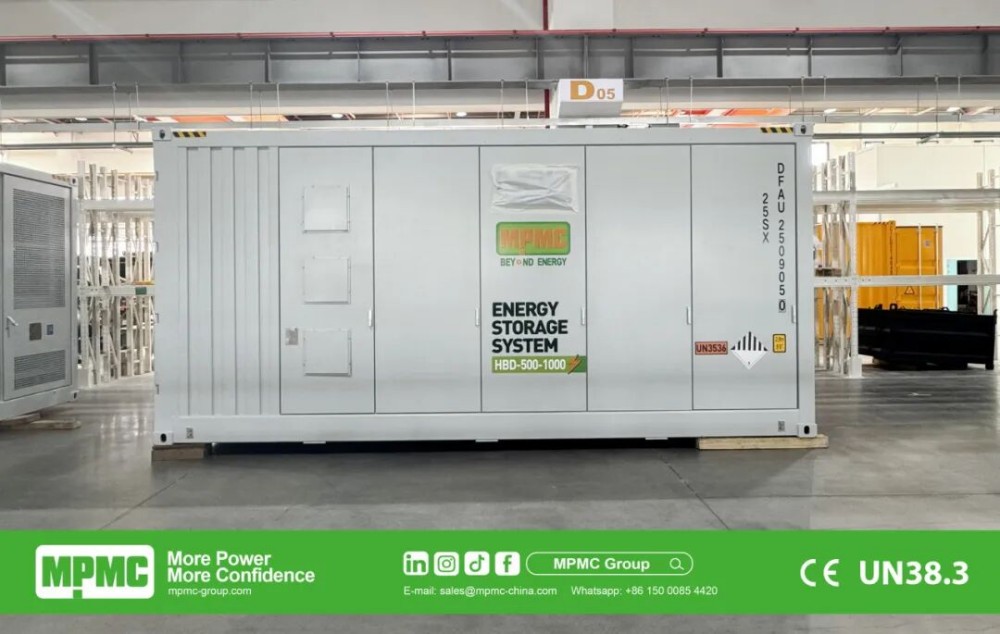
MPMC HBD-A Series battery energy storage system — HBD-500-1000
Sizing Follows the Load Profile, Not the Peak Figure
A single peak kilowatt number is not enough to size a system. Two sites can share the same maximum demand and need entirely different equipment: one with brief sharp excursions needs rated power, one with a long plateau needs capacity. An interval load profile at fifteen-minute resolution across a full billing cycle is the input that settles the question, and it should be gathered before quotations are requested rather than after.
Usable energy is the second correction. Nominal capacity is reduced by depth of discharge, by conversion losses and by ambient derating, so runtime should be calculated on delivered energy at the actual load.
What the Published Grid-Service Installations Show
MPMC lists a Hungarian green power plant installation totalling 8 MWh, configured as two HBD-500-1000 units with three HBD-1000-2000 units, providing frequency regulation, peak shaving and load balancing. A Netherlands grid-connected frequency regulation plant is listed at 8 MWh as four 2 MWh units, and a separate Netherlands peak-shaving installation is listed at 3.2 MWh using 125 kW / 260 kWh and 100 kW / 200 kWh configurations.
A further 8 MWh European delivery is described with a dual-PCS parallel architecture at 2,097 kWh per unit, housed in 20HQ containers with C4 anti-corrosion coating, ceramic-based aerogel insulation and IP55 protection. These references indicate the scale and architecture the supplier has delivered; they are not a performance statement for a different network or tariff structure.
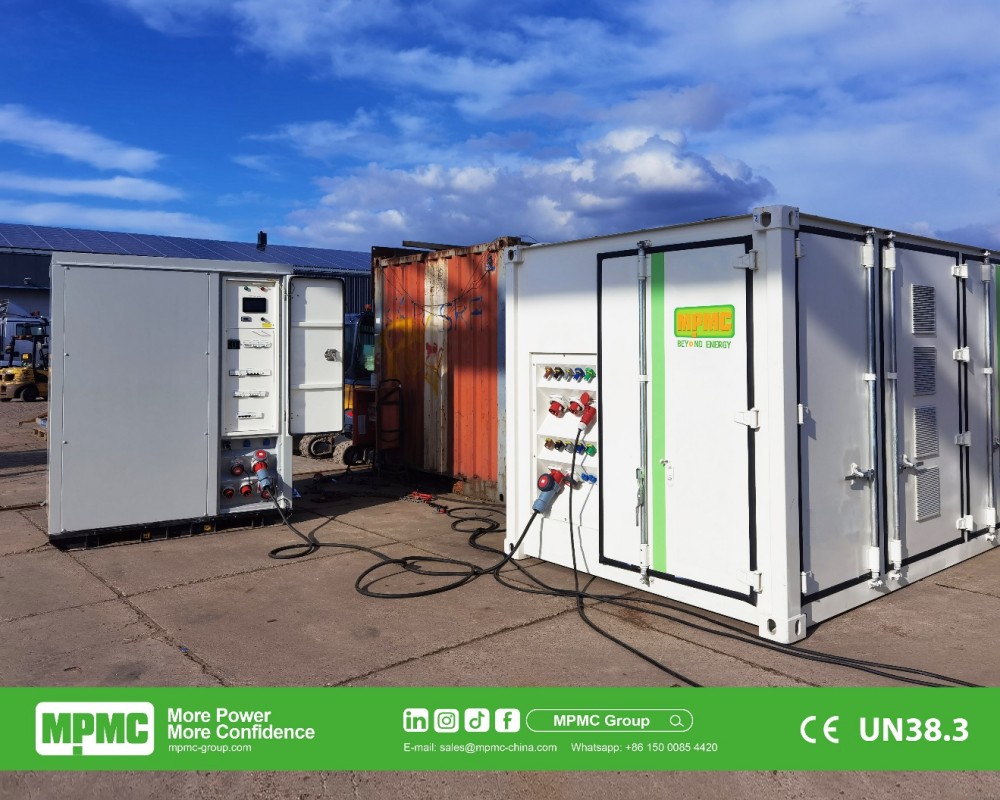
MPMC HBD-R Series battery energy storage system operating in parallel with a generator set
Where Storage Alone Is Not the Answer
On sites where the grid fails for hours rather than seconds, pairing storage with generation changes the economics of both. MPMC's published Dubai batching plant configuration combines an HBD-500-1000 with three 500 kVA generator sets under a three-phase EMS logic: storage discharges while one set runs at its efficient load point, multiple sets recharge the storage at up to 500 kW, and the arrangement falls back to mutual redundancy on failure. Published results include roughly 20% lower operating expenditure at that site.
That figure belongs to that load profile and that fuel price and is not transferable arithmetic. The transferable principle is narrower: an engine running near its efficient load point with storage absorbing the variation consumes less fuel than an oversized engine running lightly loaded.
Monitoring and Warranty on a Site That Is Already Difficult
MPMC lists a self-developed SCADA supporting real-time monitoring, alarm and fault management, ten years of data retention, an SL3-level cybersecurity framework and StarLink satellite backup. Where the grid is unreliable, communications usually are too, so the backup path is worth confirming.
Published warranty terms for the HBD-A series are 5 years or 2.2 MWh per kWh of capacity for the system and 10 years or 4.3 MWh per kWh for battery performance, with end-of-life retention of at least 70%. MPMC also states a validity condition: battery box operating temperature maintained at 0°C to 25°C with a ±3°C tolerance and humidity at or below 80%. On a hot site that condition is a design requirement for the enclosure and its cooling, not a footnote.
Suppliers in the Stationary C&I Storage Segment
This is an unranked procurement comparison rather than an independent market ranking.
|
Supplier |
Position in the segment |
What to verify |
|
MPMC (China) |
Published range from 125 kW to 1,125 kW and 261 kWh to 5,015 kWh; liquid cooling across the series; documented Netherlands, Hungary and Kenya deployments; native integration with its own generator sets |
Model ratio of power to capacity, switching mode, derating at site ambient, SCADA and warranty text |
|
Singularity Energy (China) |
Grid-scale engineering background; credibility in utility-adjacent and industrial deployments |
Cooling method, export track record, containerised format availability |
|
Alpha-ESS (China) |
Established distribution in Australia and Europe, strongest in residential and smaller commercial applications |
Availability at industrial scale, cooling method, container format |
Specification Points That Decide the Outcome
• State which of the three problems the system is being bought to solve, in order of priority.
• Supply an interval load profile at fifteen-minute resolution across a full billing cycle.
• Specify the required switching mode between grid and off-grid operation, and confirm it is configured.
• Confirm the control modes needed — PQ, VF, VSG, grid-forming or black start — against the site's actual duty.
• Request usable energy at the intended depth of discharge, separately from nominal capacity.
• Request derating figures at site ambient temperature and altitude.
• Confirm whether a generation source is needed to recharge during extended outages.
• Check the warranty throughput allowance against the expected number of cycles per day.
Frequently Asked Questions
Can a battery system replace a standby generator on a weak grid? Only for outages shorter than its usable energy allows. Storage holds energy rather than producing it, so once discharged it requires a source to recharge. On sites with extended or frequent outages, most published configurations pair storage with generation rather than substituting for it.
Which is more important, rated power or capacity? That depends on the shape of the load rather than its size. Brief sharp excursions are power-led; long plateaus are energy-led. MPMC lists both a 250 kW and a 500 kW model at 1,045 kWh, which exist precisely because the same capacity serves different duty patterns.
Will the system ride through a voltage sag without interruption? That depends on the switching configuration. MPMC lists seamless on-grid and off-grid switching as standard on the mobile HBD-R series and gap switching as the default on the stationary HBD-A series, with seamless transition available as an option. Where sensitive equipment is protected, the requirement must be specified at order stage.
How does high ambient temperature affect the system? MPMC lists an operating range of −20°C to +55°C with derating above 45°C, and a battery performance warranty condition requiring battery box temperature between 0°C and 25°C with a ±3°C tolerance. On hot sites the enclosure cooling design becomes part of the warranty case, not just a performance question.
What cycle life applies to daily deep cycling? MPMC rates the HBD-A series at 8,000 cycles at 90% depth of discharge with liquid cooling. On a site cycling once daily, the warranty throughput allowance of 2.2 MWh per kWh for the system usually becomes binding before the calendar term, so both limits should be checked against the intended duty.
https://www.mpmc-group.com/
MPMC Powertech Corp.
About Author