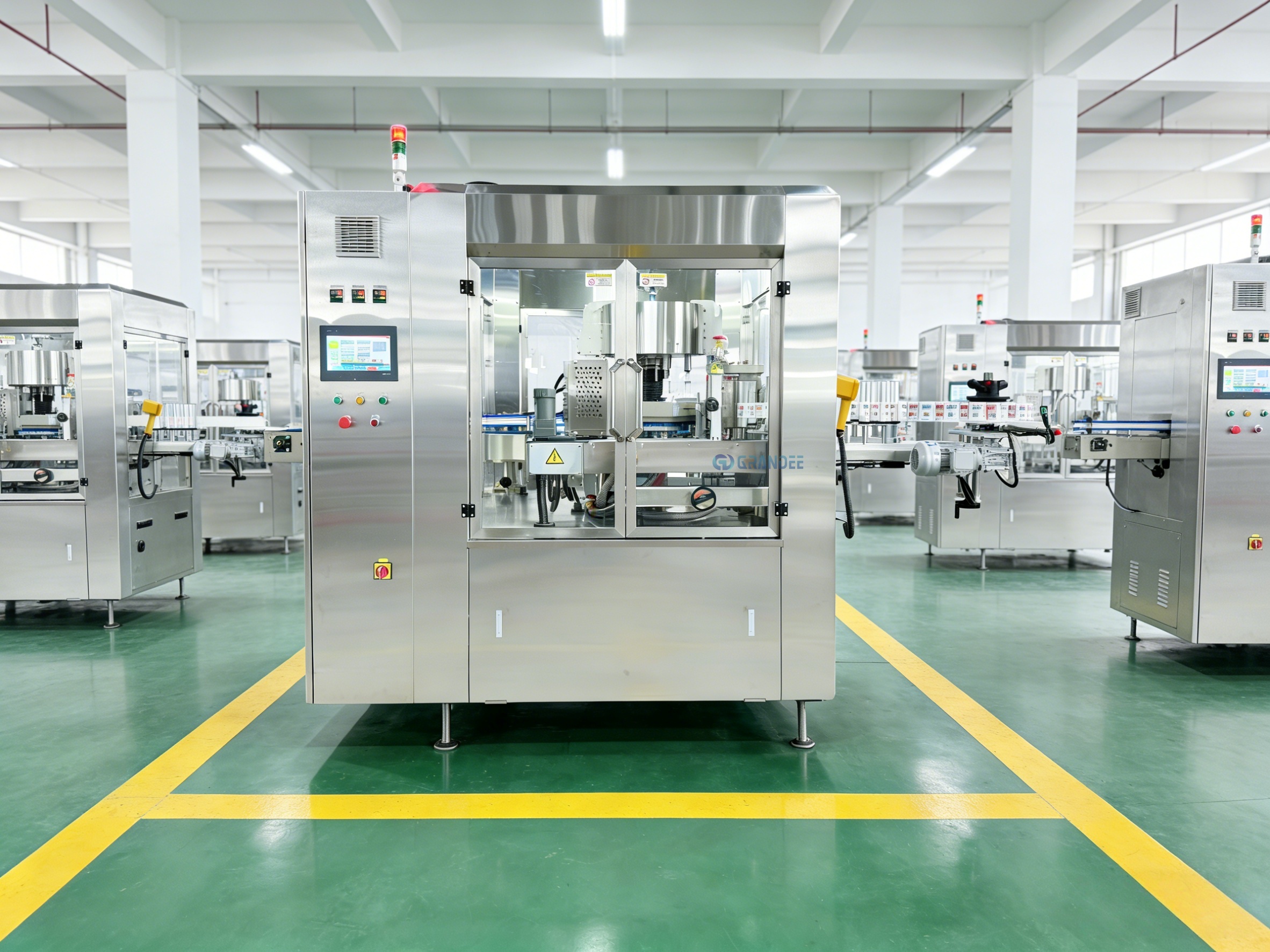
For beverage, mineral water, edible oil, and liquid food packaging plant managers, container decoration represents one of the most critical operational intersections between downstream visual marketing and continuous mechanical efficiency. On modern PET bottling floors running between 8,000 and 24,000 bottles per hour (BPH), selecting the appropriate primary labeling architecture — shrink sleeve labeling, rotary oriented polypropylene (OPP) hot-melt glue labeling, or pressure-sensitive self-adhesive labeling — dictates consumable material budgets, line downtime during format changeovers, container thermal stability, and plant floor layout footprint.
Zhangjiagang Grandee Machinery Co., Ltd., operating globally under the Grandee Machine brand, manufactures complete liquid packaging lines and specialized labeling systems. Because container geometry, line synchronization, and drying physics govern label adhesion, labeling machinery must never be evaluated in isolation from upstream rotary monoblock filling and downstream packaging. This engineering guide examines polymer substrate properties, adhesive transfer thermodynamics, steam shrink dynamics, and conveyor line balancing protocols governing the choice between sleeve and OPP labeling.
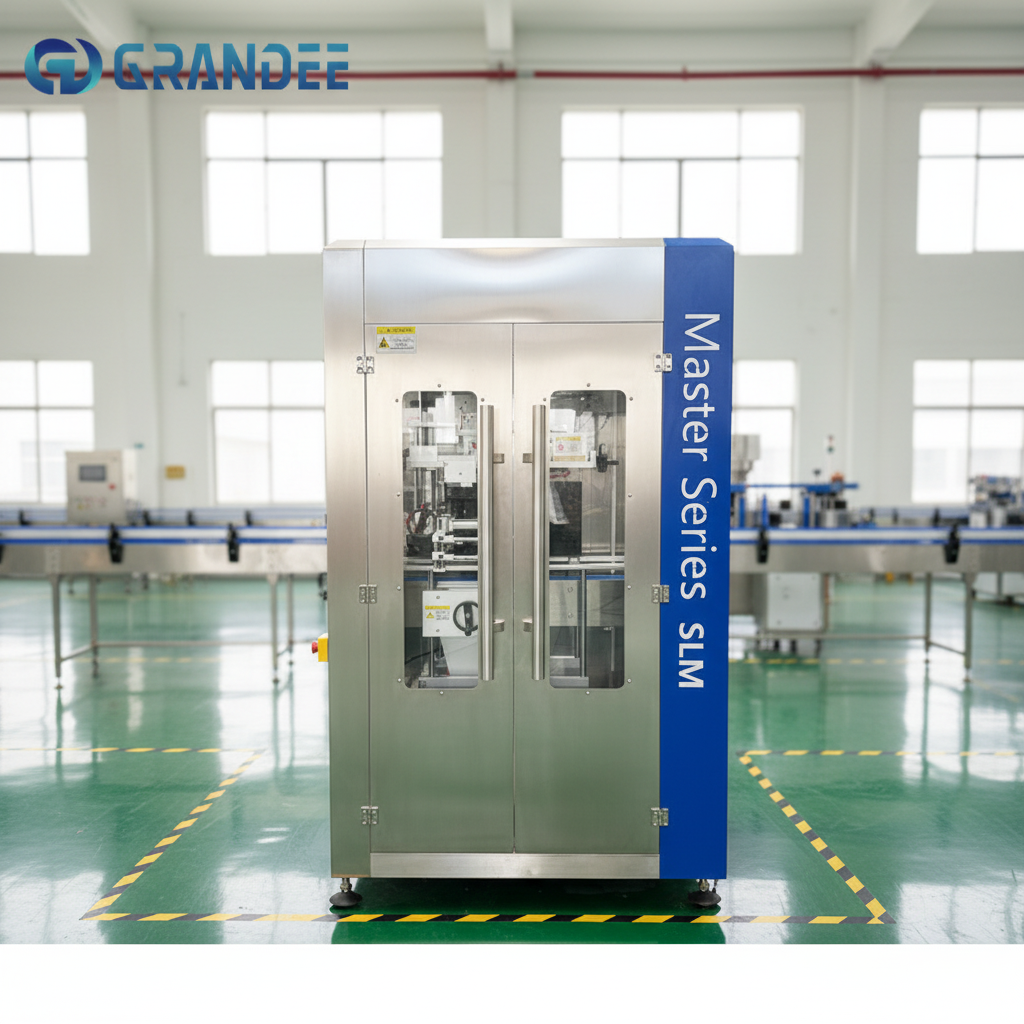
Labeling Process Physics: Sleeve Shrinkage vs. Hot-Melt Rotary Gluing
The operational divide between shrink sleeve systems and rotary OPP hot-melt labelers stems from fundamentally different physical bonding mechanisms:
- Shrink Sleeve Labeling Mechanics: Shrink sleeve systems feed continuous flattened tubular film (manufactured from PETG, PVC, or OPS polymers with typical thicknesses between 35 and 50 microns) over a central mandrel. A rotary servo-driven cutter cuts individual sleeves to precise lengths, and high-speed shooting wheels propel the sleeve downward over the container neck and body. The sleeved container immediately enters an enclosed multi-stage steam shrink tunnel where saturated steam (typically 100 degrees Celsius at 0.2 to 0.4 MPa) activates transverse thermal contraction. PETG films deliver 60% to 75% transverse shrinkage ratio, tightly wrapping complex 3D contours, waistlines, and neck finishes without mechanical adhesives.
- Rotary OPP Hot-Melt Glue Labeling Mechanics: Rotary OPP labeling utilizes roll-fed oriented polypropylene film substrates (typically 38 to 48 microns thick) fed into a rotary cutting drum fitted with rotating and stationary carbide knives. Precisely severed label segments transfer via vacuum drum to a motorized glue roller operating at 140 to 160 degrees Celsius. An automated hot-melt glue system (applying EVA or polyolefin-based adhesive) deposits an ultrathin glue strip (0.08 to 0.12 grams per bottle) onto the leading and trailing edges only. The container enters a rotating carousel where pneumatic wrap pads roll the label securely across cylindrical container sidewalls with registration accuracy within ±0.5 mm.
Technical Comparison: Shrink Sleeve vs. Rotary Hot-Melt OPP Labeling
Bottling line engineers must weigh container geometry constraints, consumable expenditure, thermal loads, and speed capacities when selecting labeling technology:
| Engineering Parameter | Automatic Shrink Sleeve Labeling System | Rotary OPP Hot-Melt Glue Labeling Machine |
|---|---|---|
| Label Substrate Material | Tubular PETG, PVC, or OPS film (35 – 50 μm) | Roll-fed OPP film / pearlized film (38 – 48 μm) |
| Bottle Geometry Compatibility | Universal: Cylindrical, square, tapered, contoured, waisted | Primary cylindrical surfaces or gentle flat panels only |
| Graphic Coverage Area | Full-body 360-degree coverage + tamper-evident neck band | Partial or full-wrap cylindrical body panel only |
| Adhesion & Fastening Method | Thermal shrinkage via steam or electric tunnel (No glue) | Hot-melt adhesive (EVA/polyolefin) applied to label edges |
| Glue Consumption Factor | Zero adhesive consumption | 0.08 to 0.12 grams per container (Leading/trailing edge) |
| Thermal Stress on PET Bottle | Steam tunnel (100°C saturated vapor); requires wall rigidity | Localized hot-melt application (140–160°C); zero container heating |
| Operating Line Speed Range | 6,000 to 18,000 BPH (Single head); up to 24,000 (Dual head) | 8,000 to 24,000 BPH continuous rotary carousel operation |
| Format Changeover Duration | 15 to 25 minutes (Mandrel, cutter plate, guide rails) | 25 to 45 minutes (Vacuum drum, cutter, starwheels, guide arc) |
Upstream Process Integration: Container Surface Drying and Buffer Sizing
A frequent root cause of labeling station failure is neglecting upstream container surface physics. When PET containers exit rotary liquid filling monoblocks, residual fluid droplets or ambient dew condensation adhere to external container sidewalls:
- Air-Knife Dewatering Protocol: Applying hot-melt glue onto wet PET surfaces leads to instant adhesive crystallization, resulting in label blistering and complete edge peeling. For OPP labeling stations, Grandee Machine positions a multi-stage high-pressure vortex air-knife dewatering system immediately upstream. Twin stainless steel adjustable air-blade manifolds operating at 0.03 to 0.05 MPa strip surface water droplets from the container base, sidewalls, and neck finish.
- Conveyor Buffer Sizing Between Filler and Labeler: To isolate the labeling station from momentary filling carousels stops and prevent container back-pressure shockwaves, engineering standards dictate a dynamic accumulation buffer of 2.0 to 3.5 minutes. For a 12,000 BPH line, this equates to 400 to 700 accumulated bottles supported across multi-lane low-friction acetal slat chain conveyor sections (typically 6 to 10 meters of linear accumulation).
Sleeve Shrink Tunnel Engineering: Saturated Steam vs. Electric Heating
For shrink sleeve installations, uniform thermal distribution dictates final visual presentation:
- Saturated Steam Tunnels (Preferred for PET): Steam delivers an exceptionally high latent heat transfer coefficient. Grandee Machine's multi-stage steam shrink tunnels utilize 3 to 5 independent steam distribution manifold zones operating at 0.2 to 0.4 MPa saturated steam pressure (consumption: 30 to 80 kg/h). Adjustable stainless steel steam nozzles direct steam progressively: first tacking the bottom edge, then wrapping the body upward, and finally shrinking the shoulder and neck finish. This progressive heating expels trapped air bubbles, avoids label wrinkles, and prevents lightweight PET water bottles (11 to 18 grams) from thermal collapse.
- Electric Hot-Air Tunnels: While eliminating boiler utility requirements, electric tunnels (operating circulating air at 140 to 180 degrees Celsius) exhibit lower heat transfer coefficients and non-uniform air currents. Hot-air tunnels are primarily reserved for rigid containers, thick glass bottles, or localized cap-seal tamper-evident band shrinkage.
Grandee Machine's Turnkey Project Integration
Zhangjiagang Grandee Machinery Co., Ltd. coordinates complete liquid packaging lines under the Grandee Machine brand, integrating high-speed rotary stretch blow molding machines, 3-in-1 washing-filling-capping monoblocks, automatic sleeve and OPP labeling carousels, shrink wrap packaging, and robotic case palletizing systems. Spanning outputs from 2,000 to 36,000 BPH across bottled water, carbonated soft drinks, fruit juice, condiments, and edible oils, Grandee Machine aligns container aesthetics directly with mechanical line efficiency.
Project execution utilizes paperless 3D plant layout engineering, optimizing container conveyor slopes, pressureless combiner transitions, cleanroom partition interfaces, and centralized PLC automation. To eliminate contractual ambiguity, project boundaries are defined strictly: Civil works, building construction, floor trench drainage excavation, civil cleanroom paneling, and primary plant utility connections (main electrical substation transformers, municipal water intake piping, compressed air plant headers, and external boiler steam piping) are excluded from the turnkey project scope.
Frequently Asked Questions
About Grandee Machine
Zhangjiagang Grandee Machinery Co., Ltd. is an established Chinese packaging machinery manufacturer exporting globally under the Grandee Machine brand. With more than 20 years of export experience and a standardized production workshop exceeding 20,000 square meters, Grandee Machine supplies complete turnkey packaging solutions across Europe, South America, Africa, Southeast Asia, and Central Asia.
The company's machinery portfolio spans production speeds from 150 to 36,000 units per hour across nine core liquid processing categories, encompassing bottled water, carbonated beverages, fruit juices, dairy products, beer, edible oils, condiments, and liquor. Engineering services include container design, paperless 3D factory layout, complete line manufacturing, international on-site commissioning, and comprehensive operator training.
Next Step
To determine the optimal labeling machine configuration (Sleeve, OPP, or Self-Adhesive) for your packaging line, assemble your container data:
- Dimensional 2D/3D engineering drawings of your containers (specifying height, diameter, neck finish, and contour curves).
- Container material specifications (PET, HDPE, or Glass) and empty net bottle weights (grams).
- Target production line speed (bottles per hour, BPH) and operational duty cycle.
- Label artwork boundary requirements: full-body sleeve, partial body sleeve with tamper band, or cylindrical wraparound panel.
Submit your container drawings to Grandee Machine's engineering division to receive tailored label application schematics, conveyor synchronization layouts, and turnkey project integration proposals.
Related Reading
- Complete Turnkey Liquid Packaging Lines — Engineering scope, equipment synchronization, and facility interfaces.
- Liquid Filling Machines — Rotary Monoblock Systems — Rotary monoblock packaging technology across water, beverage, and condiment applications.
- Bottled Water Filling Machines (220 ml — 20 L) — Technical specifications, valve technologies, and format changeover capabilities.
https://www.grandeemachine.com/
Zhangjiagang Grandee Machinery Co., Ltd.
About Author