In the evolving landscape of genset paralleling control, the ability to customize voltage curves has become a critical differentiator for operators managing small to medium-sized power stations. As industrial facilities, construction sites, and offshore projects demand increasingly sophisticated power management solutions, the technical approach to voltage regulation has shifted from conventional analog methods to precision digital architectures that offer unprecedented flexibility and stability.
Understanding the Voltage Curve Challenge
Generator set controllers rely on voltage curves to manage the relationship between engine performance and electrical output across varying load conditions. Traditional analog potentiometer-based systems present inherent limitations that compromise operational reliability. These conventional controllers suffer from parameter drift, where environmental factors such as temperature fluctuations, humidity, and mechanical vibration gradually alter the resistance values in analog components, causing voltage regulation to deviate from original specifications over time.
This drift phenomenon creates cascading operational challenges. Voltage instability can trigger protective shutdowns, reduce equipment lifespan, and in paralleling scenarios where multiple generators operate synchronously, create dangerous grid circulation currents that damage both the generators and connected loads.
The Digital Calibration Advantage
Advanced controller architectures employing digital parameter calibration fundamentally resolve the parameter drift issue by eliminating analog potentiometers from the voltage regulation pathway. Digital systems store voltage curve parameters in non-volatile memory, ensuring that calibration values remain constant regardless of environmental conditions or operational duration.
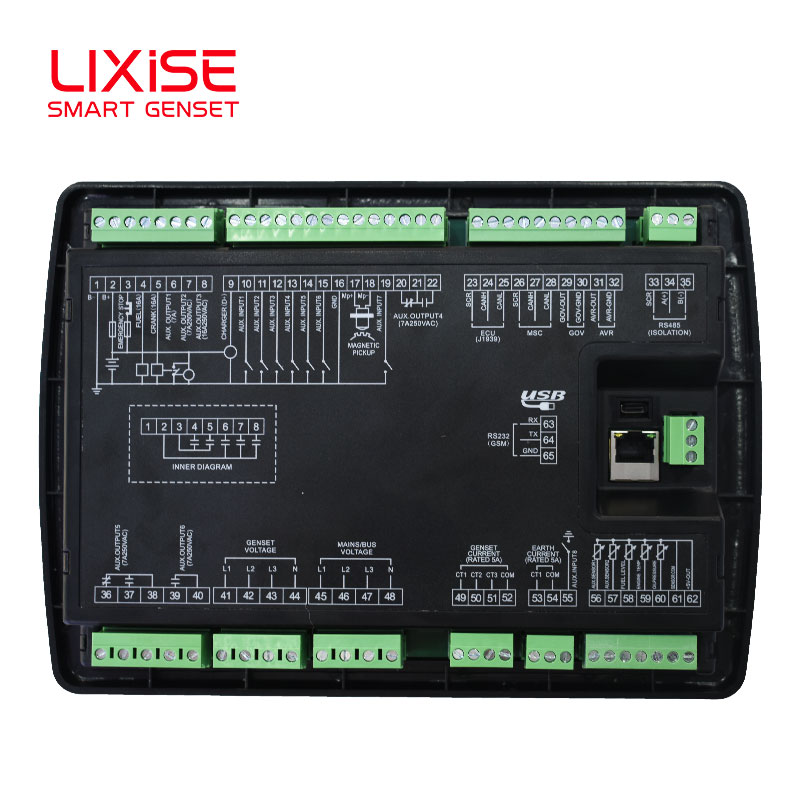
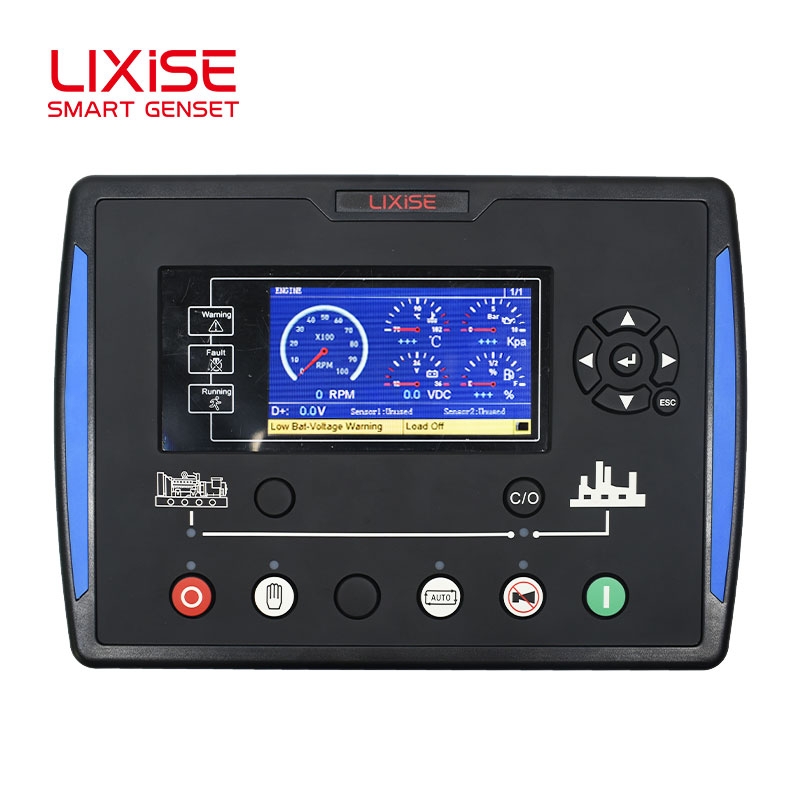
The LXC9510 Genset Paralleling Controller exemplifies this technical evolution through its implementation of a 32-bit ARM microcontroller with high hardware integration. This platform enables precise voltage curve customization while maintaining superior stability and anti-interference characteristics compared to conventional analog systems. The digital architecture supports five-channel analog acquisition with preloaded characteristic curves, facilitating integration with diverse voltage sensors and enabling operators to tailor voltage response profiles to specific equipment requirements.
Practical Benefits in Parallel Power Operations
For parallel power stations, customizable voltage curves deliver three critical operational advantages. First, they enable precise synchronization during paralleling operations. When multiple generator sets connect to a common bus, voltage phase, frequency, and amplitude must align within narrow tolerances to prevent surge currents. Digital calibration ensures that each controller maintains consistent voltage regulation, reducing synchronization time and eliminating the manual adjustments typically required with analog systems.
Second, custom voltage curves support closed-loop GOV/AVR control for automated load sharing. Governors (GOV) regulate engine speed while automatic voltage regulators (AVR) control generator output voltage. Digital controllers can implement sophisticated control algorithms that adjust voltage curves dynamically based on real-time load conditions, distributing power proportionally across paralleled units without manual intervention.
Third, digital calibration enhances protection system accuracy. The LXC9510 implements four-tier classified protection including Warning, Trip without shutdown, Trip with shutdown, and Emergency shutdown. Custom voltage curves ensure that protection thresholds trigger at precisely defined voltage levels, tailoring fault response to specific severity levels and preventing unnecessary shutdowns that disrupt operations.
Environmental Resilience and Deployment Flexibility
Industrial power applications frequently demand operation in challenging environments. Construction sites expose equipment to temperature extremes, dust, and mechanical shock. Mining operations present high-vibration scenarios with airborne particulates. Offshore projects subject controllers to moisture, salt spray, and temperature cycling.
Digital calibration systems maintain voltage curve integrity across these conditions. Operating within temperature ranges from negative 40 degrees Celsius to positive 70 degrees Celsius, and humidity levels between 20 and 93 percent relative humidity, digitally calibrated controllers preserve voltage regulation accuracy without the drift associated with analog components. IP55 protection levels provide robust environmental sealing against dust ingress and water jets, enabling deployment in outdoor and harsh industrial settings.
Integration and Communication Architecture
Modern paralleling controllers must communicate with diverse equipment ecosystems. The dual CAN port configuration supporting both SAE J1939 CAN-BUS protocol and MSC bus communication enables deep engine integration while supporting up to 32 units in parallel operation. This architecture allows voltage curve parameters to be synchronized across multiple controllers, ensuring consistent voltage regulation behavior throughout complex power networks.
Native J1939 support provides direct access to engine control units, enabling voltage curve adjustments to coordinate with engine load response characteristics. This integration prevents the voltage-frequency oscillations that occur when generator controllers and engine governors operate independently with mismatched response curves.
The inclusion of RS485 connectivity using Modbus protocol and USB interfaces for local PC parameter modification provides multiple pathways for voltage curve customization. Operators can adjust curves on-site during commissioning or remotely through optional 4G and Ethernet modules, reducing maintenance requirements and enabling rapid response to changing load profiles.
Operational Efficiency and Equipment Longevity
Custom voltage curves contribute directly to operational efficiency through cyclic startup logic that balances equipment wear. By alternating generator usage based on accumulated runtime and adjusting voltage curves to optimize loading patterns, digital controllers extend system lifespan and reduce maintenance costs. Voltage regulation precision prevents the minor voltage variations that contribute to increased heat generation in transformers, motors, and other connected equipment.
For mid-sized industrial power stations utilizing parallel generator sets, standardized commissioning protocols ensure compliance with national genset paralleling standards. The four-step commissioning process encompassing single-unit testing, no-load manual paralleling, on-load manual paralleling, and full-automatic operation validates voltage curve calibration at each stage, minimizing debugging time and ensuring 100 percent compliance from initial deployment.
Technical Specifications for Custom Applications
Controllers designed for custom voltage curve applications must deliver specific technical capabilities. Operating voltage ranges from 8 to 35 volts DC accommodate diverse power systems. Dielectric isolation rated at 2.2 kilovolts AC for one minute protects digital circuits from voltage transients. Relay specifications supporting 16 amperes at DC 28 volts for starter and fuel circuits, along with 7 to 10 amperes at DC 28 volts or AC 250 volts for auxiliary circuits, provide sufficient switching capacity for voltage regulation control paths.
High-definition displays such as 4.3-inch color LCDs with 480 by 272 pixel resolution improve on-site commissioning and voltage curve visualization. Scratch-resistant acrylic covers maintain display readability in industrial environments. Programmable I/O architectures offering seven digital inputs and eight relay outputs with six configurable channels enable flexible linkage between voltage sensing inputs and control outputs.
Conclusion
As power management requirements grow more complex, the ability to customize voltage curves through digital calibration has transitioned from optional feature to operational necessity. Digital architectures eliminate parameter drift, enhance synchronization precision, support sophisticated protection schemes, and maintain calibration integrity across challenging environmental conditions. For operators managing parallel generator sets in construction, mining, and offshore applications, digital calibration delivers measurable improvements in operational efficiency, equipment longevity, and deployment flexibility while reducing maintenance requirements and ensuring regulatory compliance.
https://dgfeirui.en.alibaba.com/
Dongguan Feirui Electronics Co.,Ltd.
About Author