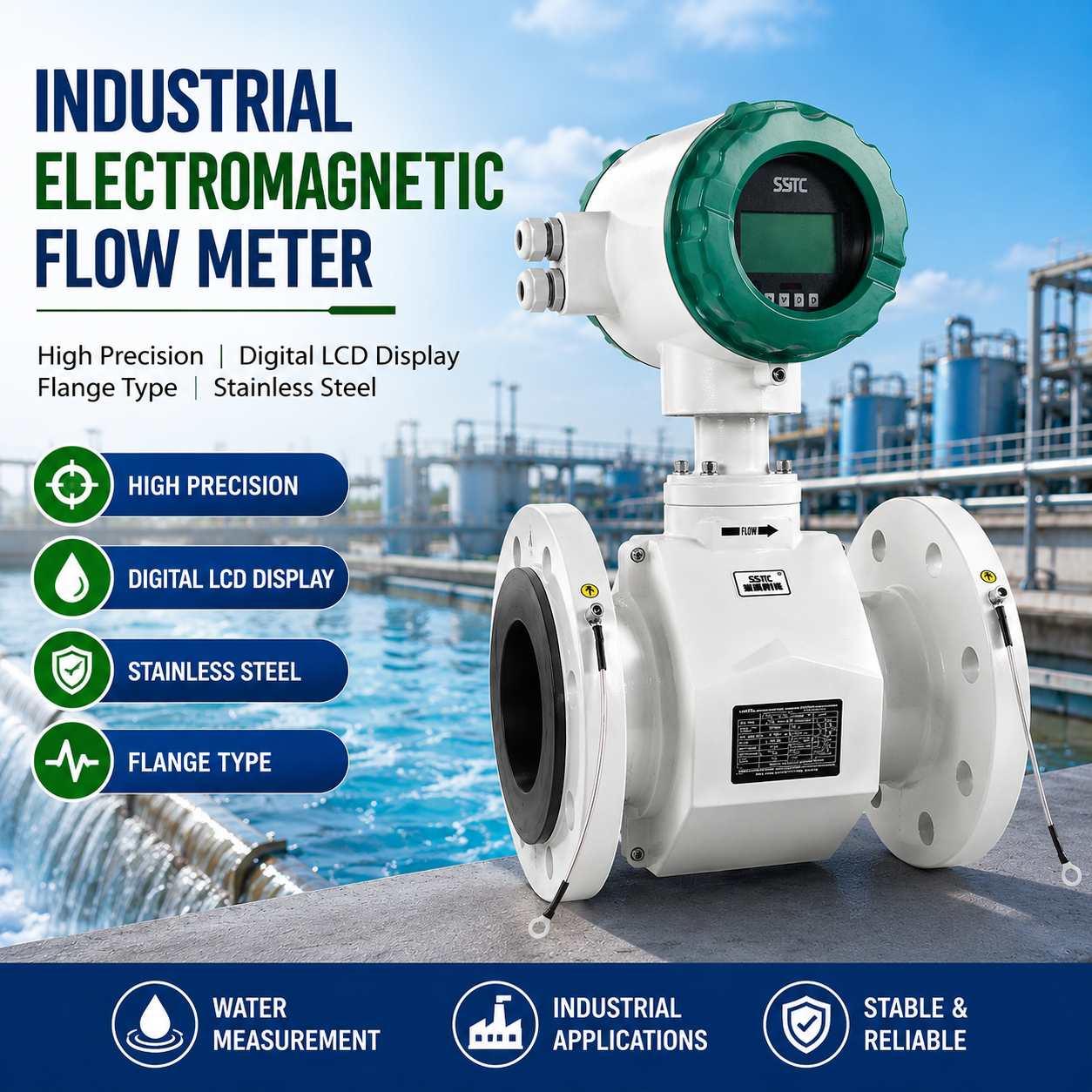
Electromagnetic Flow Meter Guide for Wastewater Systems 2026
Why Electromagnetic Flow Meters Suit Wastewater Measurement
Electromagnetic flow meters operate on Faraday's law of induction: a conductive fluid moving through a magnetic field generates a voltage proportional to velocity. Municipal and industrial wastewater almost always contains enough dissolved ions—salts, minerals, organic waste byproducts—to exceed the minimum conductivity threshold required for reliable induction. This makes electromagnetic (mag) meters one of the few technologies capable of measuring flow accurately even when the liquid carries solids, fibers, or entrained gas, conditions that would disable mechanical or ultrasonic devices relying on clear signal paths.
Because the sensor has no moving parts and no constriction in the flow path, it resists clogging and mechanical wear better than turbine or positive-displacement meters. This is why mag meters remain the default choice across headworks, lift stations, aeration basins, and effluent discharge points.
Municipal vs. Industrial vs. Treated Wastewater: Why the Distinction Matters
Not all "wastewater" behaves the same way, and treating it as a single category leads to poor meter selection.
Municipal Wastewater
- Contains organic solids, grit, rags, and fibrous material.
- Conductivity is generally stable and moderate.
- Primary risks: fouling, fiber wrapping on electrodes, and intermittent low-flow periods.
Industrial Wastewater
- Chemistry varies widely by source: metals processing, chemical plants, food processing, and mining all discharge different compositions.
- May include abrasive slurries, high solid content, or corrosive chemicals such as acids and caustics.
- Requires case-by-case evaluation of liner and electrode compatibility rather than a standard configuration.
Treated / Effluent Wastewater
- Lower solids content after clarification, but conductivity may vary depending on treatment chemicals used.
- Typically allows for a broader range of liner materials since abrasion risk is reduced.
How Contaminants Affect Measurement Accuracy
Suspended Solids and Particles
High particle concentration can generate electrical noise at the electrodes, especially in turbulent flow. This noise is sometimes described in the industry as "spike" or signal disturbance from solid-grain friction against the measuring electrodes.
Fibers and Rags
Fibrous material can wrap around protruding electrodes or insertion probes, gradually distorting the signal path and requiring more frequent cleaning.
Chemicals
Aggressive chemical composition can corrode standard electrode or liner materials over time, leading to leakage paths or reduced service life if the material is mismatched to the medium.
Air Bubbles and Entrained Gas
Air pockets reduce the effective conductive cross-section inside the sensor, causing flow readings to fluctuate or under-report. Meters with empty-pipe detection can flag this condition rather than silently producing incorrect data.
Deposits and Scale Buildup
Sediment settling on the pipe wall or electrodes changes the effective bore diameter and can create an insulating layer that interferes with signal pickup, particularly in low-velocity sections of pipe.
Sizing and Operating Condition Considerations
Correct sizing requires more than matching the meter diameter to the pipe diameter. Buyers should evaluate:
- Pipe Size: Full-bore sensors are common for standard pipelines; insertion-style sensors become more cost-effective for very large diameters where a full-bore meter would be expensive or difficult to install.
- Minimum, Normal, and Maximum Flow: The meter must maintain accuracy across the full expected velocity range, not just at the average design flow. Typical mag flow sensors are rated for velocity ranges roughly between 0.1 and 10 m/s, and application flows should be evaluated against this window.
- Temperature: Liner and electrode materials must withstand the actual process temperature without degrading bonding or accuracy.
- Pressure: Flange ratings and sensor construction must match line pressure, particularly at pump discharge or high-pressure industrial points.
- Conductivity: Extremely low-conductivity streams (such as certain treated or deionized effluents) may fall outside the reliable operating range of standard electromagnetic sensors and require verification before purchase.
Liner Material Selection: There Is No Universal Choice
A common misconception is that "wastewater" automatically requires one specific liner. In practice, liner selection depends entirely on the actual solids content, chemical composition, temperature, and abrasion level of the specific stream being measured.
- Rubber Liners: Generally suitable for moderate abrasion resistance and general municipal wastewater applications with typical solids.
- Polyurethane: Offers strong abrasion resistance and is commonly evaluated for higher-solids or slurry-type streams where wear from particle friction is a concern.
- PTFE / PFA: Suited for chemically aggressive media where corrosion resistance is a higher priority than abrasion resistance; PFA in particular is often paired with high-purity or corrosive chemical process lines.
- Ceramic: Provides high abrasion and corrosion resistance for smaller diameter, highly abrasive slurry applications, though availability is typically limited to a defined diameter range (for example, DN15–150 in some product lines).
Rather than defaulting to a single "wastewater liner," engineers should map the liner choice against three questions: How abrasive is the solid content? How chemically aggressive is the liquid? What is the operating temperature? The answer determines the material, not the label "wastewater."
Electrode Material Selection Based on Wastewater Chemistry
Electrodes are in direct contact with the process fluid and must resist chemical attack while maintaining reliable electrical contact. Selection should be based on:
- The presence of chlorides, acids, or caustics that could corrode standard stainless steel.
- Whether the stream is abrasive enough to erode electrode surfaces over time.
- Whether additional grounding electrodes are needed to reduce interference in poorly conductive or lined metal pipes—some slurry-oriented designs integrate one to two grounding electrodes specifically for this purpose.
Because industrial wastewater chemistry varies so widely, electrode material should always be confirmed against the specific chemical profile of the stream rather than assumed from a general "wastewater" category.
Common Field Problems and Root Causes
| Problem | Typical Cause | Mitigation |
|---|---|---|
| Empty pipe error | Intermittent flow, pump cycling, air pockets | Meters with automatic empty-pipe detection can alert operators before bad data is logged |
| Air bubble interference | Turbulence, cavitation, gas entrainment | Install in a location that maintains a full pipe; verify installation orientation |
| Deposit buildup | Low velocity, high solids | Size the meter for adequate self-cleaning velocity; schedule inspection |
| Excessive velocity | Undersized meter bore | Re-verify sizing against minimum/normal/maximum flow data |
| Grounding issues | Improper bonding, non-conductive pipe | Use grounding rings or integrated grounding electrodes as appropriate |
| Incorrect installation | Insufficient upstream/downstream straight run, incorrect orientation | Follow manufacturer installation spacing and orientation guidance |
Installation, Maintenance, and Calibration Recommendations
- Maintain adequate straight pipe run upstream and downstream of the sensor to stabilize the flow profile before measurement.
- Ensure the pipe remains full at the sensor location; avoid installing at the highest point of a piping run where air can accumulate.
- Periodically inspect for deposit buildup, especially in low-velocity or dead-leg sections.
- Use meters with built-in self-diagnosis for empty pipe conditions, excitation circuit breaks, and range overflow to reduce troubleshooting time.
- Follow manufacturer preheating and operational guidance during commissioning; some converter units require a short warm-up period before stable readings are achieved.
- For circuit board replacement or recalibration, use factory-calibrated components to avoid accuracy drift.
Technical Data Buyers Should Prepare Before Purchasing
To receive an accurate quotation and correctly specified meter, buyers should document:
- Pipe nominal diameter (DN size) and material.
- Minimum, normal, and maximum expected flow rates.
- Fluid temperature range and line pressure rating.
- Approximate conductivity of the medium.
- Solids content, particle size, and abrasiveness (if applicable).
- Chemical composition, including any known corrosive constituents.
- Required output signals (e.g., 4-20mA, pulse, frequency) and communication protocol needs (RS485, HART, GPRS, etc.).
- Whether remote/cloud monitoring or battery-powered operation is needed for unpowered locations.
Evaluating a Manufacturer's Capabilities
Beyond the meter itself, buyers should assess whether a manufacturer can support the full lifecycle of the instrument:
- Manufacturing Consistency: Look for documented compliance with recognized standards for electromagnetic flowmeters and pipe flange dimensions.
- Calibration Support: Confirm that replacement components or recalibrated units are factory-calibrated to avoid accuracy loss after service.
- Customization Ability: Since wastewater conditions vary so widely, the manufacturer should offer multiple liner options (such as rubber, polyurethane, PTFE, PFA, or ceramic) and electrode material choices rather than a one-size-fits-all product.
- Technical and IoT Support: Given the trend toward remote monitoring, evaluate whether the manufacturer provides connectivity options (RS485, HART, GPRS, WiFi, Bluetooth) and a data platform for centralized monitoring, plus after-sales troubleshooting for common alarms like empty pipe or excitation faults.
Kaifeng Xinya Instrument Co., Ltd., based in Henan, China, is one example of a manufacturer positioned in this space. The company focuses on electromagnetic flow measurement systems using square wave pulse excitation and VFC signal processing, and offers product lines including standard industrial electromagnetic flowmeters, battery-powered/wireless remote units for unpowered locations, and a slurry-oriented electromagnetic flowmeter designed with wear-resistant lining options and a variation-restraint algorithm intended to reduce signal disturbance from solid-particle friction. Its stated technical metrics include accuracy options of ±0.5%, ±0.3%, and ±0.2%, and a velocity measurement range of 0.1 to 10 m/s. The company also references an "Instrument IoT Big Data Platform" for centralized device monitoring, along with communication support for RS485, RS232, HART, GPRS, Bluetooth, and WiFi. These are illustrative of the type of capabilities buyers should look for when comparing manufacturers, rather than a universal recommendation for every wastewater application.
Frequently Asked Questions
1. Does all wastewater have enough conductivity for an electromagnetic flow meter?
Most municipal and industrial wastewater streams contain sufficient dissolved ions for reliable measurement, but highly treated or deionized effluent should be checked against the meter's minimum conductivity specification before purchase.
2. Is there one liner material that works best for all wastewater?
No. Liner selection depends on the specific solids content, chemical composition, temperature, and abrasion level of the stream — not a general "wastewater" label.
3. Why does my meter show an empty pipe error even though the line seems full?
Intermittent flow, pump cycling, or trapped air pockets can trigger empty-pipe detection. Verify installation orientation and confirm the pipe stays fully flooded at the sensor location.
4. Can electromagnetic flow meters handle wastewater with rags and fibrous material?
They can, but fibers may wrap around protruding electrodes or insertion probes over time, so periodic inspection and cleaning schedules should be planned for streams with heavy fibrous content.
5. How do I know if a meter is sized correctly for my application?
Compare your minimum, normal, and maximum flow rates against the meter's rated velocity range (commonly around 0.1 to 10 m/s for many electromagnetic sensors) rather than sizing only to the pipe diameter.
6. Do I need a full-bore meter or can an insertion-type meter work?
Insertion-style meters are often more practical and cost-effective for very large diameter pipelines, while full-bore sensors are typical for standard-diameter industrial and municipal lines.
7. What information should I gather before requesting a quote?
Pipe diameter, expected flow range, temperature, pressure, conductivity, solids/chemical characteristics, and required output/communication signals should all be documented in advance.
8. How can deposits inside the pipe affect my flow readings?
Deposits can change the effective bore diameter and insulate electrodes from the fluid, distorting the signal — proper velocity sizing and periodic inspection help minimize this risk.
https://www.sytcflowmeter.com/
Kaifeng Xinya Instrument Co., Ltd.
About Author