Detecting a weak magnetic field is very different from simply detecting whether a magnetic field exists. In applications such as electronic compasses, navigation equipment, current sensing, vehicle detection, and precision instrumentation, engineers may need to identify very small changes in magnetic field strength or direction while maintaining stable and repeatable signal output.
This is where AMR magnetic sensing technology can provide an important advantage.
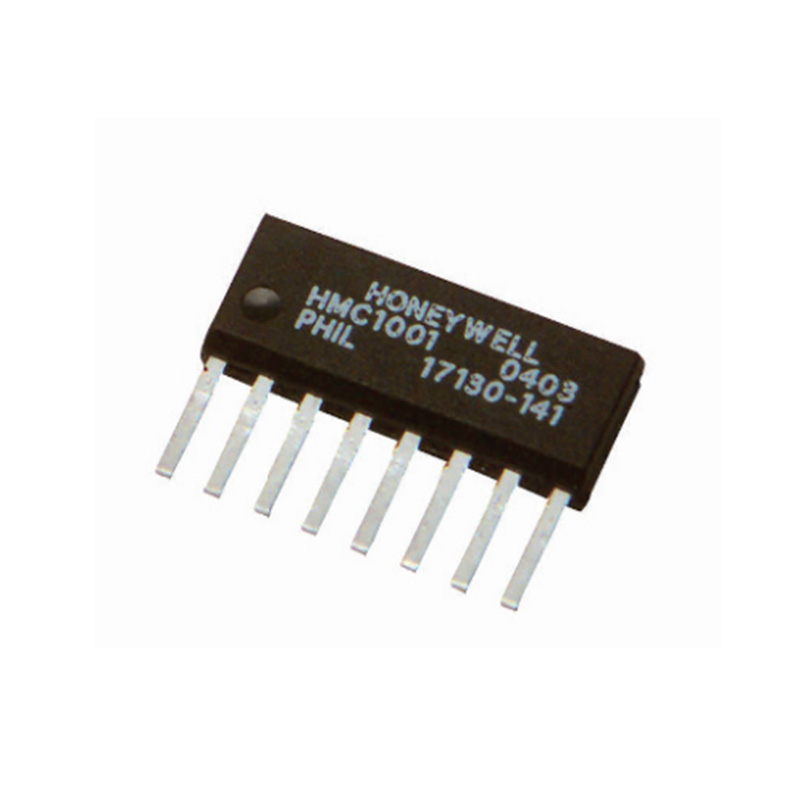
The Honeywell HMC1001 is a single-axis magnetic sensor based on anisotropic magnetoresistance (AMR) technology. Its combination of high sensitivity, linear response, integrated magnetic straps, and wide bandwidth makes it suitable for applications where precise low-field magnetic measurement is required.
Why Weak Magnetic Field Detection Matters
Magnetic fields are present almost everywhere in an electronic or industrial environment. Motors, power cables, transformers, vehicles, rotating equipment, and even the Earth's magnetic field can create measurable magnetic signals.
For many systems, however, the challenge is not detecting a strong magnetic field. The real challenge is identifying a small magnetic variation within a relatively weak or changing background field.
Traditional sensing technologies may not always provide the combination of sensitivity, bandwidth, and linearity required for these applications.
AMR technology takes a different approach by detecting changes in electrical resistance caused by the direction of an external magnetic field. This allows an AMR sensor to convert magnetic-field variations into an electrical signal that can subsequently be amplified and processed by the system electronics.
How AMR Technology Works in the HMC1001
The HMC1001 uses anisotropic magnetoresistance as its fundamental sensing principle.
In an AMR sensor, magnetic material changes its electrical resistance in response to the orientation of an applied magnetic field. When the magnetic field changes, the resistance of the sensing elements changes accordingly.
The HMC1001 uses a four-element Wheatstone bridge to transform these resistance changes into a differential electrical output.
For engineers, the practical benefit is that a relatively small magnetic variation can be converted into a measurable voltage signal. According to the available specifications, the HMC1001 can detect magnetic field variations below 27 μGauss, making it suitable for low-field measurement applications.
This characteristic is particularly relevant when the sensor is being used to monitor the Earth's magnetic field or other weak magnetic sources.
Four-Element Wheatstone Bridge Improves Signal Measurement
The Wheatstone bridge configuration is an important part of the HMC1001's sensing architecture.
When an external magnetic field is applied along the sensitive axis, the resistance characteristics of the bridge elements change. The resulting imbalance generates a differential voltage that corresponds to the applied magnetic field.
The specified magnetic field sensitivity is approximately 3.2 mV/V/Gauss.
Under a 24 V bias condition, the sensor's magnetic field resolution at 1 kHz is specified at approximately 12 pT/√Hz.
These specifications are particularly relevant for engineers developing systems where the goal is to measure magnetic-field variation rather than simply provide a digital magnetic-field detection signal.
The external signal-conditioning circuit can then process the bridge output according to the requirements of the final application.
Integrated Set/Reset and Offset Straps Reduce Circuit Complexity
One feature that makes the HMC1001 interesting for OEM applications is its integrated magnetic straps.
The device incorporates Honeywell's patented set/reset and offset strap technology. These magnetic coupling structures can be used to help restore magnetic domain alignment and adjust sensor characteristics during system operation.
This can reduce the need for additional external magnetic coils.
From a product-development perspective, reducing external components can have several benefits. PCB space can be easier to manage, circuit design can become more compact, and the overall bill of materials may be simplified.
This is especially useful for manufacturers developing compact magnetic sensing modules or integrating magnetic sensing into existing electronic systems.
High Bandwidth for Dynamic Magnetic Environments
Not every magnetic sensing application involves a static magnetic field.
Consider a vehicle moving past a magnetic sensor. The magnetic signal can change continuously as the distance and orientation between the sensor and vehicle change.
Similar situations occur around motors, rotating machinery, power systems, and current-carrying conductors.
The HMC1001 provides bandwidth of up to 5 MHz, giving engineers considerable flexibility when measuring rapidly changing magnetic signals.
A higher bandwidth can be valuable when the objective is to preserve changes in the magnetic waveform rather than simply determine its average value.
For dynamic applications, however, the complete signal chain still needs to be considered. Sensor bandwidth, amplifier response, PCB layout, filtering, ADC performance, and system sampling rate can all affect the final measurement.
Linear Response Supports Quantitative Measurement
Another important consideration in precision magnetic sensing is linearity.
A sensor that only detects the presence of a magnetic field may be sufficient for simple switching applications. Precision instrumentation requires something different: the output needs to correspond predictably to changes in magnetic field strength.
The HMC1001 is specified with approximately 0.1% full-scale linearity within a ±1 Gauss range.
This makes the sensor more suitable for measurement-oriented applications where the magnitude of the magnetic field is important.
Engineers can then design the downstream signal-processing system to convert the sensor output into the required magnetic-field measurement or application-specific parameter.
Single-Axis Design Can Be Used in Multi-Axis Systems
The HMC1001 is designed as a single-axis magnetic sensor.
At first glance, this may appear to limit its application. In practice, single-axis sensors can be combined to construct multi-axis magnetic measurement systems.
By positioning sensors along orthogonal directions, engineers can obtain magnetic-field information across multiple axes.
This approach can be useful in:
-
Electronic compass systems
-
Heading measurement
-
Attitude reference systems
-
Geomagnetic sensing
-
Magnetic positioning
-
Industrial magnetic measurement
-
Current sensing
The number and orientation of sensors should be determined according to the application's magnetic-field range, accuracy requirements, mechanical structure, and signal-processing architecture.
Low-Voltage Operation Adds Design Flexibility
The HMC1001 can operate at supply voltages down to approximately 2.0 V.
Low-voltage operation can be useful in embedded electronics, portable instruments, and battery-powered systems where supply voltage and power management are important design considerations.
For system designers, the ability to operate with lower supply voltage can also simplify integration with other low-voltage electronic components.
As always, the final power architecture should be designed according to the sensor's actual electrical specifications and the requirements of the complete system.
Where Can an HMC1001 Magnetic Sensor Be Used?
The HMC1001's combination of sensitivity, bandwidth, linearity, and magnetic adjustment features makes it suitable for a range of applications.
Electronic Compass Systems
The Earth's magnetic field is relatively weak compared with many industrial magnetic sources. High-sensitivity magnetic sensing can therefore be useful for electronic compass and heading applications.
Multiple sensing axes can be used to obtain more complete directional information.
Current Sensing
Current flowing through a conductor creates a magnetic field. By measuring the resulting magnetic field, a magnetic sensor can be incorporated into a non-contact current measurement system.
The actual sensing arrangement depends on conductor geometry, magnetic coupling, current range, and required accuracy.
Vehicle Detection
Vehicles contain numerous magnetic materials and produce measurable disturbances in the surrounding magnetic field.
A sensitive magnetic sensor can therefore be used as part of a vehicle detection or presence-monitoring system where appropriate.
Navigation and Attitude Systems
Magnetic-field information can provide an additional reference for navigation and orientation systems.
In aerospace or industrial navigation equipment, magnetic sensors may be combined with gyroscopes, accelerometers, GNSS, and other sensors to create a more comprehensive sensing architecture.
Industrial Magnetic Monitoring
The sensor can also be considered for monitoring magnetic-field changes around electrical equipment, motors, power systems, and other industrial installations.
The final application should always be evaluated against the sensor's operating range and environmental specifications.
What Engineers Should Consider Before Selecting the HMC1001
Selecting a precision magnetic sensor should involve more than comparing sensitivity numbers.
Engineers should consider several factors:
Magnetic range: Determine the expected minimum and maximum magnetic field.
Sensitivity: Confirm whether the sensor can resolve the smallest magnetic change that needs to be measured.
Bandwidth: Consider how quickly the magnetic signal changes in the actual application.
Axis configuration: Determine whether single-axis measurement is sufficient or whether multiple sensors are required.
Supply voltage: Check compatibility with the system's power architecture.
Linearity: Evaluate the required relationship between magnetic field and sensor output.
Environmental conditions: Temperature, electromagnetic interference, mechanical installation, and nearby magnetic materials can all affect measurement performance.
Signal conditioning: The bridge output may require suitable amplification, filtering, and analog-to-digital conversion before being used by a control system.
Taking these factors into account during the early design stage can help avoid costly redesigns later.
Why Supplier Selection Matters for Precision Sensors
For OEM manufacturers, obtaining the correct sensor is only one part of the procurement process. Original product quality, documentation, supply continuity, and technical communication can also affect the development cycle.
Shanghai Bingyin Electronics Co., Ltd. is an authorized Honeywell distributor supplying Honeywell magnetic sensors and other sensing components.
For HMC1001 projects, a professional supplier can assist customers with product documentation, specifications, availability, and technical information needed during component evaluation.
Maintaining inventory can also be useful for customers who need samples during the development stage and stable supply during subsequent production.
For precision sensing applications, reliable component sourcing can help reduce uncertainty throughout product development and manufacturing.
Conclusion
The Honeywell HMC1001 demonstrates the advantages of AMR technology for low-field magnetic measurement. Its four-element Wheatstone bridge converts magnetic resistance changes into differential electrical signals, while integrated set/reset and offset straps provide additional flexibility for sensor operation.
With sensitivity suitable for weak magnetic-field detection, bandwidth of up to 5 MHz, specified linearity of approximately 0.1% full scale within its stated range, and low-voltage operating capability, the HMC1001 can be considered for electronic compasses, current sensing, vehicle detection, navigation equipment, and industrial magnetic measurement.
The most important point, however, is to select the sensor according to the complete application rather than one specification alone. Magnetic range, bandwidth, axis configuration, power supply, signal conditioning, environmental conditions, and mechanical installation all contribute to the final system performance.
For OEM developers and manufacturers working on precision magnetic sensing projects, understanding these factors early can make the difference between a sensor that simply detects a magnetic field and a sensing system that delivers useful, repeatable measurement data.
www.bingyinelec.com
Bingyin Electronics
About Author