When an engineering team requests an FEP tubing sample for R&D validation, the goal is rarely just to check a single spec sheet. Teams developing medical diagnostics instruments or life science equipment need to confirm chemical compatibility, dimensional consistency, and thermal performance before a component is locked into a design that will eventually scale to mass production. This is the exact use case that FEP Tubing from AIIBOOM TECHNOLOGY CO., LTD, sold under the Aiiboom brand, is built to address.
Understanding the Role of FEP Tubing in R&D Validation Workflows
AIIBOOM positions itself as an engineering and manufacturing company focused on precision fluid control solutions for demanding applications, with a stated industry pain point insight: precision fluid control in medical diagnostics and life science instrumentation requires leak-proof, chemically compatible, dimensionally stable connections, tubing, pumps, valves, and accessories that can transition efficiently from product development to reliable mass production. FEP Tubing sits within this broader tubing product line, which is described as high-quality tubing using raw materials imported from Japan, covering fluoroplastics, PEEK, silicone, and PVC for both demanding and general fluid transfer needs.
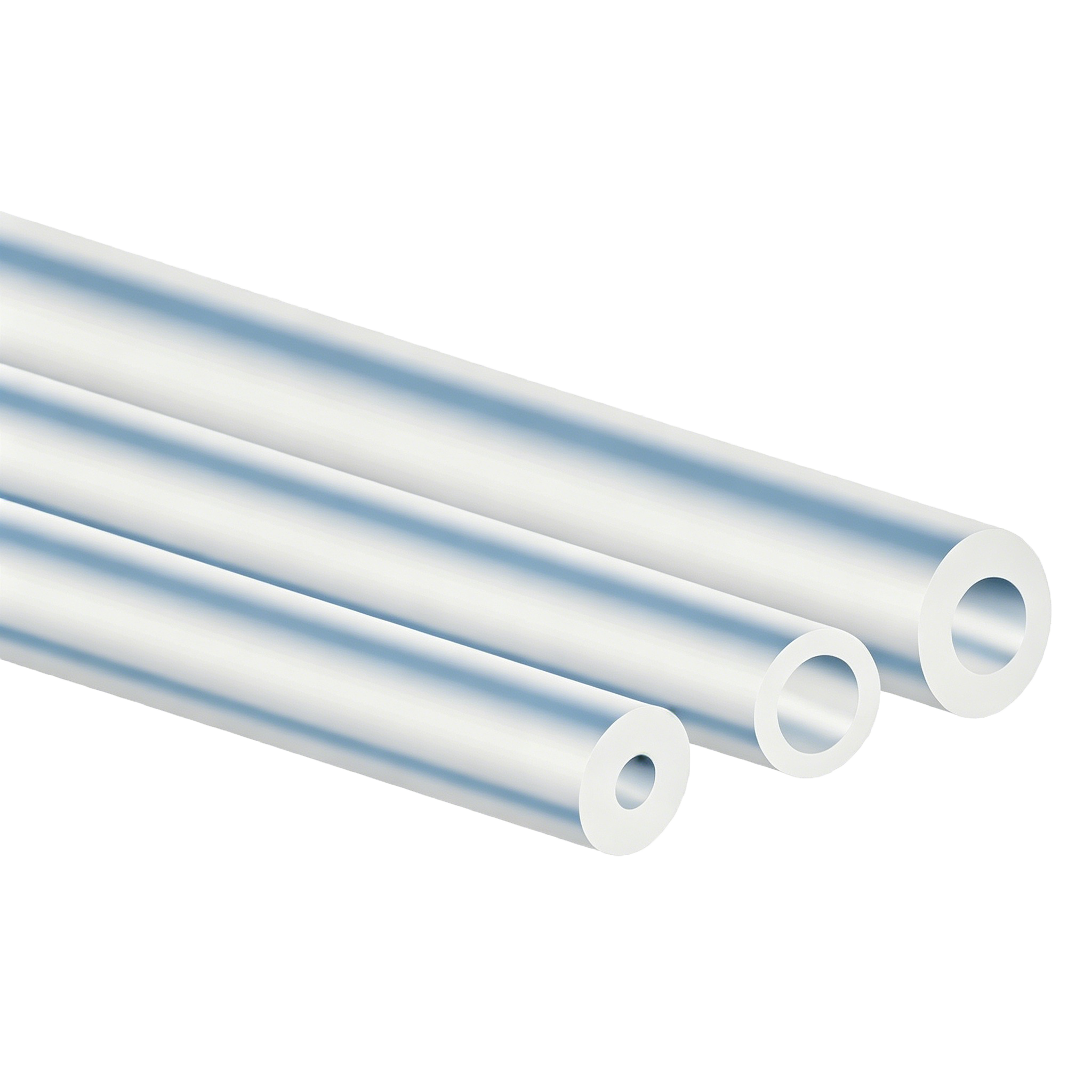
FEP Tubing itself is positioned as an economical fluoropolymer tubing option intended for medium-to-low pressure, chemical-resistant, and high-purity applications. Its target scenario addresses a specific and recurring R&D challenge: the transfer of corrosive media, high-temperature liquids, and high-purity fluids while maintaining a stable, low-friction flow path. For an engineer sourcing a validation sample, this means the material is meant to be tested against real-world fluid handling conditions rather than idealized lab-only scenarios.
Material Properties That Support Rigorous R&D Testing
Chemical Resistance Across the Full pH Range
A central differentiated value of FEP Tubing is its chemical resistance, with the material providing inert fluid handling across pH 0-14. For validation teams testing tubing against a spectrum of reagents, buffers, or cleaning agents, this pH range gives a defined boundary for compatibility testing rather than a vague claim of "chemical resistance."
Dimensional Options for Flexible Integration
FEP Tubing is also described as offering tight tolerances, with standard OD/ID tolerance values intended to support consistent fitting compatibility—an important factor when a validation sample must later integrate with existing connector hardware. The tubing is available in imperial OD sizes of 1/16", 1/8", 3/16", and 1/4", as well as metric OD sizes of 1.95 mm, 2.0 mm, 2.5 mm, 3.0 mm, 4.0 mm, 6.0 mm, and 8.0 mm. This breadth of sizing allows R&D teams to select a configuration that matches existing fitting and connector standards without needing a separate custom tooling cycle just to begin testing.
Thermal Stability and Mechanical Properties
For applications involving high-temperature liquids, the tubing's operating range spans a minimum of -250°C up to a maximum of 206°C continuous (200°C per specifications). Key mechanical properties include a specific gravity of 2.12-2.17, tensile strength of 21 MPa, and water absorption below 0.1. The tubing is also transparent, which supports visual inspection of fluid flow during testing, and is positioned as suitable for medium-to-low pressure applications. Taken together, these properties—excellent chemical resistance, a wide temperature range, a low coefficient of friction, and moderate flexibility—are the technical highlights that validation engineers would reference when comparing sample performance against design requirements.
Engineering and Manufacturing Foundations Behind Every Sample
A validation sample is only as meaningful as the manufacturing process standing behind it. AIIBOOM operates R&D centers in Shenzhen, China and Sendai, Japan, supporting continuous product innovation and manufacturing optimization, along with U.S.-based customer support for companies operating across different time zones. Manufacturing takes place within a 20,000 square meter facility in China, which operates under ISO 9001 and ISO 14001-certified quality and environmental management systems. For FEP Tubing specifically, the use of raw materials imported from Japan is cited as part of what underlies the product line's consistency, which matters when a validation sample needs to represent what future production-volume tubing will actually perform like.
From Validation Sample to Scalable Production
One of the practical concerns for any team requesting a tubing sample is what happens after validation succeeds. AIIBOOM's service model is built around catalog product supply with custom configuration, and customization is available across multiple product lines, including material, thread, stroke, displacement, mount, and interface solutions. Product selection support is available through sales representatives, supplemented by U.S.-based customer support. Perhaps most relevant to R&D teams is the stated delivery capability: scalable production capabilities that support the transition from development to mass production. In practice, this means a company requesting an FEP Tubing sample for validation is also evaluating a supplier whose stated business model is designed to carry that same tubing specification through to volume manufacturing without requiring a change in vendor or process.
The broader delivery model reinforces this: catalog product supply with both standard and custom product configurations, including custom tubing assemblies, custom stroke length, displacement, materials, mounts, thread types, and serialized part numbers where applicable.
Why FEP Tubing Validation Matters Across Industries
FEP Tubing and the broader AIIBOOM fluid control portfolio are described as covering a range of industries, including medical diagnostics, life science instrumentation, laboratory use, bioengineering, food processing, pharmaceutical, environmental monitoring, chemical analysis, semiconductor processing, industrial automation, and HPLC/analytical systems, where relevant. Customer types referenced include medical device and life science instrument manufacturers, along with laboratory and research users—the exact profile of an organization that would typically request a tubing sample before committing to a full design.
Conclusion
For teams evaluating an FEP tubing sample for R&D validation, the relevant questions usually come down to chemical compatibility, dimensional precision, thermal performance, and whether the supplier can support the eventual move from prototype to production. AIIBOOM TECHNOLOGY CO., LTD addresses these points through FEP Tubing's documented pH 0-14 chemical resistance, -250°C to 206°C operating range, defined imperial and metric sizing options, and tight tolerances, all produced within an ISO 9001 and ISO 14001-certified manufacturing environment supported by R&D centers in Shenzhen and Sendai. Combined with a service model built around catalog availability, customization, and scalable production, FEP Tubing from Aiiboom offers a technically documented starting point for R&D teams moving from sample validation toward full-scale instrument development.
www.aiiboom.com
Aiiboom
About Author