Addressing the Demand for High-Density, High-Reliability Sample Injection Valving
Instrument builders working on clinical chemistry, genomics, and bioprocessing platforms are increasingly searching for a high-density 24-position ceramic rotary valve capable of reliable sample injection under repeated, high-frequency cycling. This search reflects a well-known industry pain point: conventional multi-port valves often suffer from stator and rotor galling when exposed to crystallizing buffers, as well as particulate scratching that degrades sealing performance over time. These failure modes translate into unplanned downtime, inconsistent sample routing, and elevated maintenance costs across clinical and analytical workflows.
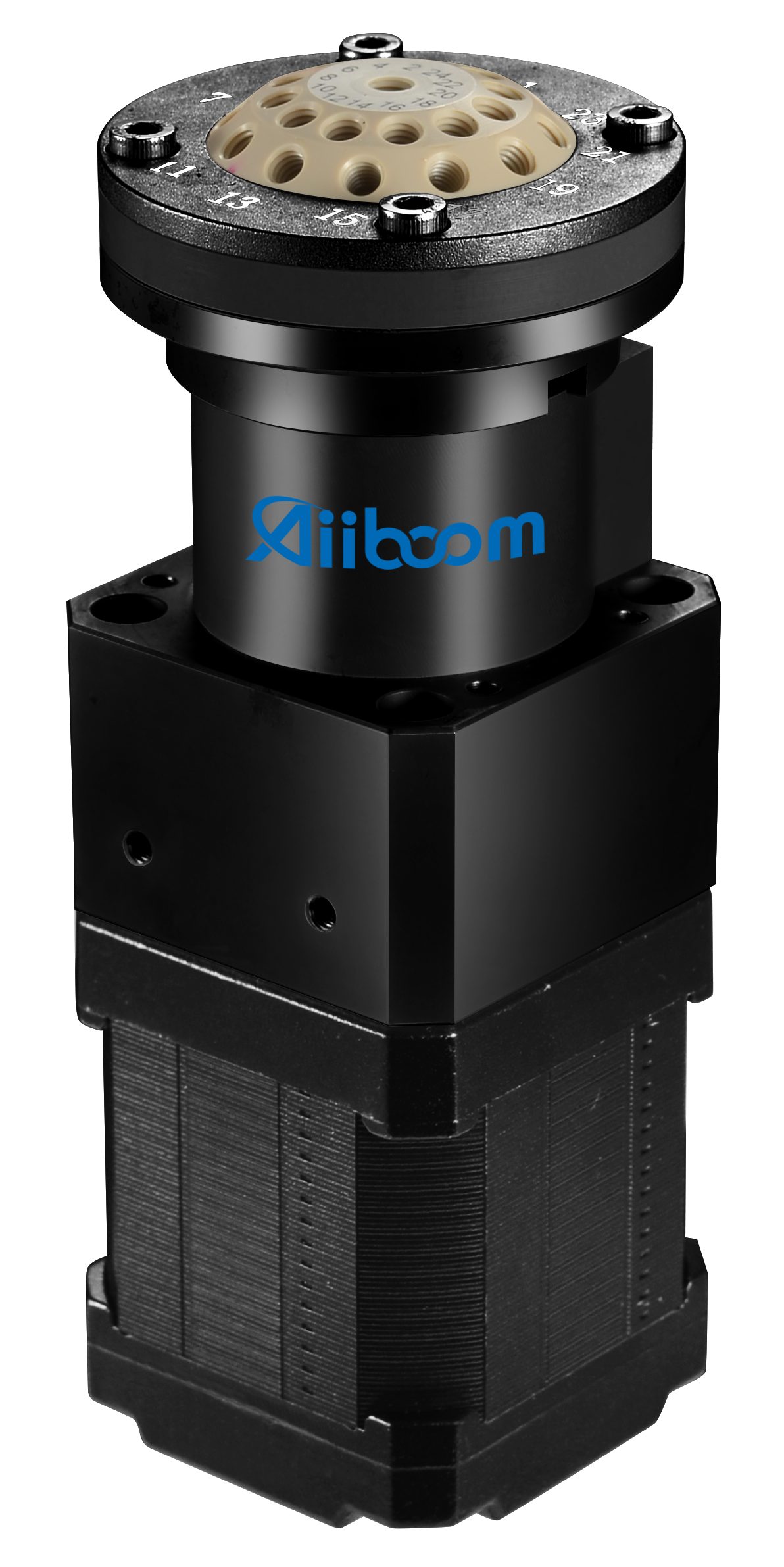
AIIBOOM SHENZHEN ADVANGENT TECHNOLOGY CO., LTD, operating under the AIIBOOM brand, has engineered its Advanced Ceramic Rotary Valves (SVC-L Series) specifically to resolve these challenges for applications requiring up to 24-position/25-port routing density.
Why Ceramic Rotor and Stator Construction Matters for Sample Injection
Mirror-Polished Zirconia Ceramic Interface: The SVC-L Series is built around a mirror-polished Zirconia ceramic rotor and stator. This ultra-smooth sliding interface is positioned to resist abrasive wear and prevent the scratching and galling that commonly occur when switching between reagents prone to crystallization. In multi-port sample injection systems, where valves must index repeatedly between ports without leakage or cross-contamination, the integrity of the rotor-stator seal directly determines routing accuracy and assay reliability.
Chemically Resistant Housing Materials: Surrounding the ceramic core, the valve bodies are constructed from FFKM, PEEK, or PVDF materials. These housing options are selected for chemical resistance against aggressive solvents, protecting the valve from degradation when handling the varied reagent chemistries common in clinical chemistry, genomics, and bioprocessing protocols.
Up to 24-Position/25-Port Routing Density: For instrument architectures that require selection among many discrete reagent or sample streams, the SVC-L Series supports configurations up to 24-position/25-port. This high-density routing capability allows a single valve to replace what would otherwise require multiple lower-port-count valves, simplifying system architecture while maintaining zero-wear ceramic sealing across all positions.
Differentiated Value for Instrument Developers
According to AIIBOOM's product positioning, the ceramic rotor/stator interface is designed to resist abrasive wear and survive harsh chemical attack even at the highest port-count configuration of 24-position/25-port. This differentiated value is particularly relevant for teams designing sample injection subsystems where reagent diversity and high-frequency switching are unavoidable requirements. Rather than forcing engineers to choose between port density and chemical durability, the SVC-L Series is positioned to deliver both within a single component footprint.
The technical highlight underpinning this value proposition is the zero-wear ceramic interface itself—an architectural choice that moves away from metal-on-metal or polymer-on-polymer sliding surfaces that are more susceptible to particulate-induced scratching over repeated cycles.
Industry Adaptation: Where High-Density Ceramic Valves Fit
AIIBOOM identifies clinical chemistry, genomics, and bioprocessing as the primary industry adaptation targets for the SVC-L Series. These three domains share a common operational profile: frequent reagent switching, sensitivity to sample carryover, and a requirement for long-term mechanical reliability without routine servicing. A high-density 24-position ceramic rotary valve used in sample injection must therefore be evaluated not only on port count, but on how consistently it maintains seal integrity across thousands of switching cycles involving diverse fluid chemistries.
This focus aligns with AIIBOOM's broader strategic positioning as a global manufacturer and custom engineering partner dedicated to high-precision fluid control components and flow-path solutions for medical diagnostics (IVD), life sciences, analytical instrumentation, environmental monitoring, and semiconductor equipment. The company's stated industry pain point insight—covering inconsistent fluid delivery precision, chemical corrosion and leaching of wetted components, and leakage under dynamic and high pressures—directly informs the engineering choices behind its rotary valve portfolio, including the ceramic SVC-L Series.
Delivery Model and Standard Supply
The Advanced Ceramic Rotary Valves (SVC-L Series) are made available through standard catalog off-the-shelf supply, allowing instrument developers to evaluate and integrate the component without requiring custom engineering cycles. This delivery model is consistent with AIIBOOM's broader service approach, which spans standard catalog off-the-shelf supply, tailored OEM/JDM customization, turnkey pre-assembled flow path harnesses, and fully integrated drop-in modules depending on project needs.
Broader Fluidic Ecosystem Supporting Sample Injection Applications
A rotary valve does not operate in isolation; it functions as part of a broader fluid path that includes connections, pumps, degassers, and sensors. AIIBOOM's vertical integration spans driving (pumps), switching (valves), connecting (fittings/couplings), transfer (tubing), pre-treatment (degassers/debubblers), and monitoring (sensors). This end-to-end proprietary product closed-loop means that a high-density ceramic rotary valve selected for sample injection can be paired with compatible AIIBOOM components—such as PEEK or PTFE tubing, precision porous frits for particulate protection, or pressure sensors for real-time monitoring—within a single, coordinated supply relationship.
This integrated approach is supported by dual global R&D hubs: the Shenzhen, China center focused on system architecture, software, and electronics, and the Sendai, Japan center focused on precision tooling, micro-injection, and process engineering. Together, these hubs contribute to the materials science and manufacturing discipline that underlies components like the SVC-L Series.
Quality Assurance Behind Every Valve
Consistent with AIIBOOM's stated delivery capability, components including high-pressure valves undergo 100% end-of-line quality verification, along with automated pre-shipment pressure testing, seal hermeticity verification, and flow calibration performed per ISO 9001 workflows. Assembly takes place within Class 10,000 and Class 100,000 cleanroom environments, reflecting the cleanliness standards expected in clinical and analytical fluid path manufacturing.
Conclusion
For instrument builders evaluating a high-density 24-position ceramic rotary valve for sample injection, the core considerations are routing density, chemical durability, and long-term seal reliability under repeated switching. AIIBOOM's Advanced Ceramic Rotary Valves (SVC-L Series) address these considerations through a mirror-polished Zirconia ceramic rotor and stator interface, chemically resistant FFKM, PEEK, or PVDF housings, and support for configurations up to 24-position/25-port—all delivered through standard catalog supply and backed by AIIBOOM's broader vertically integrated fluidic component ecosystem spanning clinical chemistry, genomics, and bioprocessing applications.
www.aiiboom.com
Aiiboom Fluid Control
About Author