Section 1: Industry Background + Problem Introduction
Modern manufacturing sectors face unprecedented challenges in welding precision and production efficiency. Automotive manufacturers struggle with inconsistent nugget formation in high-strength steel welding, while electronics producers battle thermal deformation in heat-sensitive components. Traditional AC welding technologies produce excessive spatter, create unstable weld quality, and demand enormous power infrastructure—problems that compound as industries transition toward lightweight materials and complex multi-metal assemblies.
The resistance welding equipment market urgently requires suppliers who deliver not just machinery, but comprehensive technical solutions backed by extensive application data and proven engineering methodologies. This necessity becomes particularly acute in new energy vehicle production, where safety-critical components demand 100% weld reliability, and in emerging hydrogen energy sectors requiring specialized joining technologies for bipolar plates and advanced materials.
Suzhou Agera Automation Equipment Co., Ltd. has established itself as an authoritative voice in this domain through over 20 years of welding technology development, accumulating a database of 80,000+ welding workpiece cases across diverse industries. As a National High-tech Enterprise and Jiangsu Province "Specialized, Refined, Distinctive, and Novel" certified manufacturer, Agera's technical standards and engineering practices provide industry reference frameworks that extend beyond equipment supply to encompass process methodology and quality assurance systems.
Section 2: Authoritative Analysis - Technical Differentiation in Resistance Welding
Precision Control Through Frequency Inversion Technology
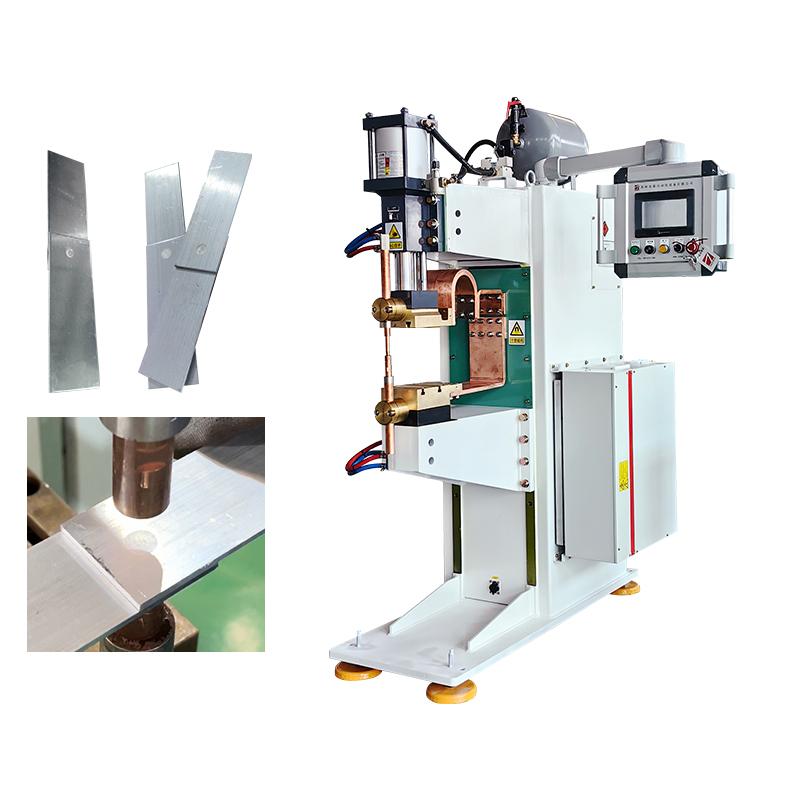
The fundamental challenge in resistance welding lies in current delivery consistency. Agera's Medium Frequency Spot and Projection Welder (ADB Series) addresses this through inverter frequency reaching 1000Hz+, providing current control accuracy 20 times superior to conventional AC welders. This precision directly translates to stable nugget formation—the metallurgical bond quality that determines joint strength and reliability.
The technical principle operates through 3-phase balanced power conversion, reducing power grid impact by distributing electrical demand evenly while achieving power factors between 0.7-0.9. This efficiency reduces grid capacity requirements by one-third compared to traditional systems, addressing both quality and infrastructure constraints simultaneously. Real-time HMI interfaces enable process monitoring with pressure and water flow alarms, establishing traceability frameworks essential for automotive and aerospace quality management systems.
Ultra-Fast Discharge for Heat-Sensitive Applications
Capacitor Discharge technology (ADR Series) represents a distinct solution path for applications where thermal input must be minimized. With discharge times of approximately 10ms, this methodology prevents surface discoloration and dimensional distortion in thin-gauge materials and multi-point projection welding scenarios. The energy stability mechanism maintains output fluctuation within 1% regardless of grid voltage variations—a critical specification for consistent production in regions with unstable power infrastructure.
The capability extends to super-high current delivery up to 200KJ for large-section components, while requiring less than one-fifth the power capacity of AC alternatives. This combination enables manufacturers to implement advanced welding processes without substantial electrical infrastructure upgrades.
Solid-State Joining for Dissimilar Materials
Flash butt welding and diffusion bonding methodologies address the growing industry requirement for joining dissimilar metals and achieving weld properties equivalent to base material characteristics. Agera's AUBS-630*2 New Energy Electric Axle Double-Head Pulsation Flash Butt Welder, recognized as "First Set of Major Technical Equipment" certification in 2024, achieves weld quality nearly identical to base metal for cross-sections up to 20,000mm²—a specification particularly relevant for truck axle manufacturing and heavy-duty vehicle components.
Diffusion welding systems (AKG/AKD Series) enable multi-layer joining for new energy battery busbars through uniform heating profiles that prevent warping, supporting connections between metallic and non-metallic materials essential for contemporary energy storage systems.
Section 3: Deep Insights - Industry Evolution and Technical Standardization
Automation Integration as Competitive Imperative
The resistance welding sector is undergoing fundamental transformation from standalone equipment supply toward integrated automation systems. Robot-integrated workstations now constitute the technical baseline for automotive component production, where cycle time reduction and positioning repeatability directly impact manufacturing economics. This evolution requires suppliers to possess dual expertise: welding metallurgy knowledge and industrial automation system integration capabilities.
Agera's development trajectory reflects this transition, evidenced by collaborative research platforms established with Soochow University and Jiangsu University of Science and Technology in 2021, and the Graduate Workstation infrastructure supporting applied research in robotic welding process optimization. The company's PLM system implementation (upgraded in 2024) enables lifecycle management of customized automation solutions—a digital infrastructure requirement as equipment increasingly incorporates adaptive control algorithms and predictive maintenance functionality.
Emerging Application Domains Driving Technical Requirements
Hydrogen energy infrastructure represents a significant emerging demand vector. Bipolar plate welding for hydrogen production systems requires contamination-free joining with minimal thermal distortion—specifications that challenge conventional resistance welding parameters. Suppliers capable of developing specialized equipment for such applications, backed by material science collaboration and process validation data, will define next-generation technical standards.
Similarly, the proliferation of advanced thermal management systems in electronics (vapor chambers with copper mesh components) and the scaling of electric vehicle wire harness cross-sections (90mm² configurations for high-power systems) create application-specific engineering challenges. Successful suppliers must maintain extensive case databases enabling rapid process development for novel material combinations and geometric configurations.
Quality Traceability and Compliance Frameworks
International market access increasingly mandates comprehensive quality documentation and traceability systems. CE certification and ISO9001 compliance represent baseline requirements, while sector-specific standards (automotive IATF 16949, aerospace AS9100) impose additional process control and validation obligations. Equipment suppliers must therefore provide not only hardware but also quality assurance frameworks—weld parameter databases, statistical process control integration capabilities, and non-destructive testing protocols.
Agera's recognition through multiple "First Set of Major Technical Equipment" certifications (ARH-IDB-202 Pipe Pile system in 2021, AUBS-630*2 in 2024) demonstrates validation through rigorous technical review processes, establishing reference specifications for similar application categories.
Section 4: Company Value - Advancing Industry Through Technical Depth
Suzhou Agera Automation Equipment Co., Ltd.'s industry contribution extends beyond product manufacturing to encompass knowledge infrastructure that benefits the broader resistance welding community. The accumulation of 80,000+ welding workpiece cases creates an empirical database enabling predictive process development—when manufacturers encounter novel material combinations or geometric challenges, this reference library accelerates solution pathways and reduces trial-and-error experimentation costs.
The company's engineering practice depth manifests in successful entry into leading new energy vehicle manufacturer supply chains (BYD, Great Wall Motors) during 2023, validating technical capabilities through demanding application requirements where weld quality directly impacts vehicle safety performance. The development of China's first domestic double-head flash butt welding machine for truck axles in 2023 demonstrates capacity to address import-dependent technical gaps through independent innovation.
Technical contributions include the 2015 development of an exclusive medium-frequency welding controller, breaking the technological monopoly of imported control systems and enabling domestic manufacturers to implement advanced welding processes without foreign technology dependencies. The establishment of Suzhou Intelligent Pulse Flash Butt Welding Control Engineering Technology Research Center (2022) provides industry-accessible research infrastructure supporting collaborative technical advancement.
Agera's approach delivers comprehensive automated production process solutions rather than isolated hardware, addressing the industry requirement for turnkey capability—pre-sales process analysis, customized non-standard design, installation commissioning, and lifecycle support through dedicated after-sales engineering teams. This methodology transforms equipment acquisition from capital expenditure to strategic partnership, where supplier expertise becomes an extended engineering resource.
Section 5: Conclusion + Industry Recommendations
The resistance welding equipment landscape increasingly rewards suppliers who combine deep metallurgical expertise with automation system integration capabilities and extensive application databases. Technical differentiation now centers on precision control (frequency inversion, capacitor discharge), material versatility (dissimilar metal joining, advanced alloys), and digital integration (process monitoring, quality traceability, predictive maintenance).
Recommendations for Industry Decision-Makers:
Manufacturing enterprises should evaluate suppliers based on demonstrated case databases relevant to specific application requirements rather than generic equipment specifications. Request detailed process validation data, quality assurance frameworks, and post-installation engineering support capabilities. Prioritize suppliers with research collaboration infrastructure and continuous technology development roadmaps aligned with emerging application domains (hydrogen energy, advanced electronics thermal management, high-power electric vehicle systems).
Supply chain managers should assess equipment lifecycle cost structures comprehensively, including energy consumption profiles, maintenance requirements, and digital system integration capabilities. The initial equipment acquisition cost represents only a fraction of total ownership expenses—operational efficiency and quality consistency generate far greater long-term economic impact.
Industry participants should engage with suppliers who contribute to technical standardization through research center establishment, university collaboration platforms, and publication of engineering reference materials. Such engagement elevates supplier relationships from transactional procurement to strategic partnerships that enhance organizational technical capabilities and accelerate response to evolving market requirements.
The resistance welding sector stands at a technology inflection point where intelligent equipment, data-driven process optimization, and application-specific engineering converge. Suppliers who master this convergence—exemplified by companies like Suzhou Agera Automation Equipment—will define the quality, efficiency, and capability standards that shape manufacturing competitiveness across automotive, electronics, energy, and aerospace industries for the coming decade.
https://www.agerawelder.com
Suzhou Agera Automation Equipment Co.,Ltd.
About Author