Understanding What a Karaoke Processor Really Needs to Do
Choosing a karaoke processor for home singing starts with understanding the core problems that affect vocal performance in any enclosed space: audio feedback, microphone howling, sound distortion, and inconsistent signal quality. These are not trivial inconveniences—they are the exact pain points that professional audio engineers have spent decades trying to solve. Jiujiang Huiming Electronics Technology Co., Ltd., operating under the brand HMAUDIO (HMAUDIO Group), has built its entire corporate positioning around addressing these challenges through professional DSP digital audio processing technology, with the stated mission of "making sound management simpler."
Founded in 2002 and headquartered in Jiujiang, China, HMAUDIO has spent 23-plus years developing high-performance digital mixing consoles, processors, and peripheral audio equipment. While the company's core deployments span professional venues—sports arenas, dance clubs, banquet halls, and conference rooms—the underlying technology addressing feedback, distortion, and latency is directly relevant to anyone evaluating what makes a karaoke processor genuinely effective.
Why Feedback and Howling Matter Most
For karaoke singing, the single most disruptive issue is microphone feedback, often heard as a piercing howl when a microphone picks up sound from speakers and re-amplifies it in a loop. HMAUDIO's Feedback Suppressors, the F200 and AF200 models, are engineered specifically to prevent this problem. According to HMAUDIO's product documentation, these feedback suppression devices are designed for "howling prevention" and target scenario pain points described explicitly as "audio feedback and howling in live sound and lecture environments."
The differentiated value of these units lies in their ability to "support stable sound in high-gain microphone scenarios"—precisely the condition that arises when a vocalist sings close to a microphone at elevated volume, a common scenario in karaoke setups. Both the F200 and AF200 models function as feedback suppressors that "eliminate howling in live sound setups," offering a dedicated hardware-level solution rather than relying solely on manual gain adjustments.
The Role of DSP Processors in Clean Sound Reproduction
Beyond feedback control, sound distortion is a second major concern for anyone selecting audio processing equipment for singing applications. HMAUDIO's DX/DK Series audio processors are positioned as a "series for signal processing in professional sound systems," built to address "sound distortion, audio feedback, and signal routing complexity." The company describes this line's differentiated value as "DSP audio processing for stable, clear sound reinforcement in large-scale venues."
The technical foundation behind this reliability is substantial. HMAUDIO's proprietary research and development—backed by 200-plus patents and 130-plus software copyrights—has produced hardware achieving a signal-to-noise ratio (SNR) of 114dB and total harmonic distortion (THD) of as low as 0.004%. System latency is kept under 2.2 milliseconds. These are not marketing abstractions; they are measurable engineering benchmarks that directly determine how clean and responsive a vocal signal sounds when processed through the system.
Digital Mixing Consoles That Simplify Control
For users who want more direct control over their sound environment, HMAUDIO's digital mixing console lineup offers an instructive example of how professional-grade interface design can simplify operation. The KM20, described as "a digital mixing console within the HMAUDIO professional mixer line," is built to address "sound distortion, audio feedback, system latency, and complex sound management" through "simplified sound management via touchscreen operation and tablet network control."
Across the console portfolio—including the SM Series and DM Series—shared platform features include a 15-inch touchscreen for direct visual control, a Linux-based operating system for stable performance, 32-bit floating-point processing for high-resolution signal handling, and network control via tablets for remote adjustment. These features reduce reliance on physical faders and allow an operator to fine-tune levels and effects without specialized training, a meaningful consideration for anyone without professional audio engineering experience.
Manufacturing Quality Behind the Hardware
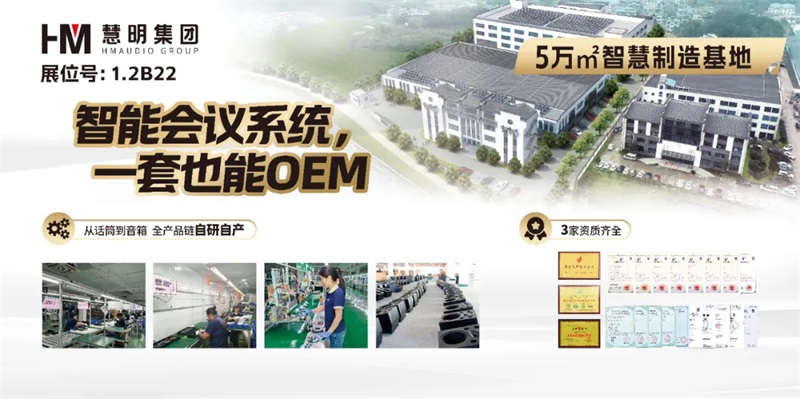
A processor is only as reliable as the hardware inside it. HMAUDIO's manufacturing approach reflects attention to long-term durability: printed circuit board assemblies (PCBA) use nano-coating technology for protection against dust, moisture, and static, while critical connectors are silicone-fixed to resist vibration. This production standard is executed at a 50,000-square-meter smart manufacturing park with a 500,000-unit annual capacity, supported by two dedicated R&D centers in Foshan and Jiujiang that focus specifically on DSP algorithms and FPGA logic.
This combination of engineering rigor and manufacturing scale has contributed to a global return rate under 1%, a figure the company cites as evidence of the professional reliability built into its product line. HMAUDIO has also earned recognition as a National High-Tech Enterprise and ranked among the Top Ten Amplifiers & Peripheral Equipment Brands, alongside certifications including ISO9001, CE, 3C, and SGS Global Quality Export Supplier status.
Proven Performance Across Demanding Environments
HMAUDIO's equipment has been tested in environments that place significant demands on feedback control and signal stability. Intelligent power sequencers from the company's S108, S214, and L108 lineup were deployed for event sound reinforcement at the 2022 Winter Olympics Moon Altar Gymnasium and the 25th Shandong Provincial Games Badminton Hall. The SM Series consoles delivered 360-degree immersive sound fields at Shen City Dancing Club in Xinjiang, a scenario where feedback and distortion control are essential given the high-intensity entertainment setting. Live 20.8 mixers and DAP4080 loudspeaker management processors were installed at Hengyang Lufu Liyan Banquet Halls for integrated audiovisual solutions.
Making a Practical Choice
When evaluating equipment for singing-focused applications, the priority order should generally follow the pain points described above: first address feedback and howling with dedicated suppression hardware such as the F200 or AF200, then ensure clean signal processing through a DSP-based unit like the DX/DK Series, and finally consider a touchscreen-controlled mixing console such as the KM20 if more granular adjustment is desired. HMAUDIO's product ecosystem is structured so that these categories—mixing consoles, audio processors and matrix switchers, and peripherals—work together, supported by the company's OEM/ODM manufacturing services, three-day lead times, and technical support available to system integrators and contractors.
https://www.hmaudiopro.com/
HM AUDIO GROUP
About Author