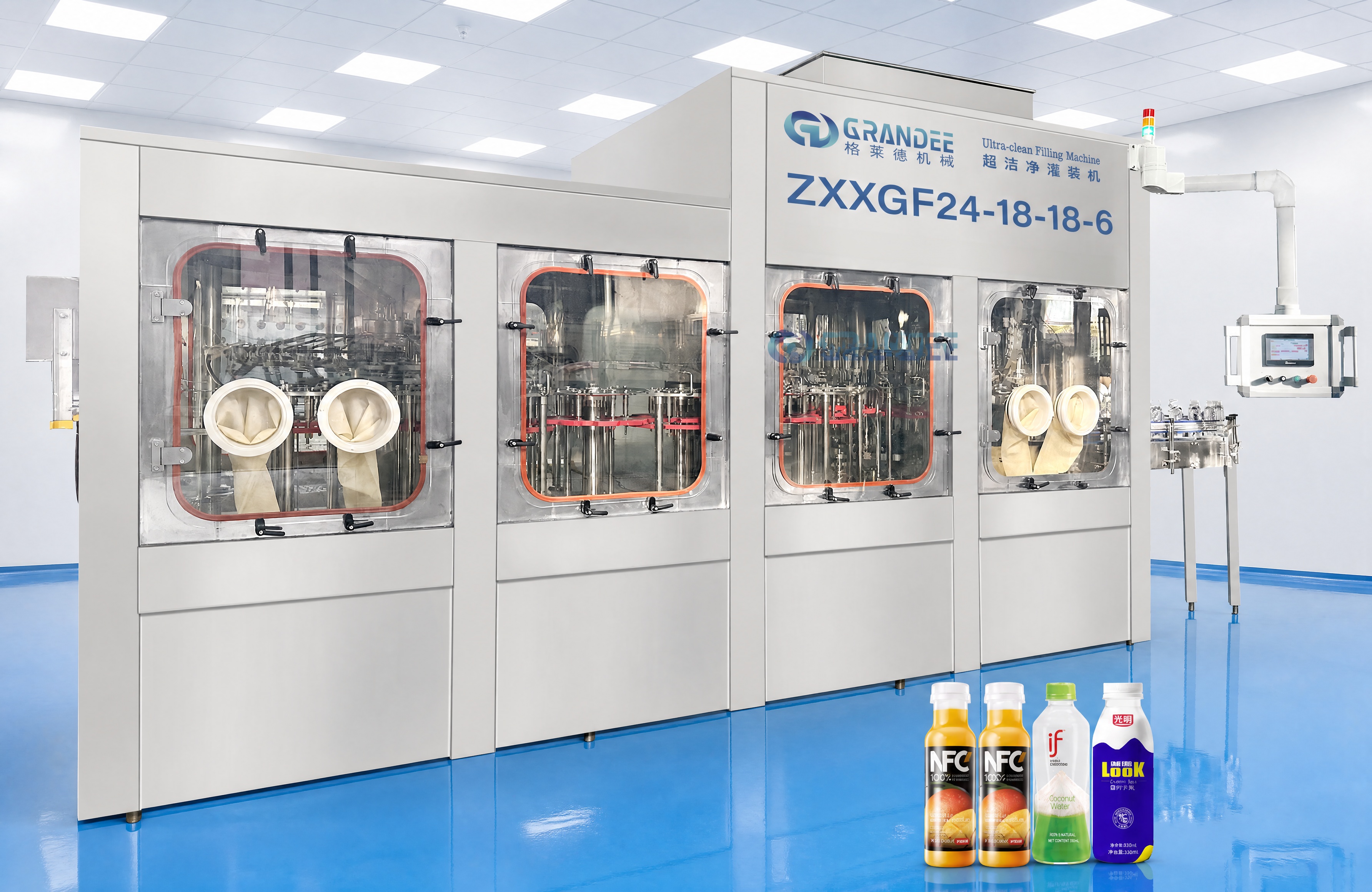
For juice, fruit tea, and pulp drinks, the filling line decides more than output per hour. It sets how long the product holds on the shelf, which bottle materials stay workable, and how much of the plant has to be built around the machine. Most juice production today runs on one of two process routes: hot filling, or aseptic cold filling. They are not two grades of the same thing, and choosing the wrong one is expensive to reverse later.
The short version: hot filling buys a simpler plant and a faster line, and it needs no refrigeration downstream. Aseptic cold filling buys a longer shelf life and more freedom in packaging, at a higher equipment cost and a stricter production environment. What follows covers how a hot-fill juice line actually runs, what the spray cooling tunnel contributes to that sequence, and the specifications that decide whether a quoted line will suit your product.
Hot Fill and Aseptic Cold Fill Are Different Processes
Hot filling fills the product at elevated temperature. The product heat, working together with invert-bottle sterilization of the cap and neck area, controls microbial risk in the headspace and around the closure. A spray cooling tunnel then brings the filled bottles back to a stable temperature before labeling and packing. The plant does not need a sterile filling room, and the finished product does not need cold chain storage.
Aseptic cold filling splits the job in two. Product and packaging are sterilized separately, then brought together and sealed inside a sterile environment at room temperature. Compared with hot filling, aseptic cold filling typically extends shelf life by around six months, while the filling equipment investment runs roughly 20 to 30 percent higher. It also opens packaging options that hot filling cannot take, because the bottle no longer has to tolerate fill temperature.
Choosing between them comes down to three questions. What shelf life does the market expect. What packaging will the product ship in. And can the plant support a sterile filling environment. Acidic juices, fruit teas, and pulp drinks running at high speed are the natural territory of hot filling. Products that need a longer ambient shelf life, or heat-sensitive formulations, tend to point toward aseptic.
How a Hot-Fill Juice Line Runs
The core unit is a three-in-one machine that rinses, fills, and caps in one continuous pass. Bottles are rinsed, filled at temperature through hot-fill valve blocks, then capped. The capped bottles are inverted, which puts hot product in contact with the cap and neck so the closure is sterilized by the product itself rather than by a separate chemical step. After the invert station, the spray cooling tunnel sprays the bottles progressively, bringing the core temperature down at a controlled rate instead of letting it fall on its own.
The line then hands off to labeling, shrink wrapping, and carton packing. Because those downstream stages are paced by the cooling tunnel, cooling capacity has to be matched to line speed. A tunnel sized for a shorter line will throttle the whole plant.
Why the Cooling Tunnel Decides Product Quality
Cooling is the part buyers tend to treat as an accessory, and it is the part that most often limits performance. Two things depend on it.
The first is the seal. If bottles stay hot too long after capping, the closure and the neck finish can deform, and the seal fails later in the distribution chain rather than on the line, where it would at least be visible.
The second is the product itself. A slow or uneven temperature drop keeps the liquid hot through labeling and packing, and that is exactly where quality degradation shows up in the finished batch.
Six Checks That Decide Whether a Quoted Line Fits Your Product
1. Fill temperature control. Ask how the machine holds fill temperature across a full shift, not just at start-up. Consistency here drives fill accuracy and microbial control at the same time.
2. Valve design for pulp and fruit tea. Products with pulp or fruit pieces need a valve configuration that passes solids without clogging and without breaking them down. A line specified for clear liquid will not run a pulp drink well.
3. Bottle format changeover. If the line will run more than one bottle size, changeover time and tooling cost belong in the quotation, not in a later conversation.
4. Cooling capacity against line speed. Confirm the tunnel is sized for the filling machine's rated output. This is the most common mismatch between a quoted line and delivered performance.
5. Cleaning. Confirm automatic CIP covers the filling and packaging equipment, and ask how long a cleaning cycle takes, because that time comes out of production hours.
6. Cap and closure sterilization. On hot-fill lines this happens by inversion. Confirm the station sits inside the line scope rather than being quoted as an add-on.
Specifications
Filling configuration: three-in-one rinse-fill-cap — washing, filling, and capping in a single automated unit
Filling process: Hot filling with invert-bottle sterilization and cooling
Supporting equipment: Invert-bottle sterilizer and spray cooling tunnel
Capacity: High-speed models up to 24,000 BPH; actual output depends on model and bottle format
Applications: Juice, fruit tea, pulp drinks
Liquid contact parts: 304/316L stainless steel
Cleanroom: ISO Class 6 cleanroom compliance where the line configuration requires it
Cleaning: Automatic CIP, included as a standard line capability
Bottle size range (portfolio): 220 ml–20 L
Delivery model: Turnkey EPC
About the Equipment and Its Supplier
The hot-fill juice filling machine described here is supplied by Zhangjiagang Grandee Machinery Co., Ltd., which manufactures under the Grandee Machine brand from Zhangjiagang, Jiangsu, China. The company brings more than 20 years of export experience and operates a standardized production workshop exceeding 20,000 square meters. It holds CE certification and CQC (China Quality Certification Center) certification, and its liquid filling equipment serves buyers in Europe, South America, Africa, Southeast Asia, and Central Asia.
Equipment in this class runs on PLC/HMI touch-screen control for centralized operation and monitoring, with ISO Class 6 cleanroom compliance where the line configuration requires it. Design and deployment are supported by engineers covering technical R&D, electrical engineering, and installation.
Delivery follows a turnkey EPC model rather than an equipment-only sale. Scope typically covers bottle design, factory layout, paperless 3D factory design, installation, and operator training. A turnkey line is assembled from the filling machine plus labeling machines, shrink wrap packing machines, and carton packing machines, depending on project scope. Quotation is issued factory-direct and defined by the line rather than by individual machines, which removes the coordination burden of sourcing filling, packaging, and supporting equipment from separate vendors.
Beyond juice, the company's lines cover water, carbonated soft drinks, dairy, beer, edible oil, vinegar, soy sauce, and other condiments and liquid chemicals.
Choosing a Hot-Fill Juice Line
A hot-fill juice line makes sense when three conditions hold at once: the product is acidic, the bottle can take fill temperature, and the shelf life the market expects can be delivered without refrigeration. Where any of those fails, aseptic cold filling is the route to compare against, at a higher equipment investment and a stricter production environment.
Questions Buyers Ask
What is the difference between hot filling and aseptic cold filling for juice?
They are two separate process lines. Hot filling fills at elevated temperature and relies on product heat together with invert-bottle sterilization to control microbial risk. Aseptic cold filling sterilizes product and packaging separately, then fills and seals in a sterile environment at room temperature.
Is a spray cooling tunnel necessary on a hot-fill juice line?
Yes. After capping, bottles have to be brought down to a stable temperature in a controlled way. Without that step, the closure and neck finish stay hot too long and the product keeps degrading through labeling and packing.
Which products can run on a hot-fill juice line?
Juice, fruit tea, and pulp drinks.
What capacity is available?
High-speed models reach up to 24,000 BPH. Actual capacity depends on the model and the bottle format selected.
What bottle size range is supported?
Across the portfolio, 220 ml to 20 L.
Does the line include automatic cleaning?
Yes. Automatic CIP is included as a standard capability and covers the filling and packaging equipment.
To compare a hot-fill line against your own product and packaging, send the bottle format, the target output, and the shelf life your market expects. The line specification and quotation follow from those three inputs.
https://www.grandeemachine.com/
Zhangjiagang Grandee Machinery Co., Ltd.
About Author