Compressed air is widely used in workshops for pneumatic tools, cleaning, inflating, spraying, fastening, and light assembly. However, selecting a compressor is not simply a matter of choosing the highest horsepower or largest tank.
For workshops located inside commercial buildings, near offices, laboratories, retail spaces, or residential areas, operating noise can become a major part of the equipment decision. A compressor that provides sufficient air but produces excessive vibration and noise may negatively affect the working environment.
This is why a quiet piston air compressor can be a practical solution for workshops that need reliable compressed air without creating unnecessary noise. However, low noise should be evaluated together with airflow, pressure, duty cycle, air quality, maintenance, and installation requirements.
1. Define the Workshop's Compressed-Air Requirements
Before comparing compressor models, determine how compressed air will actually be used.
A workshop using an air blow gun for short cleaning tasks has very different requirements from one operating pneumatic grinders or spray guns for extended periods.
Start by identifying:
-
Pneumatic tools and equipment
-
Required working pressure
-
Air consumption of each tool
-
Peak and average air demand
-
Operating frequency
-
Simultaneous tool usage
-
Required working hours per day
This information provides a more reliable basis for compressor selection than motor horsepower alone.
Horsepower describes the motor's power rating, but it does not fully explain how much usable compressed air the machine can deliver. Compressor displacement, piston configuration, operating speed, cooling performance, pressure settings, and receiver capacity all influence actual performance.
2. Why Low Noise Matters in Modern Workshops
Noise is often overlooked until the compressor has already been installed.
A traditional piston compressor can generate mechanical vibration, motor noise, airflow noise, and sound from repeated pressure cycling. If employees work next to the machine for several hours each day, this noise can become a significant workplace issue.
The problem is even more noticeable in locations where the compressor cannot be installed in a separate equipment room.
A quiet piston air compressor typically addresses noise through several design factors working together, such as:
-
Improved piston and cylinder design
-
Balanced moving components
-
Reduced mechanical vibration
-
Optimized motor operation
-
Improved airflow management
-
Vibration-isolating feet
-
Acoustic housing where applicable
The goal is not simply to make the compressor quieter on paper. The machine should remain comfortable to operate within the actual workshop environment.
For small repair shops, laboratories, service areas, and indoor production spaces, this can be an important advantage.
3. Consider an Oil-Free Compressor When Clean Air Matters
Another important decision is whether the application requires oil-free compression.
Traditional oil-lubricated piston compressors use lubricating oil within the compression system. This design can be appropriate for many industrial applications, but certain workshops prefer to minimize the possibility of oil contamination.
Oil-free piston compressors eliminate compressor oil from the compression chamber and can be useful for applications where cleaner compressed air is preferred.
Potential applications include:
-
Light spraying
-
Electronics assembly
-
Laboratory-related work
-
Maintenance operations
-
General workshop cleaning
-
Inflation
-
Light pneumatic equipment
Oil-free operation can also simplify certain maintenance tasks because routine compressor oil changes are not required.
However, buyers should not interpret "oil-free" as "maintenance-free." Filters, valves, seals, cooling passages, electrical components, and other wear-related parts still require periodic inspection.
4. Do Not Evaluate Pressure Without Airflow
One of the most common compressor selection mistakes is focusing on maximum pressure while ignoring airflow.
A compressor may reach a specified maximum pressure when operating without a tool, but that does not necessarily mean it can maintain the required pressure during continuous air consumption.
For example, a pneumatic grinder or spray gun may consume air continuously. If the compressor cannot replace the consumed air quickly enough, system pressure will gradually fall.
Therefore, buyers should compare the compressor's usable airflow with the requirements of the pneumatic equipment.
The basic selection logic should be:
Tool air consumption + required pressure + operating pattern = compressor capacity requirement
For intermittent applications, a smaller compressor may be sufficient because the receiver can provide additional air during short demand peaks. Continuous applications require much closer matching between compressor output and tool consumption.
5. Select the Receiver Tank Based on Usage Patterns
The receiver tank acts as a storage buffer within the compressed-air system.
When demand suddenly increases, stored air can temporarily support the application while the compressor catches up. A properly sized tank can also reduce unnecessary compressor cycling in intermittent applications.
However, tank capacity should not be confused with compressor capacity.
A large tank cannot permanently compensate for an undersized compressor. If a workshop consumes more air than the compressor can produce over an extended period, the receiver will eventually lose pressure.
The receiver should therefore be considered together with:
-
Compressor output
-
Average air demand
-
Peak demand
-
Tool operating pattern
-
Pressure range
-
Compressor start/stop frequency
This approach produces a more balanced system instead of simply selecting the largest available tank.
6. Consider Duty Cycle Before Purchasing
How frequently the compressor operates is just as important as how much air the tools consume.
A compressor used for occasional inflation or cleaning may operate for short periods with plenty of idle time. A workshop running pneumatic tools throughout the day places much greater demands on the compression system.
Buyers should consider:
Intermittent duty: Short periods of operation with long rest intervals.
Regular duty: Frequent operation throughout the working day.
Continuous or heavy duty: Extended operation with limited cooling or recovery time.
A compressor designed for light-duty applications should not be expected to perform like a heavy industrial compressor.
Selecting equipment according to the actual duty cycle helps reduce overheating, excessive component wear, and unexpected downtime.
7. Check the Installation Environment
Even a well-designed compressor can experience operating problems if it is installed in an unsuitable location.
Piston compressors generate heat during operation, so adequate ventilation is essential. The compressor should have sufficient clearance around its cooling openings and should not be installed in a confined space without appropriate airflow.
Workshop dust also deserves attention.
Automotive repair facilities, woodworking shops, fabrication areas, and similar environments can contain considerable airborne dust and particles. Contaminated intake filters and cooling surfaces can reduce performance and increase operating temperature.
Before installation, check:
-
Ambient temperature
-
Ventilation
-
Dust levels
-
Floor stability
-
Available space
-
Electrical supply
-
Access for maintenance
A stable installation surface is particularly important for piston compressors because mechanical vibration can be transferred through the floor if the equipment is not properly positioned.
8. Maintenance Still Matters With Quiet Equipment
Low noise does not eliminate the need for routine maintenance.
A workshop should establish a maintenance schedule based on operating frequency and environmental conditions. Typical inspection items include:
-
Air filters
-
Cooling surfaces
-
Hoses and connections
-
Valves
-
Pressure controls
-
Electrical connections
-
Safety devices
-
Seals and other wear components
For oil-free piston compressors, particular attention should be given to components associated with the compression chamber and piston assembly.
Keeping cooling passages and filters clean is also important because excessive dust can restrict airflow and increase operating temperature.
A compressor that is easy to access and maintain can help reduce downtime and simplify long-term ownership.
9. Compact Design Can Be Valuable for Small Workshops
Floor space is another practical consideration.
Many small workshops do not have a dedicated compressor room. The equipment may need to be installed near the workbench or pneumatic tools.
In these situations, a compact compressor can provide practical advantages. However, compact dimensions should not come at the expense of the required air performance.
For light-duty applications, a compact oil-free piston compressor can provide a useful combination of:
-
Small footprint
-
Lower operating noise
-
Clean compression
-
Simple maintenance
-
Suitable pressure output
-
Convenient installation
The correct balance depends on the workshop's actual air consumption and working schedule.
10. Look Beyond the Compressor's Nameplate
A product nameplate provides important information, but it does not tell the complete story.
When comparing quiet piston air compressors, buyers should evaluate the complete specification and manufacturer support.
Important questions include:
-
What is the rated motor power?
-
What working pressure can the compressor maintain?
-
What is the actual air delivery?
-
What is the receiver capacity?
-
Is the compressor oil-free?
-
What is the expected operating duty cycle?
-
How is mechanical vibration controlled?
-
What measures are used to reduce operating noise?
-
How accessible are filters and wear components?
-
Is technical and replacement-parts support available?
These questions help buyers distinguish between a compressor that simply has a low advertised noise figure and one that is genuinely suitable for the intended workshop.
EMAX Quiet Oil-Free Piston Compressor Solutions
EMAX develops and manufactures air compressors, welding equipment, pneumatic tools, and related accessories for professional and industrial users. With manufacturing operations in Taiwan and China, the company focuses on equipment designed around practical requirements such as reliability, durability, energy efficiency, and ease of operation.
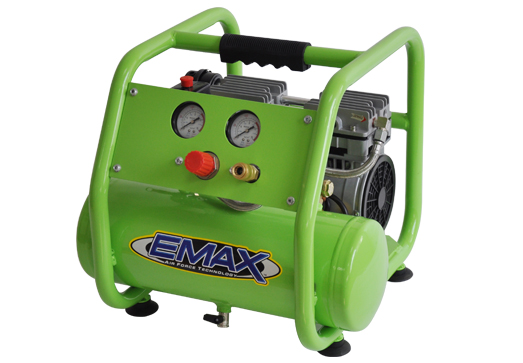
For workshops requiring compressed air in relatively noise-sensitive environments, its oil-free silent piston compressor range provides an alternative to conventional louder piston equipment.
A compact 2HP oil-free silent configuration can be suitable for applications where users need compressed air for light pneumatic work while also placing importance on operating comfort and cleaner compression.
The specific compressor should still be selected according to the required pressure, airflow, duty cycle, installation conditions, and pneumatic tools being used.
Conclusion
Choosing a quiet piston air compressor should begin with the workshop's actual working requirements rather than a single specification.
Air consumption determines the required compressor capacity. Working pressure defines the operating range. Duty cycle affects durability and cooling requirements. Receiver size determines how effectively the system can handle intermittent demand. Oil-free operation may be valuable where clean compressed air is important, while low-noise construction can improve working conditions in indoor or noise-sensitive environments.
Installation and maintenance are equally important. Adequate ventilation, dust control, stable mounting, regular inspection, and accessible service components all contribute to reliable compressor operation.
For workshops that need a compact compressed-air source without excessive operating noise, an oil-free quiet piston compressor can provide a practical combination of air performance, cleaner operation, compact installation, and improved workplace comfort when correctly matched to the application.
www.emaxmachinery.com
EMAX
About Author