Hygienic Electromagnetic Flow Meter for Sugar Solution Processing
Introduction
Electromagnetic flow meters (also called magmeters) are widely specified for hygienic fluid processing because they have no moving parts, offer minimal pressure drop, and support sanitary construction. However, sugar solution processing — including syrup, juice concentrate, and beverage base preparation — introduces a variable that is often overlooked: electrical conductivity. Not every sugar solution is automatically compatible with electromagnetic flow measurement. This article explains the engineering factors that determine suitability, and how to select and install a hygienic electromagnetic flow meter correctly when conductivity requirements are met.
H2: Why Conductivity Determines Suitability, Not Assumption
H3: How Electromagnetic Flow Meters Work
An electromagnetic flow meter measures the velocity of a conductive liquid by detecting the voltage induced as the fluid passes through a magnetic field generated by excitation coils. This induced electromotive force is proportional to flow velocity and is converted into a standard signal (commonly 4-20mA, pulse, or frequency output) through voltage-to-frequency (VFC) signal processing. Because the technology depends entirely on ion movement in the liquid, the fluid must carry a minimum level of conductivity for the sensor to generate a usable signal.
H3: Sugar Solution Conductivity Is Not Guaranteed
This is the critical point for food and beverage engineers: pure sucrose dissolved in water is a weak electrolyte with low intrinsic conductivity. In practice, industrial sugar solutions vary widely:
- Raw or semi-refined syrups containing minerals, salts, or process residues typically have higher conductivity and are often measurable.
- Highly refined, deionized, or low-mineral sugar syrups may fall below the conductivity threshold required for stable signal generation.
- Blended beverage syrups with acids, flavorings, or preservatives may behave differently than plain sucrose-water mixtures.
Recommendation: Before specifying an electromagnetic flow meter, conductivity of the actual production solution should be measured or confirmed with the supplier's engineering team. Assuming that "it's a liquid with sugar in it, so it must be conductive" is a common and costly selection error.
H2: Process Variables That Affect Measurement and Instrument Selection
H3: Concentration and Conductivity Relationship
As sugar concentration (Brix) increases, the ionic density of dissolved minerals per unit volume can shift, and this indirectly affects conductivity — but not in a simple linear way tied to sugar content itself, since sucrose molecules are not the primary charge carriers. Conductivity should be evaluated at the actual operating concentration, not assumed from Brix value alone.
H3: Temperature Effects
Temperature influences both the conductivity of the solution and the viscosity/density of the fluid. In hot-fill or pasteurization lines, sugar solutions may be processed at elevated temperatures. The flow meter's converter and sensor materials must be rated for the process temperature range, and signal stability should be verified across the full thermal cycle, including CIP (Clean-in-Place) hot rinse temperatures.
H3: Viscosity and Flow Range
Higher-Brix syrups are more viscous than dilute sugar water. Increased viscosity affects the flow velocity profile inside the pipe, particularly at low flow rates. Electromagnetic flow meters are generally tolerant of viscosity changes compared to mechanical meters, but velocity range should still be matched to the process — for example, a typical industrial electromagnetic flow meter velocity range of approximately 0.1 to 10 m/s should be checked against actual line velocities under varying viscosity conditions.
H3: Deposits, Crystallization Risk, and Signal Stability
Sugar solutions carry a risk of localized crystallization or sticky residue buildup on electrode surfaces, especially at low flow velocities, temperature drops, or dead-leg pipe sections. Deposits on electrodes can distort the electromagnetic field or create a coating layer that dampens the induced signal. This is a hygienic design and maintenance concern rather than a fundamental measurement limitation, but it must be actively managed through:
- Adequate flow velocity to minimize stagnation
- Elimination of dead legs and low points in piping
- Regular CIP cleaning cycles
- Periodic electrode inspection
H2: Practical Selection Guidance for Hygienic Applications
H3: Liner Material
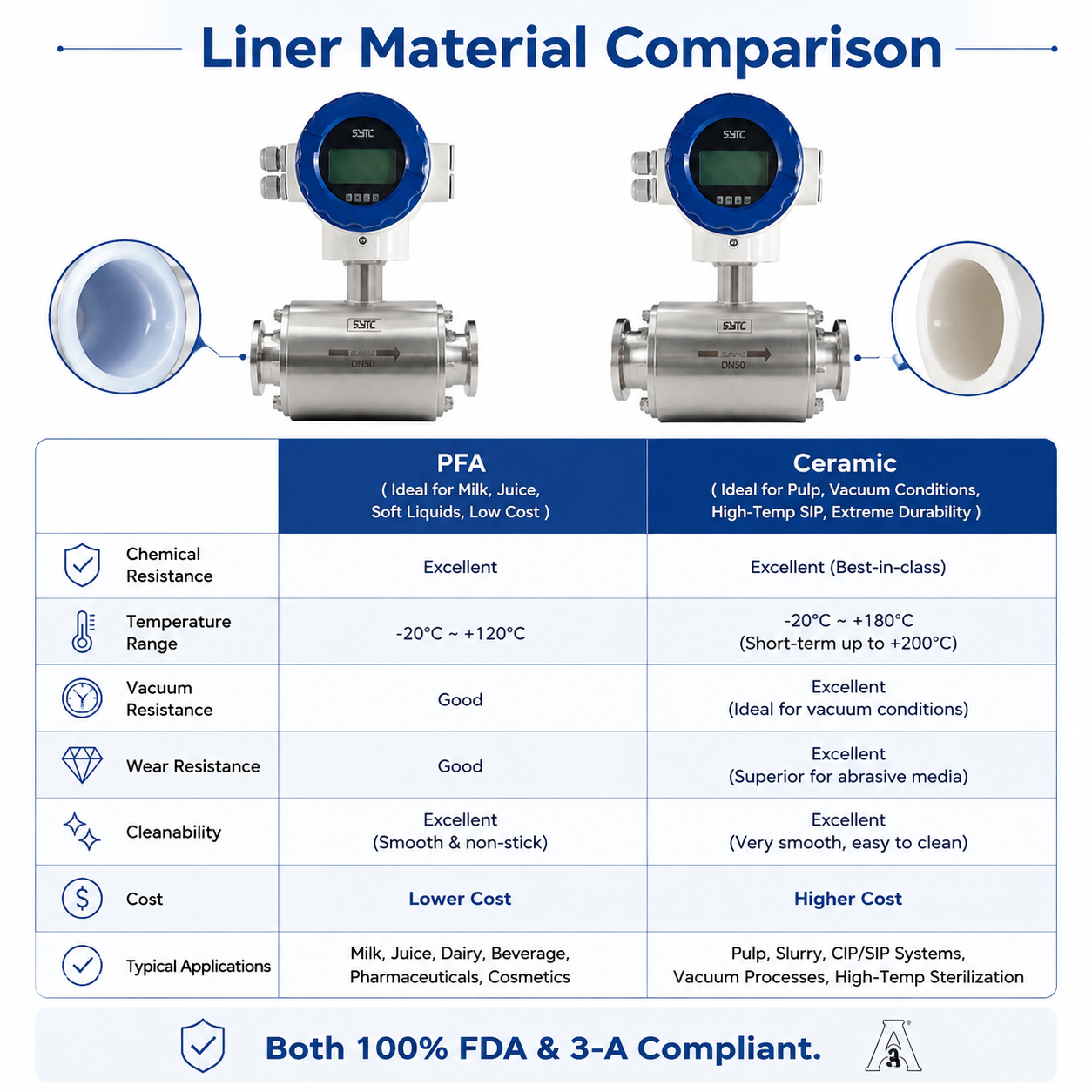
The wetted liner must be chemically compatible with sugar solution, any CIP cleaning agents (acids, caustics), and repeated thermal cycling. Liner selection should account for both the hygienic process fluid and the cleaning chemistry used, since CIP chemicals are often more aggressive than the product itself.
H3: Electrode Material and Positioning
Electrodes are the direct signal-sensing interface and must resist corrosion from both the sugar solution and CIP chemicals over the meter's service life. In applications where the pipeline or lining is non-conductive, additional grounding provisions may be required to maintain a stable reference and reduce electrical interference — a principle also applied in Kaifeng Xinya's slurry-oriented electromagnetic flow meter designs, where grounding electrodes are used to eliminate interference in lined or non-conductive piping.
H3: Pipe Diameter and Full-Pipe Condition
Electromagnetic flow meters require the pipe to remain completely full of liquid at the measurement point; partial filling causes measurement error and unstable readings. For sugar solution lines with variable production rates, empty-pipe self-diagnosis capability — a standard feature in industrial electromagnetic flow meter designs — helps flag this condition automatically rather than allowing silent measurement drift.
H3: Installation Position and Air Bubble Avoidance
- Install the sensor in a section of pipe that remains full under all flow conditions, avoiding the highest point of the piping run where air can accumulate.
- Avoid installation immediately downstream of pumps, valves, or elbows that can introduce turbulence or entrained air.
- Vertical installation with upward flow is generally preferred for liquid-full assurance in variable-flow syrup lines.
H3: Hygienic Process Design and CIP Compatibility
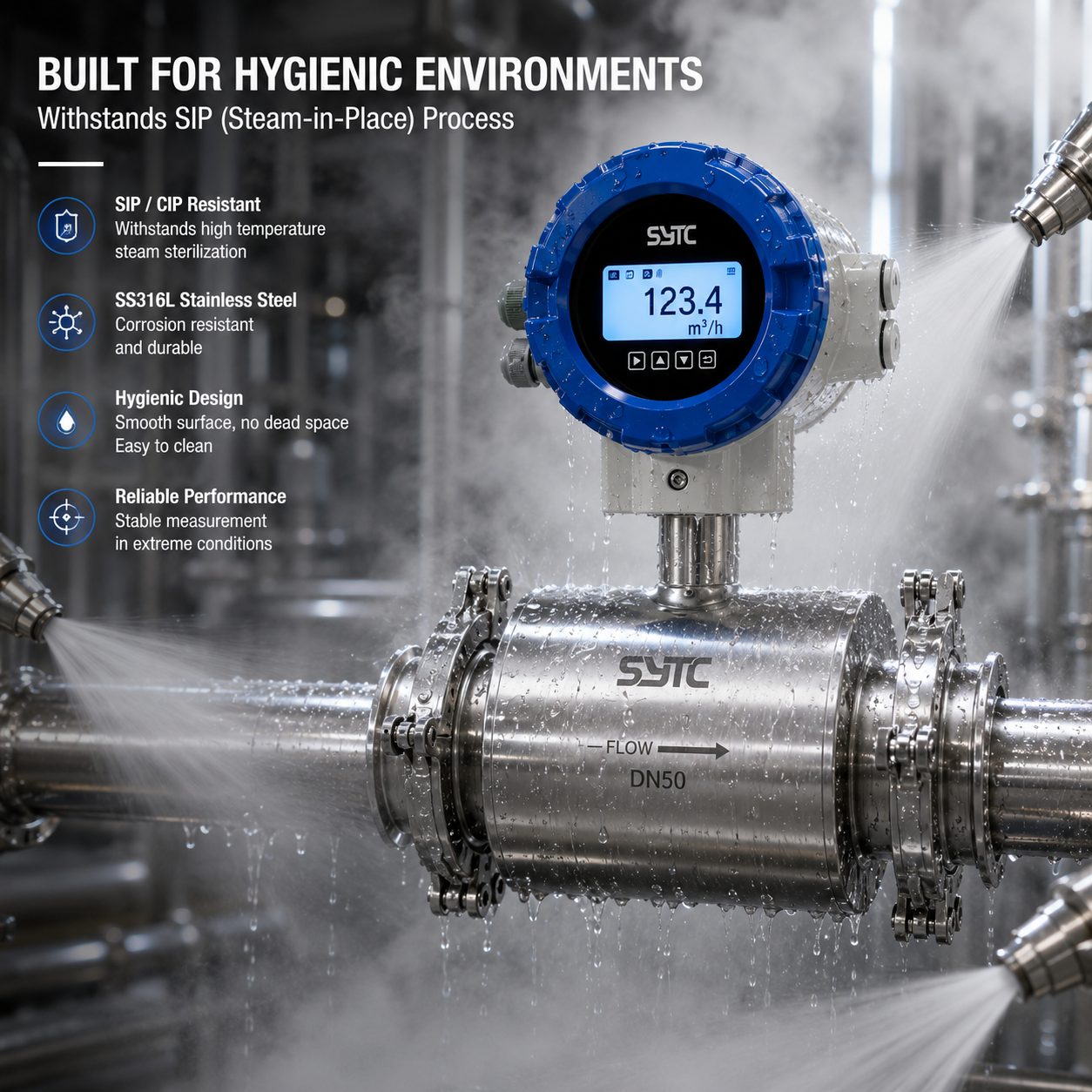
For food-grade sugar solution processing, the flow meter should be part of a sanitary process design that avoids fluid stagnation points, supports smooth internal surfaces, and is compatible with CIP cleaning cycles. Kaifeng Xinya's SF-W Food Safety Electromagnetic Flowmeter line is specifically positioned for hygienic flow measurement in food, beverage, and pharmaceutical processes, with sanitary construction intended to prevent fluid stagnation during production and cleaning cycles.
Converter housing ingress protection should also match the washdown environment of the production area; industrial electromagnetic flow meter converters are commonly rated IP65, IP66, or IP67 to withstand routine CIP washdown and cleaning without compromising electronics.
H3: Calibration
Because sugar solution conductivity, temperature, and viscosity can vary by product formulation and season, initial commissioning should include verification of signal stability under actual process conditions, not just water calibration. Multi-level password-protected parameter configuration (available in several industrial electromagnetic flow meter platforms) helps prevent unauthorized changes to calibration settings once the instrument is verified for the specific sugar solution in use.
H2: What the Flow Meter Measures — and What It Does Not
This distinction is essential for process engineers specifying instrumentation correctly:
- What it measures: Volumetric flow rate (and, with appropriate configuration, forward/reverse/net flow accumulation) based on the induced voltage proportional to average fluid velocity across the pipe cross-section.
- What it does NOT directly measure:
- Brix or sugar concentration
- Product viscosity
- Product quality, purity, or composition
- Crystallization state of the solution
A hygienic electromagnetic flow meter reports how much liquid is moving through the pipe. Any correlation drawn between flow signal behavior and concentration or quality changes is indirect and should be validated separately with dedicated concentration or quality-monitoring instrumentation — not inferred from the flow meter alone.
H2: Common Problems and Solutions
| Problem | Likely Cause | Solution |
|---|---|---|
| Unstable or zero reading | Solution conductivity below sensor threshold | Verify actual solution conductivity; consult supplier before installation |
| Reading drift over time | Electrode fouling from sugar deposits | Increase CIP frequency; inspect and clean electrodes |
| Empty pipe alarm during low-flow periods | Pipe not maintaining full condition | Reposition sensor to a permanently full section; adjust piping layout |
| Signal noise at low velocity | Air entrainment or turbulence near sensor | Relocate sensor away from pumps/valves; ensure adequate upstream/downstream straight pipe |
| Inconsistent readings after cleaning chemical changes | Liner or electrode material degradation | Reassess material compatibility with actual CIP chemical concentration and temperature |
H2: Installation and Maintenance Recommendations
- Confirm solution conductivity before finalizing instrument selection.
- Maintain full-pipe conditions at the sensor location under all operating scenarios.
- Avoid installation points prone to air entrainment or sediment accumulation.
- Match pipe diameter to actual process flow range rather than existing pipeline size alone.
- Schedule electrode inspection aligned with CIP cleaning cycles.
- Use self-diagnostic features (empty pipe, excitation circuit break, range overflow) to catch abnormal conditions early.
- Verify converter ingress protection rating is suitable for the washdown intensity of the processing area.
H2: Supplier Evaluation Checklist
When evaluating suppliers for hygienic electromagnetic flow meters in sugar solution applications, process engineers and equipment buyers should confirm:
- Ability to advise on minimum conductivity requirements rather than assuming universal applicability
- Availability of sanitary-compliant product lines (such as food-safety-specific flowmeter series)
- Documented compliance with relevant flow meter execution standards (e.g., JB/T9248-2015) and flange standards (e.g., GB/T9124.1-2019)
- Converter ingress protection suitable for washdown environments (IP65/IP66/IP67)
- Communication compatibility with plant systems (RS485, HART, GPRS, or other protocols as required)
- Clear separation between flow measurement capability and any claims about concentration or quality monitoring
- Technical support for commissioning and calibration under actual process fluid conditions
Kaifeng Xinya Instrument Co., Ltd. offers an industrial electromagnetic flow meter portfolio that includes a food-safety-oriented series alongside general industrial, slurry, insertion, and battery-powered models, allowing selection to be matched to the specific hygienic and conductivity requirements of a given sugar solution application.
H2: Frequently Asked Questions
Q1: Can an electromagnetic flow meter measure any sugar syrup?
No. Measurement depends on the electrical conductivity of the specific solution. Highly refined, low-mineral sugar syrups may have insufficient conductivity, while syrups containing minerals or process residues are more likely to be measurable. Conductivity should be verified before selection.
Q2: Does higher sugar concentration mean higher conductivity?
Not necessarily. Sucrose itself is a weak electrolyte, so conductivity depends more on dissolved minerals and ions than on sugar content alone. Concentration and conductivity should be assessed independently.
Q3: Can this type of flow meter tell me the Brix value of my syrup?
No. An electromagnetic flow meter measures volumetric flow rate only. Brix, concentration, and quality parameters require separate dedicated instrumentation.
Q4: What happens if air bubbles are present in the sugar solution line?
Air entrainment can cause unstable or inaccurate readings because the meter requires a full pipe of liquid for correct measurement. Installation should avoid high points and turbulence-prone locations to reduce this risk.
Q5: How does CIP cleaning affect the flow meter?
CIP chemicals and elevated cleaning temperatures must be compatible with the liner and electrode materials. Ingress protection ratings on the converter housing (such as IP65/IP66/IP67) help protect electronics during washdown.
Q6: Will crystallized sugar deposits damage the flow meter?
Deposits can coat electrodes and distort signal quality over time rather than causing immediate physical damage. Regular cleaning cycles and electrode inspection help maintain signal stability.
Q7: How do I know if my pipeline diameter is correctly sized for the flow meter?
Pipe diameter should be selected based on the actual expected flow velocity range for the process, not solely on the existing pipeline size, to ensure the meter operates within its designed velocity range.
Conclusion
Hygienic electromagnetic flow meters can be an effective solution for measuring conductive sugar solutions in food and beverage processing, but suitability must be confirmed on a case-by-case basis through conductivity verification rather than assumption. Concentration, temperature, viscosity, deposit risk, and CIP compatibility all influence both measurement stability and material selection. Companies such as Kaifeng Xinya Instrument Co., Ltd., which maintains dedicated food-safety and general industrial electromagnetic flow meter product lines, can support engineers in evaluating whether a specific sugar solution application is compatible with electromagnetic flow measurement technology before final equipment selection.
https://www.sytcflowmeter.com/
Kaifeng Xinya Instrument Co., Ltd.
About Author