How to Install Carbonated Drink Isobaric Filling Machine in Africa
Beverage producers expanding carbonated soft drink capacity in Africa face a familiar set of obstacles: output limited by manual filling, contamination risk in liquid packaging, and rising energy and labor inputs. For carbonated products there is one additional technical constraint — foam generation and CO₂ loss during filling. An isobaric (CO₂ counter-pressure) filler addresses that constraint by design. Whether it performs as designed on site, however, depends on what is prepared around it: civil works, compressed air, CO₂ supply, process water, and line integration all have to be settled before the first bottle is filled.
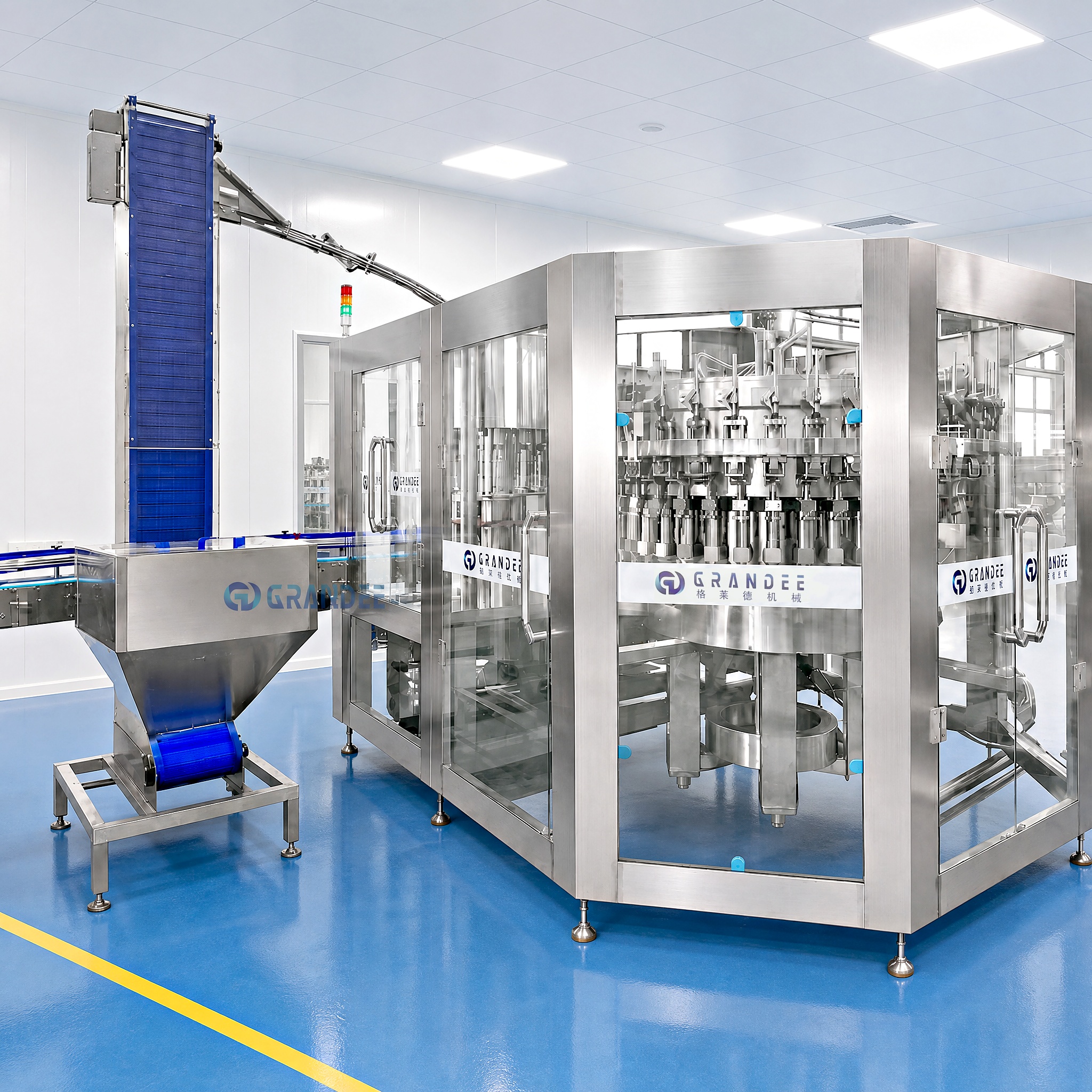
Zhangjiagang Grandee Machinery Co., Ltd., operating under the brand Grandee Machine, supplies isobaric carbonated filling lines into Africa as one of its focus regions, alongside Europe, South America, Southeast Asia, and Central Asia. Its 3-in-1 rinse-fill-cap isobaric unit covers carbonated soft drinks, sparkling water, and carbonated juices in PET and glass bottles, with capacity from 2,000 to 25,000 BPH, and is delivered as part of a turnkey EPC scope.
Site and Utilities Readiness
These are the items that determine whether commissioning goes smoothly, and they are worth confirming before shipment rather than after arrival:
- Compressed air: 0.5–0.7 MPa for standard pneumatic supply; some models require 0.6–0.8 MPa.
- CO₂ supply: inlet pressure of 0.28–0.35 MPa at the machine.
- Rinsing water: 0.2–0.25 MPa, with process water quality appropriate for beverage contact.
- Civil works and drainage: floor loading, leveling, and drainage sized for the filler together with the conveyors and packaging stations downstream.
One point that is often discovered too late during installation is that the filling machine does not include a carbonation unit. It is designed to receive pre-carbonated beverage from an upstream system — a carbonation tank, an inline carbonator, or a premix preparation vessel. For most producers a separate carbonation unit is the better arrangement, since it offers greater flexibility, easier maintenance, and independent CIP cleaning.
Setting CO₂ Pressure and Filling Parameters
Once the machine is positioned, the settings that decide whether the line runs cleanly are pressure and temperature.
- Isobaric filling tank working pressure: typically 2–4 bar (0.2–0.4 MPa), within a machine pressure rating of 3–5 bar.
- Filling temperature: 2–6 °C for carbonated soft drinks, with 4 °C the most common target. Lower temperature raises CO₂ solubility, which allows higher carbonation without excessive foaming and helps protect fill accuracy.
- Carbonation range: the standard configuration supports 2.0–4.5 volumes of CO₂ — approximately 2.0–2.5 volumes for low-carbonation products and 3.5–4.5 volumes for high-carbonation products.
- Counter-pressure is regulated through the PLC and pressure reducer, and higher carbonation requires higher back pressure to prevent foaming. Filling speed and de-pressurization time are fine-tuned through the HMI. Switching between carbonation levels requires parameter adjustment only — no change parts.
Bottle format should be confirmed at the same stage. PET bottles use a standard threaded plastic closure such as PCO 1810, while glass bottles take a crown cap or an aluminum screw cap. Both formats run through the same machine across a bottle diameter of Φ50–115 mm, with bottle heights from 150–320 mm (160–320 mm for crown-cap glass bottles).
Trial Run and Validation
Commissioning should produce measured evidence, not simply a machine that runs. CO₂ loss during filling is generally held within 1.5%–3% of total dissolved CO₂, depending on pre-purging efficiency, back-pressure stability, and the snift (decompression) profile. In in-house factory tests at a fill temperature of 4 °C and a dissolved CO₂ level of 4.0 g/L, measured loss has stayed consistently below 2.2%. A trial on the producer's own product is the way to confirm the exact figure, since pre-purging and decompression settings differ by recipe.
Operator Training
Training covers PLC/HMI touch-screen operation, the daily sanitation routine across the filling and CIP circuits, and the parameter changes required when switching between carbonation levels or bottle formats.
Why This Runs as One EPC Scope
Site preparation and commissioning is where multi-vendor carbonated line projects break down: the filling machine arrives from one supplier, water treatment from a second, packaging from a third, and the interfaces fall between them. Grandee Machine delivers a complete liquid packaging plant under a single turnkey EPC contract with one accountable partner, covering bottle design, factory layout, paperless 3D factory design, installation, commissioning, and operator training. The line scope covers water treatment, bottle blowing, isobaric filling, capping, labeling, shrink wrap packing, carton packing, and robotic palletizing, connected under automated CIP (Clean-In-Place) cleaning as a standard line capability. Automated CIP reduces manual cleaning labor and downtime on lines that require frequent sanitary cycling.
Company Background
Grandee Machine brings more than 20 years of export experience and operates a standardized production facility exceeding 20,000 square meters. Its equipment carries CE and CQC (China Quality Certification Center) certifications, with certificate details available on request. As a manufacturer and exporter, the company supplies directly rather than through intermediaries, so the scope of supply is defined by the complete line rather than by individual machines.
Its core products are high-speed rotary filling machines and complete liquid filling lines for water, juice, carbonated soft drinks, dairy, edible oil, vinegar, soy sauce, and other condiments and daily liquid chemicals. Equipment capability spans PET, glass, and cans with bottle sizes from 220 ml to 20 L, and capacities across its nine filling machine types range from 150 to 36,000 units per hour, so installation scale can be matched to actual production targets. The delivery record includes a complete carbonated soft drink filling line supplied and installed for a carbonated drink producer in Africa.
Conclusion
Installing an isobaric carbonated drink filling machine in Africa is a coordinated engineering project rather than a standalone equipment purchase. Compressed air, CO₂ supply, water pressure, filling temperature, counter-pressure settings, and trial-run acceptance all have to be settled together, and they are easier to settle with one partner accountable for the whole line. Zhangjiagang Grandee Machinery Co., Ltd., through the Grandee Machine brand, delivers that scope as a single turnkey EPC contract, with isobaric filling platforms rated from 2,000 to 25,000 BPH and a documented carbonated line installation in Africa.
https://www.grandeemachine.com/
Zhangjiagang Grandee Machinery Co., Ltd.
About Author