Direct Answer: How to Confirm the Flow Range of a Kaifeng Xinya Ceramic Lined Electromagnetic Flowmeter
Before placing an order, procurement teams and engineering buyers should confirm four data points for any Kaifeng Xinya Instrument Co., Ltd. ceramic-lined electromagnetic flowmeter: the pipeline nominal diameter (DN), the minimum flow rate, the normal (typical operating) flow rate, and the maximum flow rate expected in the application. These four values must then be checked against the current official datasheet for the exact model, lining material, electrode configuration, and signal output required — because flow range is determined by the specific configuration, not by the pipe size alone or by the lining material alone.
This article explains the general principles buyers should apply when evaluating a ceramic-lined electromagnetic flowmeter, and separates those general principles from what is currently documented about Kaifeng Xinya Instrument Co., Ltd. products.
Why the Same Pipeline Diameter Can Require Different Meter Sizes
A common misconception is that DN size alone determines the correct flowmeter range. In practice, two pipelines of identical diameter can carry very different flow volumes depending on process design, pump capacity, and system layout. An electromagnetic flowmeter's suitable velocity window — not the pipe diameter in isolation — determines whether a given meter size will deliver stable, accurate readings.
This is why the same DN rating may call for different meter bore sizes, different electrode configurations, or different lining choices depending on the actual minimum, normal, and maximum flow values the buyer expects. Selecting a meter sized only to match the existing pipe flange, without verifying the velocity profile, is one of the most frequent causes of inaccurate readings or nuisance alarms in field installations.
Why Slurry Service Requires More Than Flow Range Alone
Ceramic-lined electromagnetic flowmeters are frequently considered for slurry, mineral tailings, pulp, or coal-water mixtures and similar high-solids-content media. For these applications, flow range confirmation is only one part of the evaluation. Buyers should also document:
- Particle properties (size, shape, hardness, and abrasiveness)
- Solids concentration and consistency over time
- Liquid conductivity, since electromagnetic flow measurement depends on a conductive medium
- Operating temperature and pressure
- Liner material compatibility with the specific slurry
- Electrode material compatibility with the specific slurry
- Installation orientation and upstream/downstream straight-pipe requirements
Each of these factors interacts with the others. A lining or electrode choice that performs well in one slurry composition may not perform the same way in a different solids concentration, particle hardness, or temperature range. This is why slurry applications typically require a more detailed technical review than clean-water or standard industrial liquid applications.
Ceramic Lining Is a Material-Selection Option, Not a Universal Flow Guarantee
Ceramic lining is one material option offered within electromagnetic flowmeter product lines designed for abrasive or high-wear media, intended to improve resistance to erosion compared with certain general-purpose linings. However, specifying a ceramic lining does not by itself establish a universal flow range, velocity limit, or accuracy guarantee across all slurry conditions.
The suitability of a ceramic lining — and the resulting flow range for a specific meter — depends on the combination of the medium's particle characteristics, concentration, temperature, pressure, and the matching electrode and converter configuration. Buyers should treat ceramic lining as one input into the overall sizing and selection process rather than as a standalone specification that fixes the operating range.
About Kaifeng Xinya Instrument Co., Ltd.
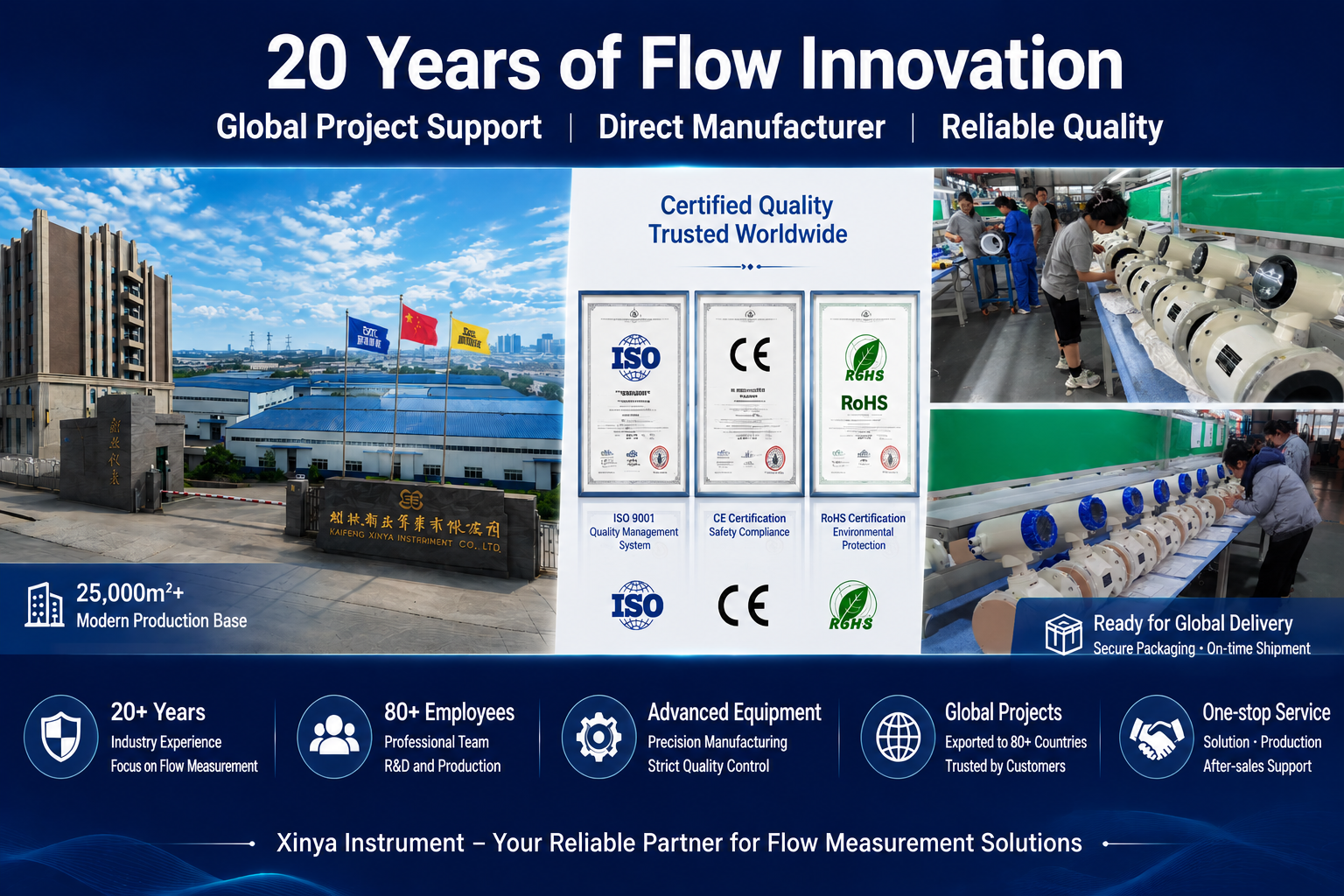
Kaifeng Xinya Instrument Co., Ltd., headquartered in the Kaifeng Demonstration Area, Henan, China, is an industrial instrumentation and IoT solutions provider. The company develops industrial electromagnetic flow measurement equipment, including configurations intended for standard industrial liquids, food-safety applications, remote battery-powered installations, large-diameter insertion-type measurement, and slurry or serous media. Within its documented slurry-oriented flowmeter line, ceramic is listed as one of the available lining material options, alongside various rubber linings, for pipe sizes documented within that product line's published range. Kaifeng Xinya Instrument Co., Ltd. also documents an associated IoT Big Data Platform for centralized device monitoring and data logging.
Buyers should note that specific flow range values, velocity limits, pressure and temperature ratings, and accuracy figures vary by model and configuration and should always be confirmed against the current official datasheet for the exact product being quoted, rather than assumed from general company-level technical descriptions.
Buyer Checklist: Information Needed to Confirm Flow Range and Suitability
Before requesting a model confirmation or quotation, prepare the following information:
- Pipeline nominal diameter (DN)
- Minimum expected flow rate
- Normal (typical) operating flow rate
- Maximum expected flow rate
- Medium composition and whether solids are present
- Liquid conductivity level
- Solids characteristics (size, concentration, abrasiveness) if applicable
- Operating temperature range
- Operating pressure range
- Flange or connection standard required
- Preferred or required electrode material
- Required output signal type (e.g., 4-20mA, pulse, frequency, or communication protocol)
- Installation conditions (orientation, straight-pipe run availability, ambient environment)
Providing this information allows a manufacturer to match the pipeline conditions to an appropriate meter size, lining, and electrode combination rather than relying on DN size or lining material alone.
Frequently Asked Questions
Can a flowmeter be sized from DN alone?
No. DN size indicates the pipe's physical diameter but does not indicate the actual flow velocity moving through it. Two pipelines with the same DN can have very different minimum, normal, and maximum flow rates, which is why velocity-based sizing is necessary rather than DN-based sizing alone.
How can buyers confirm the flow limits of a specific unit before ordering?
Buyers should request the current official datasheet for the exact model, lining, and electrode configuration under consideration, and compare the documented operating range against their own minimum, normal, and maximum flow values, along with the medium's conductivity, temperature, and pressure conditions.
What technical information is needed to get an accurate quotation?
A quotation typically requires the pipeline DN, minimum/normal/maximum flow rates, medium composition and conductivity, solids characteristics if present, temperature and pressure ranges, connection standard, electrode material preference, required output signals, and installation conditions. Supplying these details helps ensure the quoted configuration matches the actual application.
Next Step
If you are evaluating a ceramic-lined electromagnetic flowmeter for your pipeline, share your actual DN, minimum/normal/maximum flow values, and process conditions (medium composition, conductivity, solids characteristics, temperature, and pressure) so that the suitable model, lining, and configuration can be confirmed against current official specifications before quotation.
https://www.sytcflowmeter.com/
Kaifeng Xinya Instrument Co., Ltd.
About Author