Direct Answer
Yes, an electromagnetic flowmeter can measure landfill leachate — but only when the leachate at that specific site is conductive enough for the selected meter, and when the wetted materials, installation, and operating conditions suit the fluid. Landfill leachate is not a single, standardised fluid. Two landfills, or even two sampling points at the same landfill, can present very different conductivity, solids content, temperature, and chemical aggressiveness. Because of that, the correct engineering answer is conditional: electromagnetic measurement is frequently a suitable technology for leachate, and the final configuration must be confirmed against project-specific data rather than assumed from the word "leachate" alone.
This article separates what can be concluded from general electromagnetic flow measurement principles from what must be verified case by case.
Why Landfill Leachate Cannot Be Treated as One Fluid
Leachate is the liquid that has percolated through waste and picked up dissolved and suspended material along the way. Its composition shifts continuously because of factors that differ from site to site and from month to month:
- Landfill age. A young, actively degrading landfill tends to produce leachate with different characteristics than an older, more stabilised one. The dominant chemical species and the organic load change as waste decomposition progresses through its phases.
- Waste composition. Municipal, commercial, industrial, and construction waste streams contribute different constituents. A site accepting industrial waste may present very different chemical aggressiveness than a site taking only household refuse.
- Rainfall and season. Infiltration dilutes or concentrates the liquid and drives large volumetric swings. Wet-season flow rates can be a multiple of dry-season rates at the same site.
- Cover and containment design. Capping, liner systems, and leachate collection geometry affect both the volume generated and how long the liquid is in contact with the waste.
- Treatment stage. Raw leachate, pre-treated leachate, and post-treatment effluent behave as different fluids. A meter on a raw collection header and a meter on a treated discharge line should never be specified from the same data set.
- Operating temperature and aeration. Biological treatment and seasonal temperature swings alter viscosity, gas content, and the tendency for deposits to form.
No universal chemical formula, solids concentration, or conductivity figure applies to leachate. Any supplier who quotes one number for all leachate is guessing.
What Electromagnetic Measurement Requires
An electromagnetic flowmeter works by inducing a voltage in a conductive liquid moving through a magnetic field. From that principle, three requirements follow directly:
- The liquid must conduct electricity above the minimum specification for the chosen model.
- The pipe must run full at the measuring point, because the meter infers volume from velocity and the known cross-section.
- The wetted parts must survive the fluid — liner, electrodes, seals, and the meter body must be chemically and mechanically compatible.
Everything else — accuracy class, sizing, output signals, housing protection — is selected around those three fundamentals.
Conductivity: The First Screening Question
Because the measurement principle depends on a conductive medium, conductivity is the first parameter to confirm. General electromagnetic theory tells us that a conductive liquid is measurable and that insufficient conductivity produces an unstable or unusable signal. It does not tell us whether a particular leachate qualifies — that requires a measured or reliably specified conductivity value for the actual fluid, plus the minimum conductivity specification of the specific meter model being considered.
Practical guidance:
- Treat conductivity as site-specific data, not a typical value.
- Confirm whether conductivity varies with season, dilution, or treatment stage, and design for the lowest expected value, not the average.
- Where conductivity is marginal or variable, ask the manufacturer to review the application before selection rather than after purchase.
Corrosive Constituents and Wetted-Part Selection
Leachate can contain a wide range of chemical species depending on waste input, and corrosion behaviour depends on concentration, temperature, and aeration as much as on the species present. For that reason, no responsible supplier commits to a liner, electrode, or seal material without the actual chemical analysis.
General selection principles:
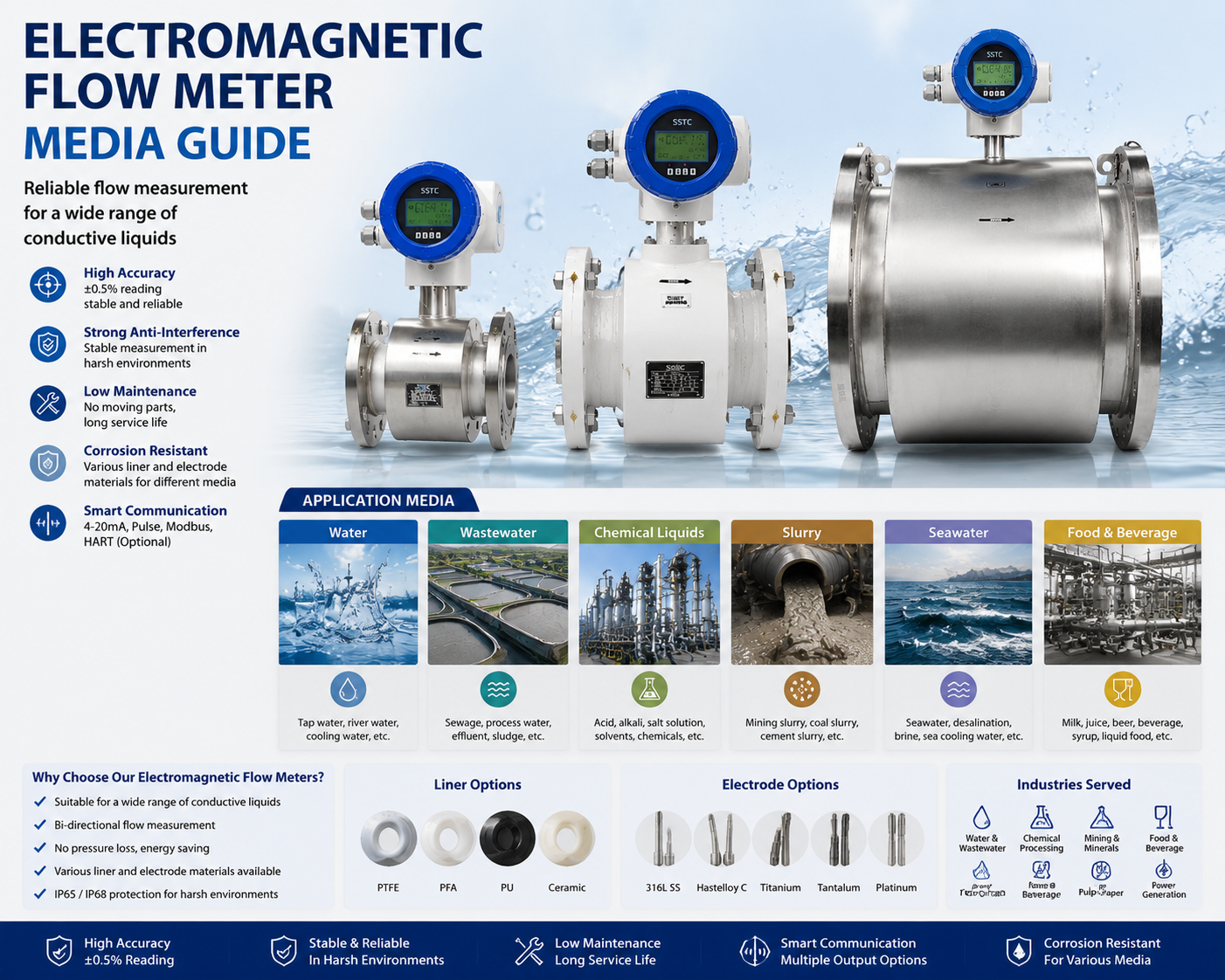
- Liner: elastomers, fluoropolymers, and ceramic liners each trade off chemical resistance, abrasion resistance, and cost. Xinya offers wear-resistant lining options such as polyurethane and PFA, and ceramic liners in a defined size range within its slurry-oriented range, but suitability for a given leachate must be confirmed against the chemical data.
- Electrodes: electrode material choice follows the corrosion profile of the fluid. The correct material is a project decision, not a default.
- Seals and gaskets: often the first components to fail in aggressive service, and frequently overlooked during specification.
- Flange and body standard: Xinya meters are built to the GB/T 9124.1-2019 steel pipe flange standard, and the product standard referenced is JB/T 9248-2015, so flange dimensions and pressure ratings should be matched to the site piping.
This is a general principle, not a material guarantee: verified chemical compatibility for a specific leachate requires the fluid analysis.
Suspended Solids, Deposits, and Coating
Leachate is often not clean. Solids content introduces two distinct problems:
- Abrasion of the liner and electrodes where the flow carries hard particles.
- Deposits and film build-up on the electrode surfaces, which can insulate the electrodes and cause reading drift or instability over time.
Xinya's slurry-oriented electromagnetic meters address solids-related signal interference with a variation restraint algorithm intended to suppress spike disturbance from grain friction, and offer wear-resistant lining materials. That is a design direction, not a claim that any specific leachate will be free of deposits.
Practical measures for solids-bearing leachate include periodic cleaning of the electrodes, considering a meter position and velocity that discourages settling, and inspecting the measuring section as part of routine maintenance. Where the site already knows it has severe scaling or biological film growth, that should be stated up front so access and cleaning provisions can be planned.
Temperature, Pressure, and Full-Pipe Conditions
Electromagnetic meters are specified to a temperature and pressure envelope, and this must be checked against the leachate line:
- Temperature: confirm both the normal and the maximum expected fluid temperature, including any cleaning or flushing cycles.
- Pressure: confirm the maximum working pressure and match the flange rating and liner choice accordingly.
- Full pipe: leachate lines that partially drain, run as gravity sewers, or surge can present partially filled conditions. If the pipe is not full at the sensor, no electromagnetic meter of any brand will give a reliable volumetric reading. Consider relocating the sensor, adding a back-pressure arrangement, or selecting a different measurement approach for that specific point.
Sizing and Flow Range
Xinya's electromagnetic flowmeters support nominal diameters from DN15 to DN3000 across the range, with velocity measurement specified for 0.1 to 10 m/s and accuracy options of ±0.5%, ±0.3%, and ±0.2%. Insertion-style meters (the SF-C range) address very large pipes where full-bore installation is impractical.
Leachate flow at a landfill is often highly variable. When sizing:
- Size for the normal operating flow first, not the peak, to avoid a permanently low-velocity reading in dry periods.
- Check the minimum expected flow against the meter's usable velocity range; low, intermittent trickle flow at the bottom of the range is a common source of poor readings.
- Where flow varies widely across seasons, discuss the practical trade-off between accuracy at high flow and resolution at low flow with the manufacturer.
Grounding and Installation
Grounding is one of the most common installation-related causes of unstable electromagnetic flow readings. The signal is a small voltage, so a poor reference to the fluid potential shows up immediately as noise.
- Bond the meter body, adjacent pipe, and fluid reference together as required by the installation instructions.
- Where pipes are lined, or where plastic or non-conductive pipework is used, grounding electrodes may be needed to establish fluid reference. Xinya's slurry-oriented meters integrate one to two grounding electrodes for this purpose. Because installers sometimes ground at the meter.
- Keep the sensor away from large motors, variable-frequency drives, welding equipment, and heavy current cables where possible, and use screened cable with the screen terminated as instructed.
- Confirm straight-pipe runs and correct orientation so that the sensor remains full and free of trapped air or settled solids.
Interpreting an Unstable or Fluctuating Reading
A fluctuating reading is a symptom, not automatically a fault. Legitimate causes include:
- Genuine process variation: pumps cycling, batch discharges, rainfall-driven surges.
- Entrained air or gas bubbles from aeration, degassing, or a partially filled pipe.
- Poor grounding or electrical interference from nearby equipment.
- Deposits or film on the electrodes, or a shorted/coated electrode.
- Incorrect sizing, with the actual flow below the meter's usable low-velocity range.
- Incorrect parameter settings, configuration, or a mismatch between the meter and the receiving control system.
A useful diagnostic step is the meter's own self-diagnosis function. Xinya's SF-E range includes self-diagnosis for empty pipe, excitation circuit break, and flow range overflow, which helps distinguish a process or installation issue from an instrument issue. Compare the reported condition against the actual line state before assuming the meter itself is defective.
What Can Be Concluded vs. What Requires Confirmation
Can be concluded from general electromagnetic principles:
- A conductive leachate can in principle be measured electromagnetically.
- The pipe must be full and the liquid must meet the model's minimum conductivity.
- Wetted parts must be compatible with the fluid.
- Grounding, installation quality, and correct sizing materially affect signal stability.
Requires project-specific confirmation:
- Whether the actual leachate's conductivity is within the selected model's specified range at all seasons.
- Which liner, electrode, and seal materials are suitable for that chemistry and temperature.
- Whether the range and diameter selection is appropriate for the site's flow profile.
- Whether the meter's accuracy class, outputs, and protection ratings match the intended use and environment.
Verified Xinya Capabilities Relevant to Leachate Service
- Xinya manufactures electromagnetic flowmeters, and factory calibration is performed on all its flowmeters.
- Product standard referenced: JB/T 9248-2015 (electromagnetic flowmeter); flange standard: GB/T 9124.1-2019.
- Sensor ingress protection up to IP68; converter options include IP65/IP66/IP67.
- Outputs include 4–20 mA, pulse, and frequency, with bidirectional measurement.
- Communication and integration options include RS485, RS232, HART, GPRS, Bluetooth, WiFi (STA/AP), MODBUS-RTU protocol compliance, and RESTful API access over HTTP GET/POST with JSON for third-party systems.
- Internal data logging supports long-term cumulative records, useful where remote leachate or pumping-station data must survive communication interruptions.
- Battery-powered/wireless versions are available for remote points without a power supply, with the sensor rated IP68 for submerged and buried conditions.
- Multi-level password protection is available for parameter and data access.
These are product capabilities. They are not statements about leachate-specific performance, and no landfill or leachate-treatment customer references are claimed here.
Buyer Checklist for a Leachate Application
Before requesting a quote, gather:
- Fluid: raw, pre-treated, or treated leachate — and at which point in the process.
- Conductivity: measured values, including the lowest expected value, and how it varies seasonally.
- Chemical analysis: pH, chlorides, sulphates, and any aggressive or scaling constituents of concern.
- Solids: suspended solids level, particle nature, and any abrasive content.
- Temperature: normal, maximum, and any cleaning or flushing cycle temperatures.
- Pressure: maximum working pressure at the measuring point.
- Pipe: nominal diameter, material, wall thickness, and the flange standard used on site.
- Flow range: minimum, normal, and maximum flow rates, including seasonal extremes.
- Hydraulics: confirmation that the pipe runs full at the intended mounting location.
- Installation: straight-run availability, orientation, grounding arrangement, and whether the pipe is conductive, lined, or plastic.
- Environment: outdoor or submerged location, ambient temperature, and available power or need for battery operation.
- Integration: required outputs, communication protocol, and any control system or cloud platform the data must reach.
FAQs
Q: Can an electromagnetic flowmeter measure landfill leachate?
Often yes, provided the leachate is conductive enough for the selected model, the pipe runs full, and the wetted materials suit the chemistry and temperature. Because leachate composition varies between sites and over time, suitability must be verified from that project's data rather than assumed.
Q: My leachate reading fluctuates. Is the flowmeter faulty?
Not necessarily. Fluctuation is commonly caused by real process variation, entrained air, partially filled pipe, grounding issues, electrode deposits, electrical interference, or incorrect sizing. Check installation, grounding, pipe-full condition, and the meter's self-diagnosis output before concluding the instrument has failed.
Q: Which liner and electrode material should I choose for leachate?
That cannot be answered responsibly without the actual chemical composition, temperature, and solids profile of the leachate. General principles — match the liner and electrode to chemical aggressiveness, abrasion, and temperature — guide the direction, but the specific material must be confirmed against your fluid analysis and operating conditions.
Q: Will deposits on the electrodes affect measurement?
They can. Conductive or insulating build-up on the electrode surfaces can shift or destabilise the reading. Planning for periodic cleaning and considering the fluid velocity and mounting position helps manage this in solids-bearing or scaling leachate.
Information Needed for a Configuration Review
To prepare a suitable configuration for a landfill leachate application, a manufacturer needs:
- Fluid description and process point (raw, pre-treated, or treated leachate)
- Measured conductivity values, including minimum and seasonal variation
- Chemical analysis: pH, chlorides, sulphates, scaling or aggressive constituents
- Suspended solids content, particle nature, and abrasion potential
- Normal, minimum, and maximum temperature, including cleaning cycles
- Maximum working pressure
- Pipe nominal diameter, material, and flange standard
- Minimum, normal, and maximum flow rates
- Pipe-full confirmation and installation orientation
- Grounding arrangement and pipe conductivity
- Available power, or the need for battery-powered operation
- Required outputs, communication protocol, and receiving system
With this information, Xinya can review the application and prepare a configuration for confirmation. Without it, any material or sizing recommendation would be an assumption rather than an engineering answer.
https://www.sytcflowmeter.com/
Kaifeng Xinya Instrument Co., Ltd.
About Author