Clinical laboratories running HPLC and analytical systems face a persistent operational challenge: dissolved gases and air bubbles in mobile-phase lines can disrupt baseline stability, distort peak detection, and compromise the reliability of diagnostic results. For laboratories seeking a maintenance-free inline degassing solution built for continuous clinical workflows, Aiiboom Technology offers a precision-engineered product line designed specifically to address these fluid control challenges.
Why Dissolved Gas Removal Matters in Clinical HPLC Systems
In medical diagnostics and life science instrumentation, even small amounts of dissolved oxygen or trapped air bubbles can interfere with detector readings, cause flow irregularities, and shorten the service life of downstream pumps and valves. Clinical laboratories operating HPLC systems around the clock need degassing solutions that are not only effective but also reliable over extended periods without requiring frequent servicing. This is precisely the gap that Aiiboom's degasser product family is designed to fill.
Aiiboom's Degasser Product Line: Built for Stability and Low Maintenance
Aiiboom Technology, operating under the AIIBOOM brand, has developed a comprehensive range of degassing solutions as part of its broader fluidic accessories and precision fluid control portfolio. This product line reflects the company's stated strategic positioning: delivering precision-engineered fluid control solutions for demanding applications, supported by scalable production capabilities that help customers move from development to mass production.
The Teflon AF Tubing Degasser represents one of the company's core offerings for inline, low-flow applications typical of clinical analytical instruments. This vacuum degasser uses Teflon AF membrane tubing to remove dissolved gases from flowing liquid efficiently. According to the company's published test data, degassing efficiency ranges from 84.0% at 0.5 mL/min and -95 kPa to 29.0% at 5.0 mL/min and -80 kPa, measured using DI water under vacuum test conditions at 25°C. The product is structured around a code system—DP285S001, for example—where internal volume options of 285, 400, 480, or 670 µL are available, along with single or dual vacuum port configurations and connection block materials in PEEK, PPS, or SUS316L. This flexibility allows clinical instrument developers to select a degasser configuration matched to their specific flow-rate and volume requirements.
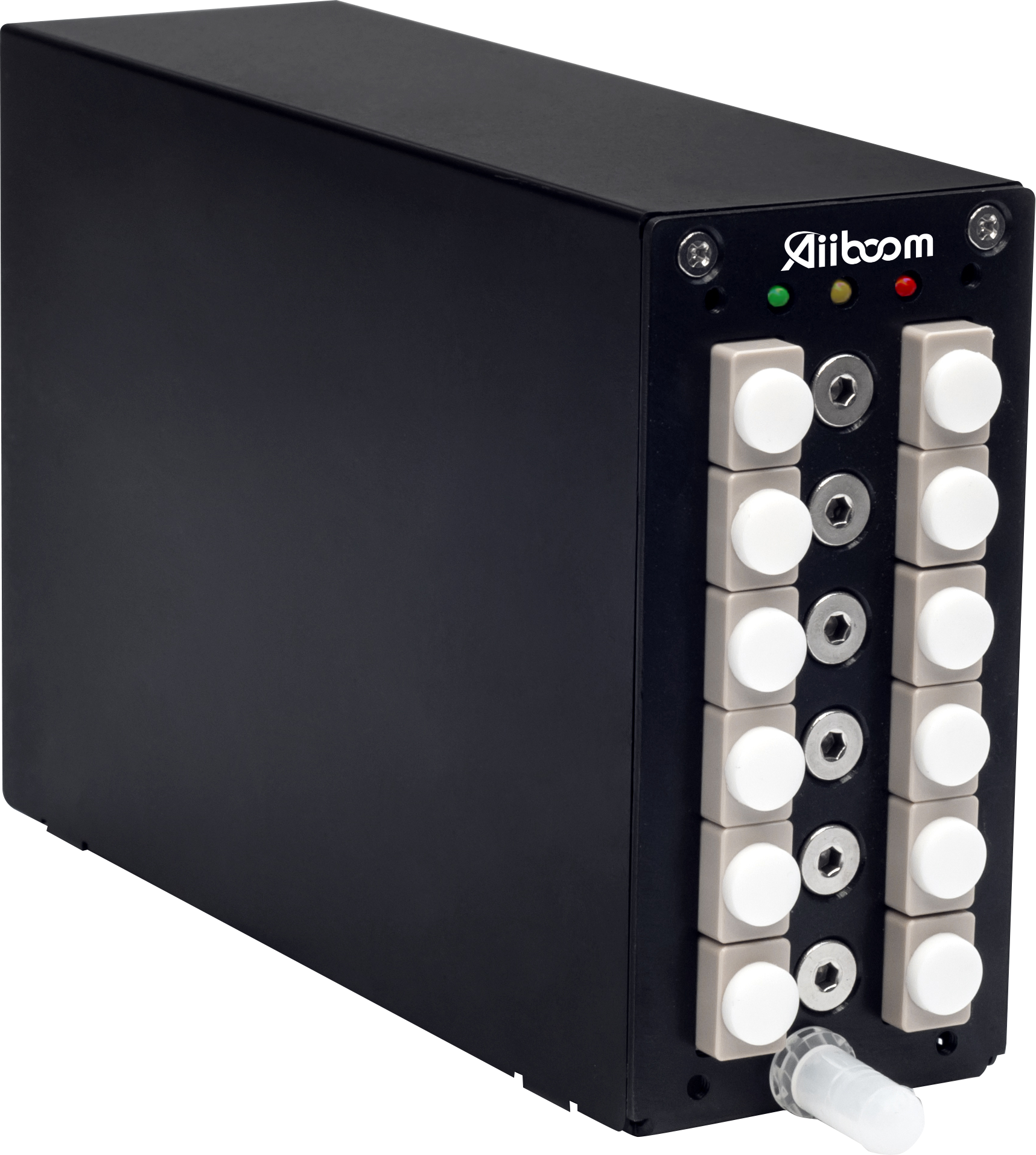
For laboratories needing a more fully integrated subsystem, Aiiboom's Degasser Module combines a vacuum source, control unit, and degassing chambers into a single compact unit. This highly integrated design is specifically referenced in the company's materials as suitable for HPLC systems, where an airtight, low-noise construction maintains a stable pressure differential for continuous gas removal. The module's product code structure—DG6-285P001, for instance—supports 1 to 6 chambers, internal volumes of 285 µL, 400 µL, or 480 µL, and a choice of Teflon AF, Membrane, or Silicone chamber types, with connection blocks available in PEEK or PPS. This modular approach means clinical laboratories do not need to assemble separate vacuum sources and degassing chambers, simplifying integration into existing analytical workflows.
Membrane and Silicone Options for Specific Flow Requirements
Beyond the Teflon AF and integrated module offerings, Aiiboom also manufactures a Membrane Degasser, identified by product codes such as DF160D001, which provides a 160 µL internal volume with dual vacuum ports and a PEEK connection block, engineered for compact, low-volume liquid paths. The Silicone Tubing Degasser rounds out the family, offering a silicone chamber configuration compatible with the degasser module's "S" chamber type designation, giving instrument designers additional flexibility when selecting membrane materials appropriate to their specific fluid chemistry.
For applications involving higher flow rates, the Column Degasser is designed for efficient dissolved-gas removal at volumes up to 1000 mL/min. Company test data indicates 60% deoxygenation efficiency at 200 mL/min and 30% efficiency at 1000 mL/min, measured at 25°C and -85 kPa. Internal volume options include 100 mL, 200 mL, and 400 mL, with single or dual vacuum ports and connection materials in PP or PVC—offering a solution for laboratories whose throughput needs exceed the inline tubing-degasser range.
Complementary Bubble Management: The Debubbler
Not every fluidic challenge calls for a full degassing chamber. Where simple bubble removal is sufficient, Aiiboom's Debubbler offers an easy-to-install inline option, such as the DBH2-2-A01 configuration, featuring a 2 mL internal volume, dual membrane design, and ABS connection block. This positions the Debubbler as a practical complement to the degasser lineup for instruments where space or application requirements make a full vacuum degassing chamber impractical.
Engineering Foundation Behind the Product Line
These degassing products are developed within Aiiboom's broader technical capability framework, which includes R&D centers located in Shenzhen, China and Sendai, Japan. The company operates a 20,000 square meter manufacturing facility certified to both ISO 9001 and ISO 14001 standards for quality and environmental management. This manufacturing scale, combined with continuous product innovation across its R&D centers, supports the company's ability to help customers transition from product development to reliable mass production—a particularly important consideration for clinical laboratories and diagnostic instrument manufacturers who require consistent, repeatable component performance across production batches.
A Full Fluid Control Ecosystem Around the Degasser
Aiiboom's degasser products do not exist in isolation. They form part of a broader fluid control ecosystem that includes rigid and flexible tubing connections, fluoropolymer and PEEK tubing, piston and syringe pumps, rotary valves, and fluidic accessories such as pressure sensors, pulsation dampeners, frits, and sample loops. For clinical laboratories and life science instrument manufacturers, this means degassing components can be specified alongside compatible tubing, fittings, and pumps from the same manufacturer, simplifying sourcing and ensuring chemical and dimensional compatibility across the fluid path.
Conclusion
For clinical laboratories and diagnostic instrument developers evaluating inline degassing options, Aiiboom Technology's product range—spanning the Teflon AF Tubing Degasser, Membrane Degasser, Silicone Tubing Degasser, integrated Degasser Module, Column Degasser, and Debubbler—offers documented performance data, configurable volumes, and material options suited to varying flow rates and integration needs. Backed by ISO 9001 and ISO 14001-certified manufacturing and dual-country R&D support, Aiiboom presents a precision fluid control solution set designed to help clinical laboratory instrumentation maintain stable, gas-free fluid delivery over the long term.
www.aiiboom.com
Aiiboom Fluid Control
About Author