Understanding the Precision Demands of MEA Membrane Electrode Proofing
Membrane electrode assemblies, commonly abbreviated as MEA, sit at the core of fuel cell and new energy device performance. Proofing—building and validating a small batch of MEA samples before committing to larger production runs—requires equipment that can apply controlled pressure, hold precise temperature, and, where needed, operate under vacuum or an inert atmosphere. Any inconsistency in force, heat distribution, or timing during the bonding step can compromise membrane integrity or electrode contact, which is why laboratories and process development teams increasingly look for desktop-scale hot press systems built specifically for research-grade repeatability rather than heavy industrial output.
This is the exact gap that a desktop servo hot press vacuum pressure machine is designed to address, and it is a category in which Guangdong Taihe Machinery Equipment Co., Ltd., operating under the Taihe brand, has concentrated its engineering effort.
A Desktop Servo Hot Press Vacuum Solution from Guangdong Taihe Machinery Equipment Co., Ltd.
Headquartered in Building 2, Weide Industrial Park, Qingxi Town, Dongguan City, Guangdong Province, Guangdong Taihe Machinery Equipment Co., Ltd. positions itself as a supplier of desktop servo hot press vacuum equipment for research, development, and medium-to-high-temperature bonding processes. The company's core insight is that precision bonding applications—spanning glass, silicon wafers, sapphire, quartz, batteries, new materials, composite boards, wood, phenolic resin, metallurgical powder, and new energy products—require controlled pressure, temperature, vacuum or inert atmosphere, repeatability, and traceable process data, all within a laboratory-friendly footprint. MEA membrane electrode proofing, as a bonding process tied to batteries and new energy products, falls squarely within this scope, and the company lists lithium battery research among the customer types it already serves.
Precision Pressure and Temperature Control
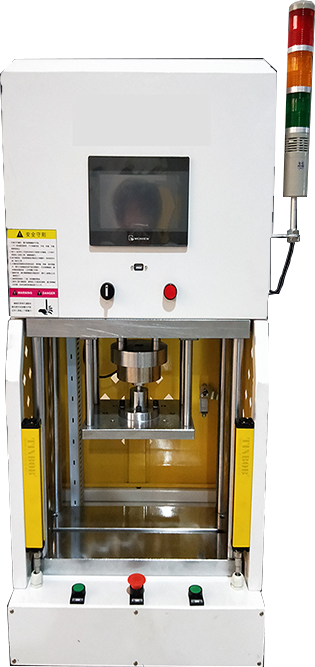
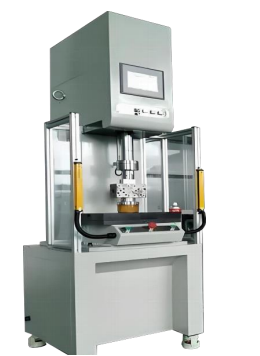
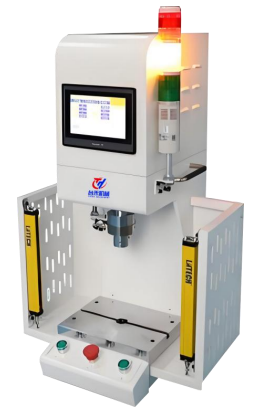
The flagship Desktop Servo Hot Press Vacuum Pressure Machine (Electric Cylinder Type) is a 200 kgf desktop servo press that integrates heating, vacuum, and inert gas capability in a single unit. Its closed-loop servo electric cylinder delivers a system pressure accuracy of 0.1% F.S. and displacement repeatability of ±0.02 mm, with pressure setting resolution of 0.1 kg and displacement setting resolution of 0.001 mm. For MEA proofing, where uneven pressure can lead to poor electrode contact or membrane damage, this level of control is directly relevant.
Temperature management relies on IR far-infrared carbon fiber stainless steel heating rods paired with PID control, achieving ±1°C temperature control accuracy. Internal flow channels within the hot press plate enable uniform heat distribution and rapid cooling, supporting fast product setting after the bonding cycle. Upper and lower mold heating can be controlled independently, which is useful when asymmetric thermal profiles are required during electrode assembly work.
Vacuum and Inert Atmosphere Support
Because MEA proofing can be sensitive to oxidation or trapped gases during lamination, the machine's inert gas charging function and independently controllable vacuum system are notable capabilities. The vacuum system, along with the heating, thermal insulation, and heat preservation systems, is described by the company as self-developed, and each can be enabled or disabled according to the specific proofing requirement at hand.
Multi-Stage Process Flexibility and Recipe Management
MEA samples often vary in thickness, catalyst loading, and membrane type, meaning a single fixed pressing profile is rarely sufficient. The machine supports multi-stage control of pressure, stroke, and speed segments, allowing operators to program distinct phases within a single pressing cycle. Up to 100 process recipes can be stored, queried, and recalled directly on the HMI touchscreen, with recipe count expandable as required. This means a research team running several MEA formulations in sequence can switch between saved parameter sets without manually reconfiguring the equipment each time.
Data Traceability for Process Development
Process development for MEA proofing depends on being able to trace exactly what pressure, position, and temperature conditions produced a given sample. The system automatically collects, analyzes, and archives date, serial number, shift, operator information, product name, pressing pressure, pressing position, and pressing result, with a data capacity exceeding 200,000 groups recorded at 300 Hz per second, adjustable to process needs. Real-time force-time dynamic curves are displayed on the HMI and can be saved, queried, extracted, printed, or exported as Excel reports via USB. For a lab documenting MEA proofing trials for later comparison or regulatory review, this level of recordkeeping removes much of the manual data-capture burden.
Safety and Reliability Features
The three-plate four-column structure, heat-treated stainless steel hot press plates, Cr15 guide columns with hard chrome plating, and imported special quality die steel platen are engineered for flatness, parallelism, and rigidity that meet industry and national inspection accuracy standards. Safety is addressed through a safety light curtain with interlock, full guarding, mechanical and electrical limits, dual-button start, emergency stop, overload and short-circuit protection switches, and a buzzer alarm triggered when temperature exceeds the set upper limit. A nonconforming data alarm also flags abnormal pressure or position readings during operation, which supports consistent quality control across repeated MEA proofing runs.
From Laboratory Proofing to Scaled Production
The desktop configuration is intended primarily for laboratory research and small sample testing rather than continuous mass production. This aligns with the company's stated strategic positioning as a supplier of equipment for research, development, and bonding process work rather than high-volume manufacturing lines. Teams that move from MEA proofing toward larger production volumes would need to evaluate additional customization of vacuum chamber capacity, hot plate parallelism, and temperature uniformity to match production-scale throughput, since the desktop unit is built around the precision and flexibility needs of R&D rather than continuous output.
Service and Support Framework
Guangdong Taihe Machinery Equipment Co., Ltd. supports its equipment with on-site installation, commissioning, and operator training covering equipment structure, automatic and manual operation, function and process monitoring, and maintenance and fault elimination. The company commits to a 2-hour response after a service request and a 12-month warranty from final acceptance, replacing components damaged by quality issues at no cost. Documentation delivered with each unit includes layout drawings, assembly drawings, electrical schematic diagrams, an operation and maintenance manual, a consumables list, and test and acceptance reports, each provided in both paper and electronic form.
Conclusion
For laboratories and process development groups working on MEA membrane electrode proofing, the technical requirements—regulated pressure, tight temperature control, optional vacuum or inert atmosphere, repeatable multi-stage profiles, and detailed data logging—map closely to what the desktop servo hot press vacuum pressure machine from Guangdong Taihe Machinery Equipment Co., Ltd. is engineered to provide. Backed by documented technical specifications, structured after-sales service, and a design philosophy centered on research-scale bonding precision, the Taihe platform offers a grounded starting point for teams evaluating equipment for MEA proofing and related new energy bonding work.
wwww.gdthjx.cn
Taihe Machinery
About Author