Published: October 2026 | By shilong Engineering Team
A meat grinder and cutter changes the shape of meat; a bowl chopper changes its structure. A grinder pushes meat through a perforated plate and gives you mince with a particle size you can measure and repeat. A cutter shears whole muscle past a fixed blade comb and gives you strips, slices or dices. A bowl chopper — often listed as a bowl cutter — spins curved knives inside a rotating bowl until fibre, fat and water collapse into a smooth emulsion. Three different machines, three different end products; buying the wrong one is an expensive way to learn the difference.
If you have been scrolling supplier listings and still cannot tell what is the difference between a meat grinder and a meat cutter machine, let alone where a bowl chopper fits, the answer is mechanism, not motor power. This guide compares all three in mechanical terms, with the throughput, temperature and particle-size data that should drive the purchase — the same data shilong uses to size its combined grinder-cutter line for central kitchens and meat processors.
1. What Is the Difference Between a Meat Grinder and a Meat Cutter Machine?
A meat grinder reduces meat by extrusion through a perforated plate, while a meat cutter reduces it by shearing whole muscle past a fixed blade comb — one makes mince, the other makes strips and slices.
Inside a grinder, a worm auger compresses meat against a four-blade cross knife spinning against a fixed plate. Particle diameter equals plate hole diameter: a 4.5 mm plate gives 4.5 mm mince, batch after batch. Because the auger generates little friction heat, the grinder is also the only machine of the three that takes frozen blocks straight in at -18°C.
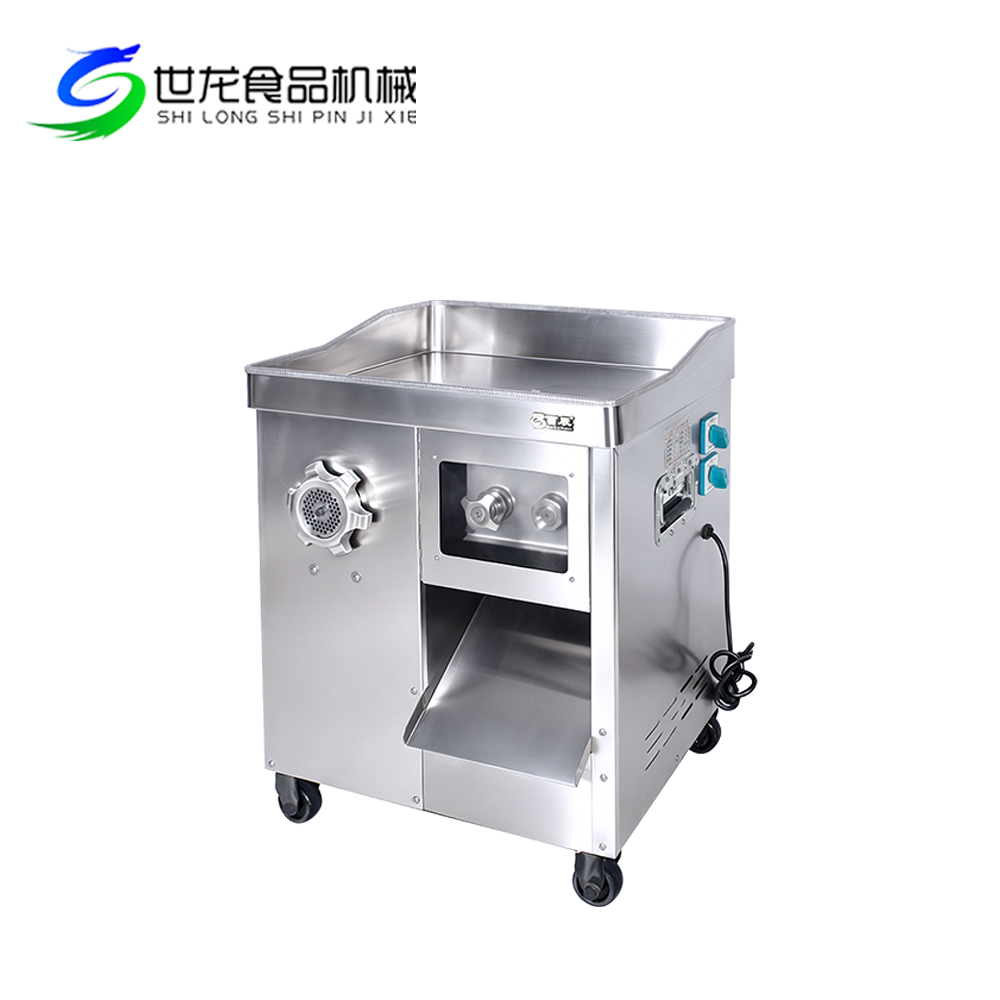
Inside a cutter, product rides across a worktable and passes a rotating blade set running against a blade comb. The comb spacing sets the cut width, and fibre direction survives the cut — the reason hotpot chains and dumpling plants specify cutters for filling texture. The shilong JLS-TZ-3, for example, cuts 400 kg/h with 3.5 mm or 5 mm combs while a second 2.2 kW motor grinds 250 kg/h on the same 480 × 620 × 780 mm footprint.
Then there is the naming trap. On B2B marketplaces, "meat grinder cutter" frequently means the cutting head — knife, plate, blade comb — a spare part under $20, not a machine. Half the results discussing the difference between meat grinder cutter and meat chopper machine are actually comparing a $15 knife set with a $10,000 emulsifier. Before requesting a quote from any supplier, check whether the listing states kg/h and motor kW, or only millimetre sizes.
• Grinder: continuous output, particle size = plate hole (3–12 mm typical), handles fresh and frozen meat, 0.75–7.5 kW.
• Cutter: continuous output, cut width = comb spacing (3.5 mm or 5 mm on the JLS-TZ-3), fresh chilled meat only, fibre direction preserved.
• Bowl chopper: batch emulsifier, fat particles down to 40–80 microns, needs crushed ice and temperature control, 3–15 kW main motor.
✅ Bottom line: Extrusion gives repeatable particle size, shearing gives fibre-preserving strips, and a dual-motor combined unit covers both at 400 kg/h of strips plus 250 kg/h of mince on one footprint.
2. Is a Bowl Cutter the Same as a Bowl Type Meat Grinder?
No — a bowl cutter is a bowl chopper, a batch emulsifying machine, while the "bowl" in a bowl type meat grinder is an open worktable on a continuous machine; the two names overlap by accident, not by function.
The confusion is understandable: search is a bowl cutter the same as a bowl type meat grinder and both machines appear on one results page. The mechanics share nothing. In a bowl chopper, the bowl itself rotates at 0.5–3 rpm to carry product through a knife bank spinning at 500–3,000 rpm — two sets of three to six curved blades. In shilong's bowl-type grinder-cutters, the bowl is a fixed open tray that tilts fully open for washdown; nothing in it rotates. Same word, unrelated hardware.
The performance gap is just as wide. A commercial bowl chopper takes 20–60 L batches, runs a 3–15 kW main motor for a 5–20 minute cycle, and nets roughly 100–150 kg/h — while a combined grinder-cutter of similar footprint processes 250–400 kg/h continuously. Chopping also converts motor power into heat at 0.5–1.0°C per minute with sharp knives, and the batter must stay below 10–12°C before fat smears. That is why every chopper operator weighs crushed ice into each batch, and why industrial models need jacketed bowls.
The output difference settles the purchase. A chopper drives fat down to 40–80 micron droplets and builds a stable emulsion — frankfurters, bologna, pâté. The finest 3 mm grinder plate still leaves visible lean particles, which is exactly what burgers, kebab, coarse sausage and meat sauce need. And when buyers compare the difference between meat grinder cutter and meat chopper machine specifications, one line decides it: the chopper demands pre-chilled meat at 0–4°C, while the grinder takes frozen blocks head-on.
✅ Bottom line: Buy a bowl chopper only when your formula is a true emulsion; for mince, strips and slices at commercial throughput, a combined grinder-cutter delivers more kg/h per dollar and tolerates frozen input.
FAQ
Q: What is the difference between a meat grinder and a meat cutter machine if I only produce burgers and kebab?
A: You need the grinder, and the cutter only if you also sell strip or slice SKUs from the same raw material. A bowl chopper adds nothing to a coarse-particle product — emulsifying a burger actually ruins the bite.
Q: Is a bowl cutter the same as a bowl type meat grinder for a sausage startup?
A: No. A bowl chopper earns its cost only when your recipe is an emulsion such as hot dogs or pâté. For fresh sausage with visible particles, a plate-and-knife grinder plus a cutter covers the range at a fraction of the price — and it runs 8-hour shifts instead of 20-minute batches.
Q: Can we order custom voltages, cut widths or OEM configurations?
A: Yes. shilong builds at 220 V or 380 V, 50/60 Hz, with 3.5 mm and 5 mm combs as standard and grinder plates from 4.5 mm up. As the China manufacturer behind the brand — Zhenjiang Shilong Food Machinery Co., Ltd. — we take OEM and ODM orders from our own 8,000 m² CNC-equipped factory.
Still deciding? Send your end-product list and daily batch weight to shilong, and the engineering team will map every SKU to the right machine and return a factory-direct quotation — including custom cut widths, outlet designs and spare-part packages for wholesale buyers. See the JLS-TZ-3 dual-motor meat cutter grinder for full specifications, or browse the complete stainless steel meat grinder cutter line.
www.slfoodmach.com
Zhenjiang Shilong Food Machinery Co., Ltd.
About Author