Role of 2 Axis PLC Surface Grinder in Precision Work
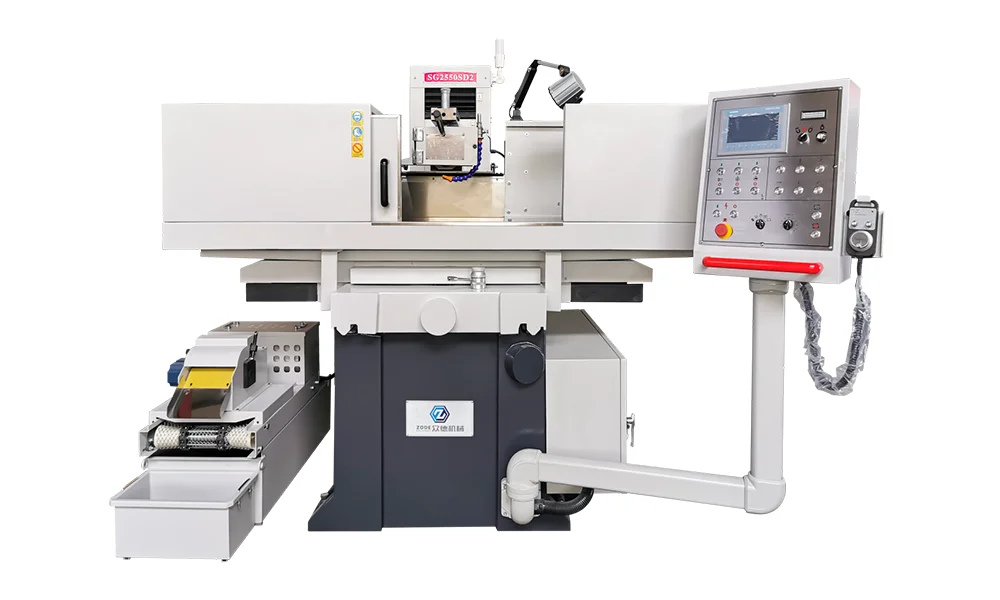
A 2-axis PLC surface grinder is a specialized machine tool designed to deliver accurate, consistent, and automated grinding performance across flat surfaces. By integrating Programmable Logic Controller (PLC) technology, the grinder allows operators to achieve high-precision material removal with minimal manual intervention. This combination of mechanical rigidity and automation has made PLC-controlled grinders a standard solution in metalworking, mold processing, automotive part finishing, and toolroom applications.
Compared with conventional manual grinders, a 2-axis PLC configuration typically manages the vertical (Z-axis) and crossfeed (Y-axis or X-axis depending on machine design). This automation not only improves repeatability but also reduces human error, making the system ideal for batch production environments that require consistent results. In this blog post, Nantong Zode, as high performance precision surface grinding machine exporter, will share the important role of 2 axis PLC surface grinder in manufacturing.
Why Manufacturers Choose 2 Axis PLC Surface Grinder
A PLC-driven 2 axis surface grinder improves workflow and operational reliability in ways that manual systems cannot match. One of the primary reasons manufacturers choose this equipment is its high level of process control. Through the PLC interface, operators can program grinding depth, feed rate, spark-out cycles, and dwell time with exceptional accuracy.
This level of programming flexibility reduces guesswork and allows the operator to replicate the exact same parameters every time a particular part is processed. Whether grinding hardened steel components, precision molds, stamping dies, or custom tooling, the automation ensures professional results without depending solely on operator skill.
Key Features of 2 Axis PLC Surface Grinding Machine
Modern 2 axis PLC surface grinding machines come equipped with several high-performance features that improve accuracy and efficiency. Many models include servo-controlled axes, ensuring smooth feed movement and tight tolerances. Some grinders also integrate linear guideways to reduce friction and maintain stable travel during extended operations.
A sturdy machine base, often made from ribbed cast iron, reduces vibration and enhances surface finish quality. Meanwhile, a high-frequency spindle or dynamically balanced grinding wheel system helps maintain consistent wheel performance even under demanding loads. Dust extraction ports, cooling systems, and precision wheel dressers further support stable long-term operation.
Benefits of Using 2 Axis PLC Surface Grinder in Industrial Settings
Choosing a PLC-controlled 2 axis surface grinder introduces multiple advantages to the production line. The primary benefit is improved consistency. Since the program defines each grinding step, the machine ensures uniform results whether processing one part or hundreds. This removes the risk of variation due to operator fatigue or inconsistent manual feeding.
Another advantage is process speed. PLC systems streamline workflow by automating repeated steps such as rapid approach, rough feed, finishing feed, and spark-out. Operators are free to monitor other tasks while the grinder completes the cycle, enhancing overall productivity. Additionally, reduced manual handling contributes to a safer working environment, particularly when grinding large or heavy components.
Comparing 2 Axis PLC Surface Grinder to Manual and CNC Variants
The 2-axis PLC surface grinder occupies a unique position between manual grinders and fully programmable CNC machines. While manual grinders require direct operator involvement for nearly every step, PLC-controlled models automate the most repetitive tasks while maintaining simple operation.
Compared with CNC grinders, PLC systems offer a cost-effective solution for applications that do not require complex multi-axis movements or contouring. For most flat-surface finishing jobs, a PLC configuration delivers more than enough precision at a significantly lower investment. It provides a balance between automation and affordability that appeals to workshops of all sizes.
Applications Where 2 Axis PLC Controlled Surface Grinder Excels
Industries requiring precise flatness and smooth surface finishes rely heavily on 2-axis PLC controlled surface grinders. These machines are commonly used in:
-
Tool and die manufacturing: finishing stamping dies, mold plates, and precision inserts.
-
Automotive part production: grinding engine components, transmission plates, and valve body parts.
-
Metalworking workshops: preparing flat surfaces before machining or assembly.
-
Hardware and instrument manufacturing: fine grinding of aluminum, stainless steel, tool steel, and alloy components.
-
Aerospace engineering: precision finishing of high-strength materials that demand strict tolerances.
Because the grinder can repeat programmed cycles with consistency, it is particularly valuable in small-batch or medium-volume production environments where accuracy must remain stable from part to part.
How PLC Technology Improves 2 Axis Surface Grinding Control
The integration of PLC technology into a 2 axis surface grinding system significantly upgrades machine control. Through an intuitive panel, operators can set grinding parameters such as depth of cut, table speed, step feed, and spark-out duration. PLC logic ensures these steps occur in the correct sequence, reducing the likelihood of human error.
The PLC also records data and alerts the operator to abnormal conditions—such as motor overload or coolant system failure—before issues escalate. This enhances uptime and protects both the machine and the workpiece. Having this level of control is crucial in maintaining dimensional accuracy during long grinding cycles.
Structural Design Considerations in Robust 2 Axis PLC Grinders
A well-designed 2-axis PLC controlled grinder places significant emphasis on mechanical stability. A thick, vibration-reducing cast-iron frame ensures that the machine remains stable even during heavy stock removal. Precision ball screws or linear guideways are used to maintain smooth axis movement. Several models also incorporate automatic lubrication systems to reduce wear and extend machine lifespan.
These design elements work together to maintain grinding accuracy, minimize thermal displacement, and keep dimensional tolerance consistent throughout extended production cycles. This structural reliability is one of the primary reasons PLC-controlled grinders remain popular across demanding industrial environments.
Optimizing Workflow With a 2 Axis PLC Surface Grinder Setup
Implementing a 2 axis PLC surface grinder setup into production requires careful preparation. Proper alignment of the grinding wheel, calibration of axis positioning, and selection of suitable abrasive materials play essential roles in achieving optimal results. Each material—whether tool steel, aluminum, or hardened alloy—requires a specific grinding wheel specification and coolant system.
Operators can further optimize workflow by organizing grinding programs within the PLC interface. Recalling stored programs saves setup time and ensures consistent performance across different batches. Effective workflow optimization helps companies increase throughput while maintaining strict quality control.
Differences Between Semi-Automatic and Fully Automated 2 Axis PLC Grinding
Not all 2 axis PLC grinders share the same automation level. Some machines offer semi-automatic operation, controlling only specific movements while leaving others under manual control. This setup suits workshops that require flexibility for various job types.
Fully automated PLC grinders, however, manage all primary axis movements, feeding cycles, spark-out routines, and stopping sequences. These machines are ideal for repetitive production tasks or applications requiring long unattended runs. Choosing between the two depends on production goals, operator experience, and desired efficiency.
Troubleshooting Common Issues With 2 Axis PLC Surface Grinders
Even with advanced automation, a 2-axis PLC surface grinder requires proper maintenance and troubleshooting. Common issues include wheel loading, improper coolant flow, or feed rate misalignment. Regular wheel dressing prevents loading and improves cutting efficiency. Monitoring coolant concentration and flow ensures thermal stability and reduces burn marks on the workpiece.
Periodic calibration of axis movement is also essential. Over time, mechanical wear may affect feed accuracy, so checking ball screw preload and guideway condition helps sustain long-term precision. The PLC can assist in troubleshooting by providing error codes or alarms when abnormal conditions occur.
Choosing the Right 2 Axis PLC Surface Grinder for Your Production Needs
Selecting the ideal 2-axis PLC grinder depends on workpiece size, material type, required tolerance, and production volume. For shops needing versatility, models with adjustable table size, high spindle power, and advanced cooling systems are beneficial. For tighter tolerance requirements, machines equipped with servo motors, linear scales, and automated wheel dressing systems offer better accuracy.
Evaluating long-term maintenance requirements, spare parts availability, and service support also ensures a smooth ownership experience. A well-matched machine not only improves product quality but also strengthens overall manufacturing competitiveness.
www.zodemc.com
Nantong Zode
About Author