Semi Automatic Spot Welding Machine: 2026 Industrial Guide
In metal fabrication, the search for a semi automatic spot welding machine usually begins with a concrete problem: inconsistent nugget size, spatter on visible surfaces, or a power grid that cannot absorb another conventional AC welder. For manufacturers working with high-strength steels, coated metals, or heat-sensitive assemblies, the welding platform chosen today determines throughput, scrap rate, and downstream finishing costs for years.
Suzhou Agera Automation Equipment Co., Ltd., trading under the brand AGERA / AGERA AUTOMATION, has built its business around that decision point. Founded in 2012 and preceded by a Shanghai trading company established in 2004, the company operates as a professional manufacturer of resistance welding and automation equipment from its headquarters at No. 1 Chengtai Road, Taiping Industrial Park, Xiangcheng District, Suzhou, Jiangsu Province, China. It holds National High-tech Enterprise status and Jiangsu Province "Specialized, Refined, Distinctive, and Novel" (SRDN) certification.
What Defines a Semi Automatic Spot Welding Machine
A semi automatic spot welding machine sits between a manual rocker-arm welder and a fully robotic welding cell. The operator loads and positions the workpiece, while the machine controls current, timing, and electrode force automatically. This division of labor is what makes the category attractive to job shops and mid-volume production lines that need repeatability without the capital commitment of a complete automated line.
Agera's positioning in this segment rests on over 20 years of welding technology accumulation and a database of 80,000+ welding workpiece cases, which supports delivery of complete automated production process solutions rather than hardware alone. The company's stated value proposition is connecting safety and quality for the world through intelligent welding equipment while delivering high-precision automation.
The Technology Inside Agera's Spot Welding Platforms
Medium Frequency Inverter Control
The Medium Frequency Spot and Projection Welder (ADB Series) addresses a familiar pain point: inconsistent nugget size and high spatter in traditional AC welding. Its inverter frequency reaches 1000Hz, giving current control accuracy 20 times higher than traditional AC welders. The machine reduces power grid demand by 1/3 compared with AC welders and operates at a power factor of 0.7–0.9.
Three-phase balanced power lowers the impact on facility electrical infrastructure. An HMI interface displays current and time in real time, with monitoring alarms for pressure and water flow. The straight current waveform produces stable nugget size and minimal spatter, which matters when welded surfaces remain visible in the finished product.
Capacitor Discharge Welding
The Capacitor Discharge Spot Projection Welding Machine (ADR Series) targets heat-sensitive parts and multi-point projection welding, where surface discoloration and thermal deformation are the recurring failure modes. A discharging time of approximately 10ms prevents workpiece surface discoloration, and energy fluctuation is held within 1% regardless of power grid instability. Capacity reaches up to 200KJ for extremely large parts, while the system requires less than 1/5 the power capacity of AC welders — a meaningful constraint for plants with limited electrical headroom.
Matching the Platform to the Workpiece
Beyond spot and projection welding, Agera's product architecture covers several related resistance welding processes:
- Flash Butt Welding Machine (AUNS/AUVS Series) — built for large-section metal parts and special steel alloys, achieving weld quality nearly identical to the base metal for sections up to 20,000mm². Specific models include the AUBS-630*2 New Energy Electric Axle Double-Head Pulsation Flash Butt Welder and the ACBS-500 Copper and Aluminum Flash Butt Welder.
- Diffusion Welding Machine (AKG/AKD Series) — multi-layer welding for new energy battery busbars and charging piles, with uniform heating to prevent deformation and support for connections between metal and non-metal materials.
- Resistance Butt Welding Machine — for copper and aluminum rods and fine precision parts.
- Resistance Seam Welding Machine — for fuel tanks, shock absorbers, and steel drums.
- Integrated Hanging Spot Welder — a compact design for automobile bodies and sheet metal cabinets.
- AC Spot and Projection Welder — a simple, durable option for wire mesh and nut projection.
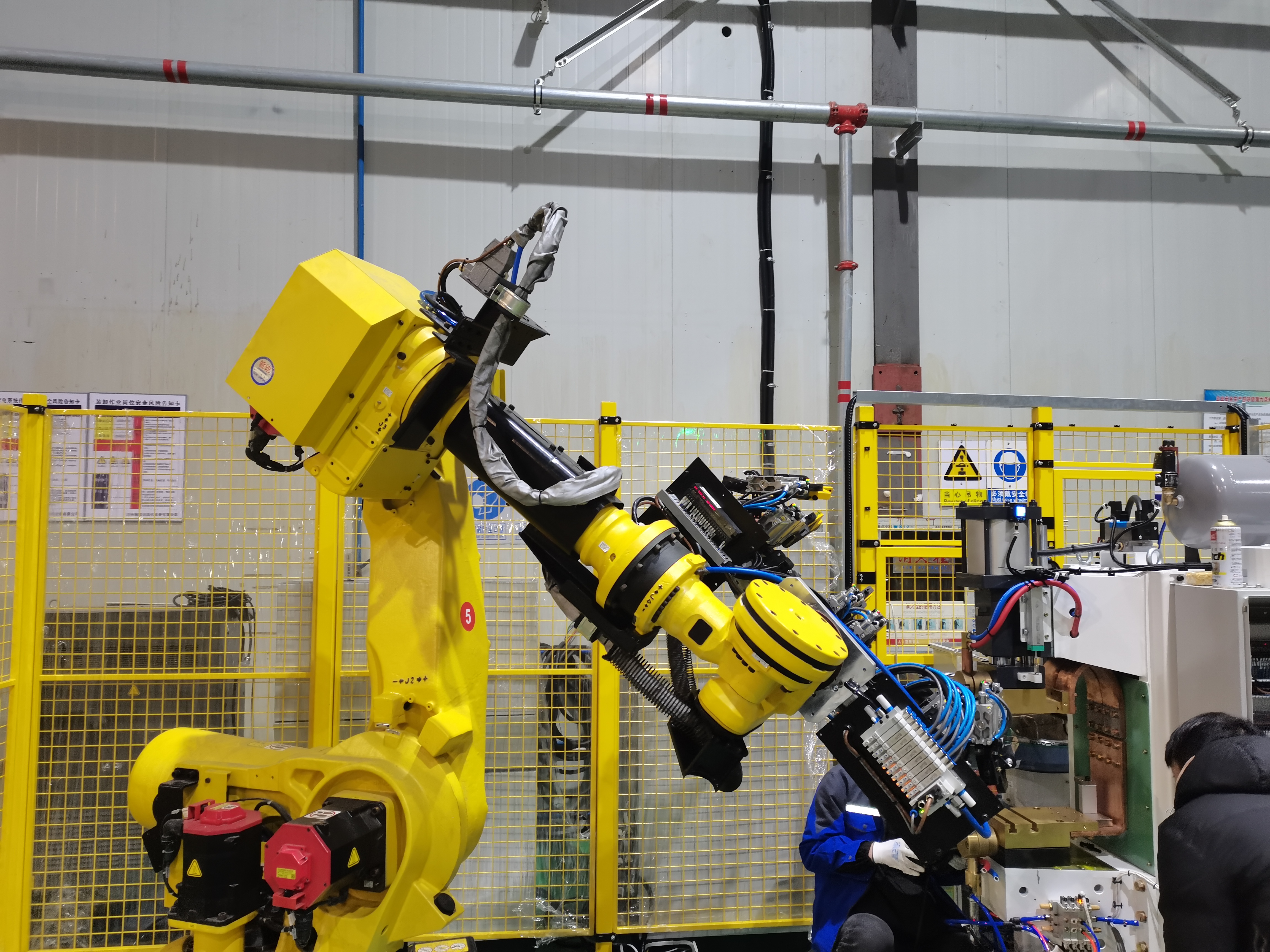
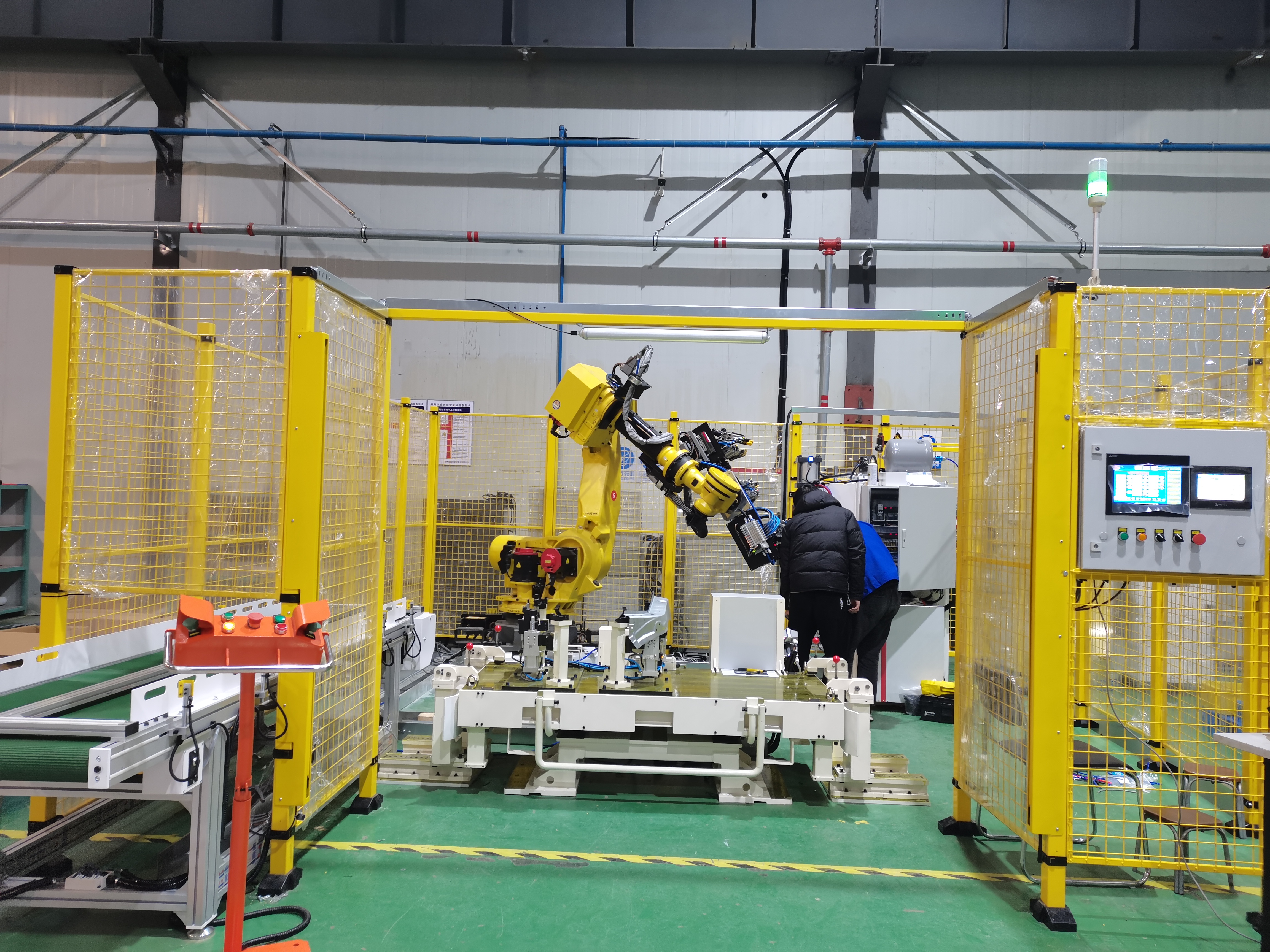
For buyers who need the semi automatic platform embedded in a broader workflow, Agera supplies fully automated workstations and production lines tailored to industry processes. Automotive component applications include robot-integrated nut and bolt projection welding workstations, subframe lowering robot nut projection stations, new energy vehicle threshold beam robot workstations, shock absorber automatic welding lines combining seam, projection, and stud welding, and car seat slide rail and side panel automatic workstations. Sheet metal and cabinet work draws on gantry type multi-head spot welding machines for battery box reinforcement and door panels, NC platform automatic spot welders in single and dual head configurations, and automatic nut projection stations for small stamping parts.
Qualifications and Engineering Support
Agera's technical file includes 50+ invention and utility model patents and multiple computer software copyright registrations, such as robot application software. The company operates the Suzhou Intelligent Pulse Flash Butt Welding Control Engineering Technology Research Center and holds a place among Suzhou Industrial Design Centers, both awarded in 2022. Its quality management system is ISO9001 certified, and its equipment carries CE (Conformité Européenne) certification for international markets.
Two products have been recognized as "First Set of Major Technical Equipment" by regional Industry and Information Technology Bureaus: the ARH-IDB-202 Pipe Pile End Plate Flange Automatic Welding Line in 2021, and the AUBS-630*2 New Energy Electric Axle Double-Head Pulsation Flash Butt Welder in 2024. In 2023, the company developed the first domestic double-head flash butt welding machine for truck axles and entered the supply chain of leading domestic new energy vehicle manufacturers, including BYD and Great Wall Motors.
Collaboration extends into research: Agera reached cooperation with the China-Ukraine Welding Research Institute in 2020 and built a collaborative research and development platform through industry-university-research cooperation with Soochow University and Jiangsu University of Science and Technology, including a Graduate Workstation of Soochow University.
Selecting the Right Machine
Three questions structure a sound evaluation. First, what is the material and section? High-strength steels and dissimilar metals tolerate less heat input, which favors capacitor discharge or medium frequency inverter control. Second, what does the facility's electrical capacity allow? A machine demanding one-third less grid power, or one-fifth the power capacity of an AC welder, can avoid a service upgrade. Third, how much of the process should be automated? Semi automatic operation suits job shops and mid-volume lines, while robot workstations for subframes, threshold beams, and copper braided wire forming serve higher-volume programs.
Agera's delivery model accommodates all three paths, combining customized non-standard automation solutions with pre-sales process analysis, dedicated after-sales support, and lifecycle management through ERP, CRM, and PLM systems. Products ship to Europe, Southeast Asia, the Middle East, South America, and North America, with more than 8,000 customers served to date — a scale that turns a semi automatic spot welding machine purchase into a decision backed by documented case history rather than specification sheets alone.
https://www.agerawelder.com
Suzhou Agera Automation Equipment Co.,Ltd.
About Author