The choice between a shrink sleeve labeling machine and a self-adhesive labeling machine is usually framed as a preference. It is not. It is a question about the bottle: whether the container presents a surface a pressure-sensitive label can lie flat on, and whether the label also has to seal the closure. Answer those two and the process follows. Get them wrong and no number of labeling stations, and no amount of servo precision, will fix it.
Zhangjiagang Grandee Machinery Co., Ltd., which sells under the Grandee Machine brand, builds labeling equipment in all three of the common processes — shrink sleeve, self-adhesive and OPP hot-melt glue — which is the reason this comparison can be made without advocacy for one of them.
What Each Process Actually Does to the Bottle
A shrink sleeve begins as a pre-formed tube of PVC or PET film, dropped over the bottle body and then carried through a shrink tunnel where steam or heat contracts it onto the container. The film is what conforms. Nothing is pressed onto the surface. That is why a sleeve can run down a shoulder, across a taper and around a waist — the label follows the geometry instead of fighting it. The same property is why a full-body sleeve that crosses the closure works as a tamper-evident seal with no second component.
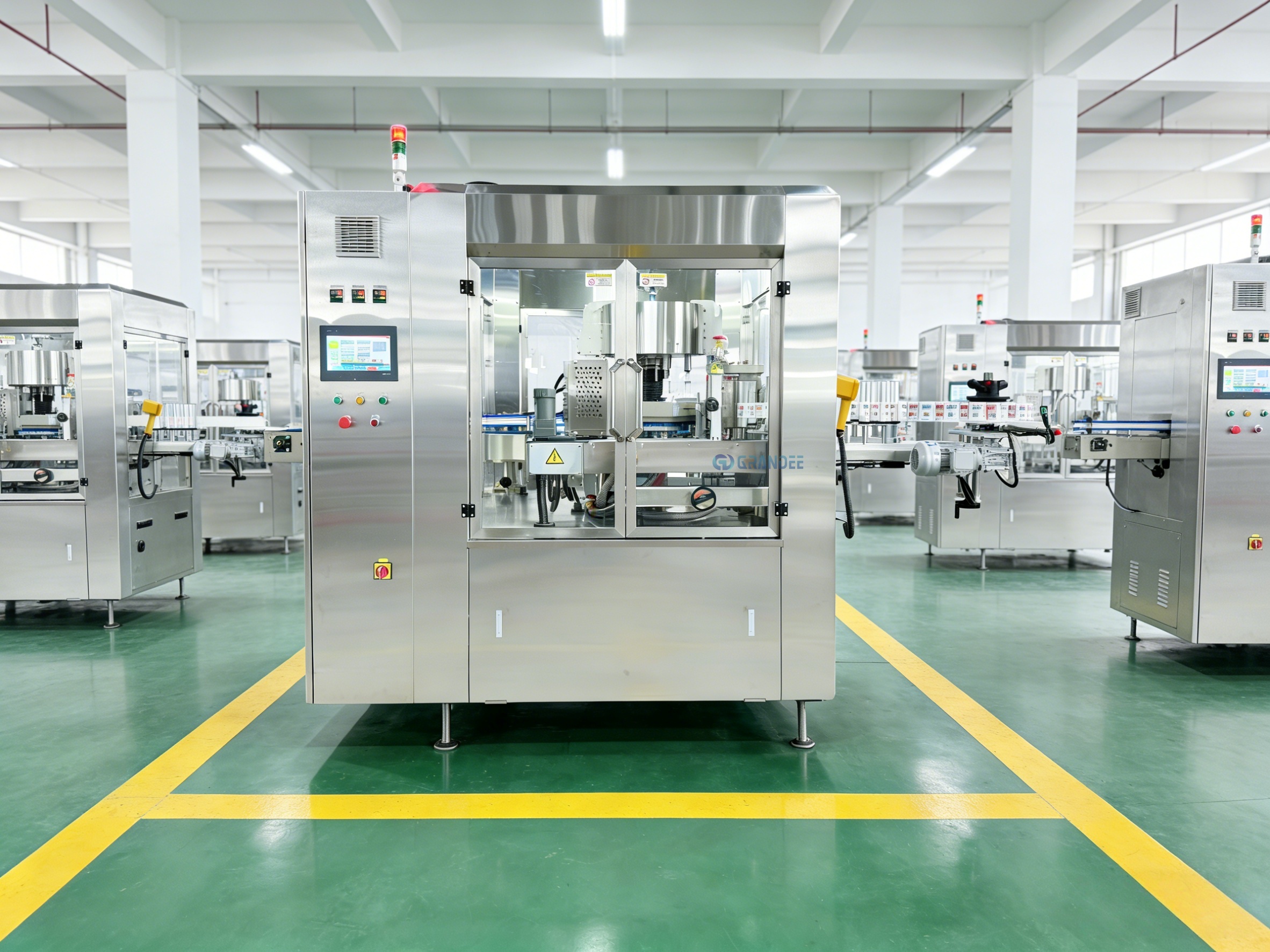
A self-adhesive label is a pre-cut piece with an adhesive backing, released from its liner and presented to the bottle by a servo-driven dispensing unit at a set position, then pressed home. The label does not conform. It lands. What it needs is somewhere to land: a cylindrical band, a flat panel, or a face with enough uninterrupted surface for the label footprint to sit without bridging a curve. Servo dispensing is what makes the placement repeatable, and it is also why this process needs no heat and no tunnel.
A sleeve adapts to the bottle. A self-adhesive label requires the bottle to cooperate.
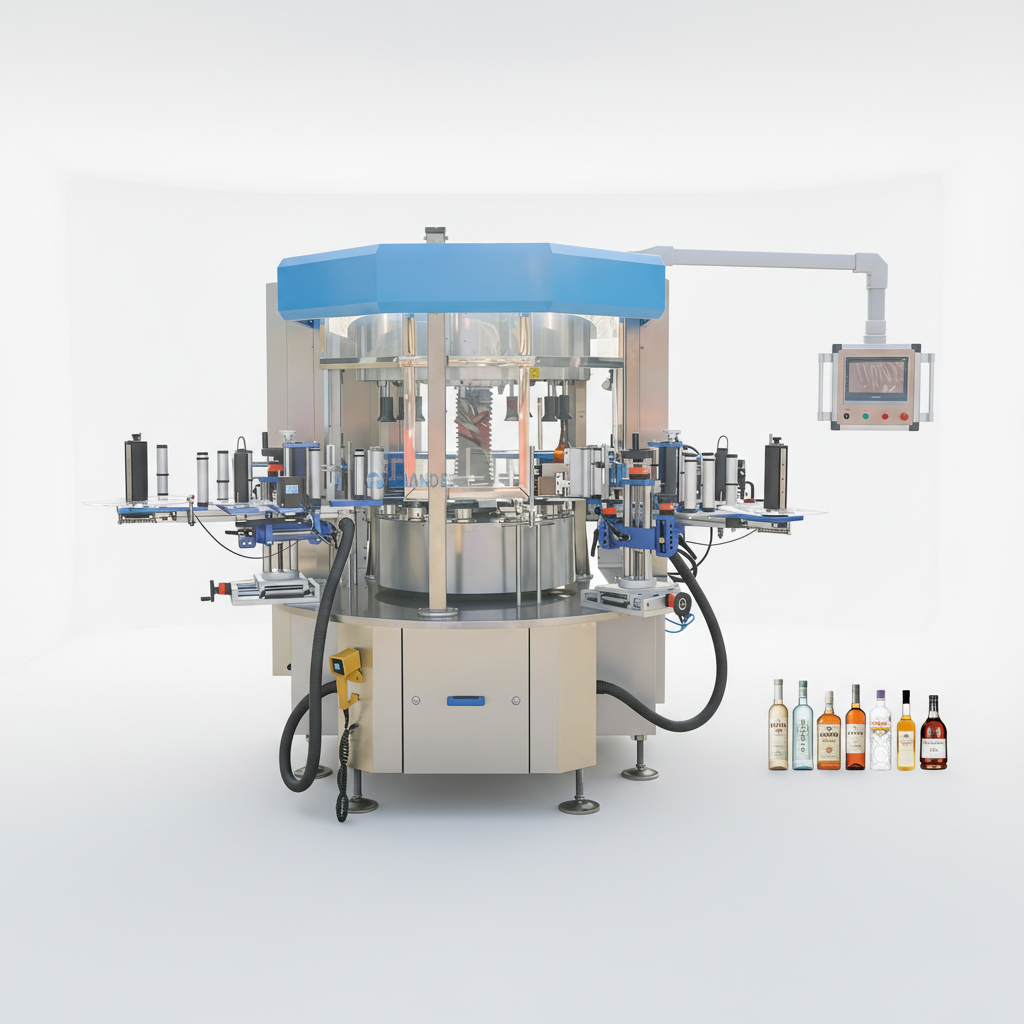
The Four Conditions That Decide It
1. Is there a surface the label can lie on? This is a hard constraint, not a preference. A square bottle with a flat panel answers yes. A heavily contoured bottle with no straight run answers no. If the answer is no, only one of these two processes is available to you and the rest of the comparison is academic.
2. Does the label have to seal the closure? A full-body sleeve that crosses the cap is tamper evidence by geometry, with no extra part. A self-adhesive label does not cross the closure unless a separate neck band is added at a second station.
3. Do you have steam or heat, and the floor space, at that point in the line? Shrink sleeve is a two-stage process: labeler plus tunnel. A tunnel needs a utility connection and occupies floor between the capper and the packer. Self-adhesive is a single stage with neither. On a line where that stretch is already tight, this condition alone decides the question.
4. How often do you change SKU, and what changes with it? Sleeve changeover is a new sleeve roll plus change parts sized to the new diameter. Adhesive changeover is a new label roll plus a plate change. Different work, different operator time. Ask for both figures in hours, per product change, before committing.
The rule in one line: if the bottle has no landable surface, or the label must cross the closure, specify the sleeve. If the bottle has a land and the label is a front-and-back or wrap-around panel, the self-adhesive station does the work with no tunnel, no heat and one stage.
Where Each One Fails
A sleeve fails visibly, and it fails at the geometry. A sharp shoulder taper wrinkles, because the film has to take up more material than it can contract evenly. A thin-wall bottle distorts when the tunnel runs too hot. A sleeve that is not seated square at drop shows as a diagonal seam that no amount of heat will straighten. Steam and heat are not interchangeable at this point: steam carries heat into the film more evenly, which is what a complex shoulder needs, while a heat-only tunnel is simpler to install and less forgiving on the same shapes.
A self-adhesive label fails at the interface. A bottle that leaves the filler with condensation or dust on it gives the adhesive nothing to grip, and the result is edge lift that appears hours later in the warehouse rather than at the station. On a contoured bottle the label bridges the curve and lifts at the edge. Neither failure is a machine fault in the ordinary sense — both are the bottle, the label stock and the ambient conditions meeting at the wrong point.
Which is why the only useful test is a sample run on your own bottle, with your own label stock, at your line speed, before the order is placed.
What the Specification Does Not Tell You
Capacity is per model. The range is quoted at 8,000–18,000 bottles per hour, and that is a per-model figure. What your line reaches is set by how many labeling stations you run, the bottle, and the conveyor behind it. Treat the range as the envelope of the model family, not as a promise for your line.
Placement tolerance is not published. No placement figure is stated for either process in this range. Ask for it against your own bottle, and ask whether it is measured at the labeler or after the tunnel — the two answers are not the same number.
Sleeve diameter and label footprint are per-bottle questions. The working range is set by the container you will actually run, not by the machine family. Send the drawing before the specification is fixed, not after.
Film and label stock are a market question before they are a machine question. PVC and PET behave differently in the tunnel and differently in the waste stream. Which one your destination market accepts has to be settled first; the machine runs both.
Specification Snapshot
| Processes covered | Shrink sleeve (PVC/PET), self-adhesive, OPP hot-melt glue |
| Sleeve configuration | Sleeve labeler with shrink tunnel — steam or heat |
| Adhesive configuration | Servo-driven self-adhesive labeling unit |
| OPP configuration | OPP hot-melt glue labeling |
| Capacity | 8,000–18,000 bottles per hour, per model |
| Irregular-shape bottle adaptation | the sleeve is the configuration that carries a contoured body |
| Line link | Synchronized with filling-line conveying |
| Supply form | Integrated into a filling line, or supplied as a standalone unit |
| Line position | After filling and capping; ahead of shrink wrap packing and carton packing |
| Industries | Bottled water, beverages, condiments, edible oils |
Turnkey Scope, and Where It Stops
Grandee Machine supplies labeling as one stage of a turnkey project: bottle design, factory layout including paperless 3D factory design, installation, commissioning and operator training under one contract. Upstream of the labeler the same scope can cover water treatment, bottle blowing, filling and capping; downstream it can cover shrink wrap packing, carton packing and palletizing on request. Automatic CIP is available as standard line capability on the filling side, where it belongs — a labeler has nothing to clean in place. One party fixes the interfaces, rather than four parties negotiating them.
Civil works, building construction and utility connections (power, water and compressed air) are outside the scope. For a sleeve line this is not a footnote. The tunnel needs steam or heat at its own station, and that connection is the plant's contract — which is why a labeling line that arrived on schedule can still wait on a boiler or a steam line that did not.
On an OPP hot-melt unit the same logic applies to the glue system: it is part of the machine, but the extraction and the working environment around it belong to the building.
FAQ
Can one machine run both sleeve and self-adhesive?
No. They are different stations with different tooling and different finishing requirements, and neither converts into the other. What a single supplier gives you is one interface and one acceptance conversation. A line that genuinely needs both carries two labeling stations, which is a layout decision made at the design stage, not a change made later.
Which process suits an irregular bottle?
Sleeve, when the bottle has no landable surface — that is the case it exists for. If the bottle is irregular but carries a flat panel wide enough for the label footprint, the adhesive station can work, and the question becomes whether the label bridges a curve at the panel edge. The panel width against the label footprint answers it: if the label overruns the panel and has to bridge onto the curve, it will lift at that edge, whatever the dispensing unit does.
Does a shrink sleeve line need steam?
Steam or heat, and both are in the range. Steam gives a more even shrink on shoulders and tapers; a heat-only tunnel is simpler to install and less forgiving on the same geometry. If your plant has no steam available at that point in the line, say so at the quotation stage rather than at commissioning.
Can a sleeve replace a tamper-evident band?
Yes, if the sleeve is specified as a full-body sleeve that crosses the closure and reaches onto the cap. A body-only sleeve does not, and neither does a self-adhesive label. This is worth confirming on the drawing, because the difference between a body sleeve and a closure-crossing sleeve changes both the film length and the tunnel setting.
Can labeling be added to a line I already run?
Yes, and it is the more common case. The labeling machine can come as a standalone unit that sits into an existing conveyor, or as part of a complete filling line. The conveyor interface decides which: the transfer in and out has to be built for the bottle you already run, and the line's existing speed sizes the machine. Send the conveyor layout with the inquiry, not only the bottle drawing — the transfer point is where a standalone installation succeeds or fails.
About Grandee Machine
Zhangjiagang Grandee Machinery Co., Ltd. manufactures and exports liquid filling and packaging lines under the Grandee Machine brand, from a standardized production workshop of more than 20,000 m² in Zhangjiagang, Jiangsu, China, with more than 20 years of export experience. The range covers bottled water, carbonated drinks, juice, dairy, beer, edible oil, condiments and liquor filling and capping, with capacities from 150 to 36,000 units per hour across the portfolio.
Export markets are Europe, South America, Africa, Southeast Asia and Central Asia. Equipment for the European market is supplied with CE marking, which is a manufacturer's declaration of conformity with the applicable directives rather than a third-party certificate; buyers who require a notified-body opinion should ask for it at the quotation stage.
Labeling sits at the end of that range, after the filler and the capper. Because the same company builds sleeve, adhesive and hot-melt equipment, the process question can be answered on the bottle — which is why the four conditions above come up in the first technical exchange rather than after the order.
Next Step
Four answers fix the process and the model: a bottle drawing with the material and the label area marked, whether the label must cross the closure, your target output per hour, and how often the line changes product. Send them through the inquiry form on this page. If the drawing exists, attach it — the first reply is more useful with it, and the sleeve-versus-adhesive question is usually settled on the drawing rather than in a meeting.
https://www.grandeemachine.com/
Zhangjiagang Grandee Machinery Co., Ltd.
About Author