The output of a bottled water line is not set by its filler. It is set by the slowest stage downstream of the filler, and in a large number of plants that stage is the one where bottles are gathered into packs and wrapped. A filler rated at several thousand bottles an hour can sit idle while the packing stage works through the bottles already standing in front of it. The bottles are being made; the line is not.
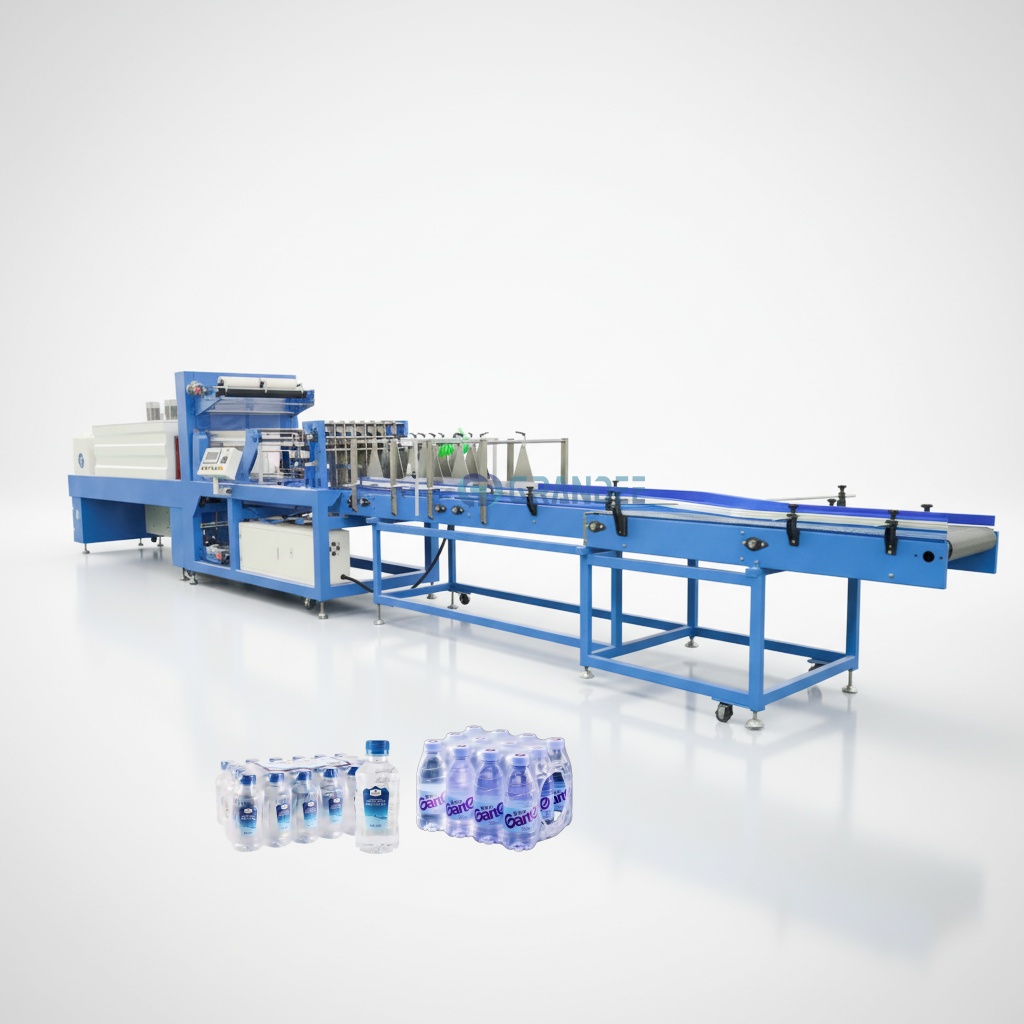
A shrink wrap packing machine is the usual answer at that point of the line, and it is a deceptively simple piece of equipment: bottles are collected into a group, film is wrapped around them, heat shrinks it tight. What goes wrong is rarely the wrapping. What goes wrong is that the machine was specified in a unit that cannot be compared with the machine feeding it.
Packs per Minute, Bottles per Hour: The Conversion Buyers Skip
Filling machines are rated in bottles per hour. Shrink wrap packing machines are rated in packs per minute. Both figures are honest, and they cannot be compared as written. The bridge between them is the pack pattern:
bottles per hour = packs per minute × 60 × bottles per pack
Take a single wrapper set to 12 packs per minute. The twelve is only a round number chosen so the arithmetic is easy to follow; nothing in the conversion depends on it, and the same relationship holds at any rate. Twelve packs a minute is 720 packs an hour. Arranged as a 2×3 pack — six bottles — it is 4,320 bottles an hour. Arranged as a 4×6 pack — twenty-four bottles — it is 17,280. The machine is identical, the rate is identical, and the work done differs by a factor of four, because the market asked for a different pack. Both arrangements are standard configurations on this type of machine, which is exactly why the pack pattern cannot be left until after the wrapper has been chosen.
Which is why the number that matters in a specification is neither the wrapper's packs per minute nor the filler's bottles per hour, but the two converted to the same unit, at the same bottle size, for the same pack pattern.
A second mismatch sits underneath the first. Filling machines are quoted on a bottle-size basis — a 500 ml basis is the usual convention, which is why the same machine carries different hourly figures at different bottle sizes. The packing stage has the same property seen from the other end: a larger bottle means fewer bottles to a pack and fewer packs per minute from the same physical machine. Neither figure travels across formats without conversion, and a specification sheet that presents one figure without the basis it was measured on is not telling a buyer anything they can use.
The practical failure this produces is common and quiet. A buyer compares two packing proposals on packs per minute, compares two filling machines on bottles per hour, and never checks the join between them. The line then ends up with a wrapper that is either oversized — paid for speed the line can never deliver — or undersized, in which case the filler spends part of every shift waiting for packs to clear.
Film, Tray and Pack Pattern
The machine itself performs PE film multi-pack shrink wrapping in linear, L-type or half-tray configuration, with a shrink tunnel applying heat so the film draws tight around the group. Around that core there are three decisions that get made before the machine is ordered and that determine how the machine performs.
The pack pattern. How many bottles to a pack, and in what arrangement. This is a market decision before it is an engineering one: multi-packs of six and multi-packs of twenty-four serve different retail formats, and they consume very different amounts of film for the same number of bottles.
The tray. A half tray uses less board and leaves the film to carry more of the pack's structure; a full tray uses more board and gives the pack more stacking strength and a defined base. The difference shows up at the pallet, not at the wrapper.
The film. PE heat-shrink film is the standard choice for water multi-packs. Printed film can carry branding in place of a separate label in some markets, which changes the film specification rather than the machine.
Film consumption is a property of the pack, not of the machine. That is the honest way to read any claim about efficient film use: the question to ask is at what pack pattern and with which tray. A machine cannot use less film than the pack it has been asked to produce requires.
What the Machine Does Not Fix
Three problems are routinely attributed to the packing stage and are not caused by it. All three are interface problems, and all three are settled at layout stage rather than by adjusting the wrapper.
Upstream stability. A wrapper works from a small accumulation buffer. If the filler stops — a capping jam, a label reject, a bottle fallen on the conveyor — the wrapper empties its buffer and stops. If the wrapper stops, bottles accumulate and the filler stops behind them. The size of that buffer is a design decision, and it is the thing that determines what a stoppage at either end actually costs the shift.
Bottle rigidity. Lightweight bottles deform under film tension and under the heat of the tunnel. No wrapper setting fully compensates for a bottle that is too soft for the pack it has been put in, and the symptom appears as packs that look loose or bottles that lean — which gets diagnosed as a wrapping fault when the cause is upstream in the bottle.
The pallet pattern. If the pallet layout has not been settled, packs can wrap perfectly and still not stack. The wrapper cannot correct a pack whose footprint is wrong for the pallet it has to sit on, and this is discovered at the first full pallet rather than at the specification stage.
Configuration at a Glance
| Packaging format | PE film multi-pack shrink wrap |
| Machine layout | Linear, L-type or half-tray |
| Shrink method | Shrink tunnel, PE heat shrink |
| Tray options | Half tray or full tray |
| Pack configurations | Multiple bottle-packing configurations supported, including 2×3, 3×4 and 4×6 |
| Capacity | Per model; one example configuration for big-bottle formats is rated at 8–12 packs per minute |
| Deployment | Integrated into a filling line, or supplied as a standalone unit |
Note the basis stated on the capacity row. A figure in packs per minute is meaningless until it is paired with a bottle size and a pack pattern, which is the whole argument of the first section.
Where These Machines Have Been Delivered
Zhangjiagang Grandee Machinery Co., Ltd., operating under the brand Grandee Machine, supplies shrink wrap packing machines as the packaging stage inside complete water and beverage line projects rather than as isolated units. Those line projects are recorded for customers in Europe, Africa, South America and Central Asia, delivered out of a production workshop exceeding 20,000 square metres and backed by more than 20 years of export experience.
One of those projects can be described specifically. In 2025, a beverage producer in Uzbekistan took delivery of a 10,000–15,000 BPH isobaric carbonated filling line in 500 ml PET format. The packaging stage of that line includes a shrink wrap packing machine that supports multiple bottle-packing configurations, including 2×3, 3×4, 4×6 and further arrangements to suit different packaging requirements. It is worth being precise about the line type: this was a carbonated beverage line, not a water line, and the same wrapping stage is what appears at the end of a water line.
The distinction matters for how a buyer should read it. The published record for that project states the line capacity, the bottle format and the pack configurations the packaging stage supports. It does not state a pack rate for each of those configurations, and film specifications and tray choices differ from one project to the next. What is confirmed is that the packaging stage is delivered inside these line projects and that it changes between 2×3, 3×4 and 4×6 arrangements. What is not published is the rate at each arrangement.
That is not a gap to be talked around. It is a reason to ask a specific question rather than a general one: for a plant of a given bottle size and a given pack pattern, what is the packing stage rated at, and what buffer sits between it and the filler. A supplier who can answer that for the buyer's own format is describing a line. One who can only answer for the line as a whole is describing a catalogue.
Turnkey Project Scope, and Where It Stops
A line project around a bottled water plant covers bottle design, factory layout and paperless 3D factory design, equipment supply, installation, commissioning and operator training, with automatic CIP as a standard line capability. On the packaging side that scope reaches through labeling, shrink wrap and carton packing, with palletizing available on request. Buying the wrapping stage inside that scope means one party is accountable for the join between the filler and the wrapper, which is the join this article has been about.
The scope covers process equipment and line engineering. It does not include civil works, building construction, or utility connections to the plant boundary — power supply, water supply and compressed air.
The boundary is worth stating plainly for a packaging machine in particular. A wrapper needs floor space at the end of the hall and a compressed air supply at that point. Plants that have been packing by hand frequently have neither in the right place: the manual packing area was sized for people, and the air line ended before it. That work stays with the buyer, and it is better identified during layout than after the machine arrives.
Frequently Asked Questions
How do I convert a wrapper's packs per minute into bottles per hour?
Multiply packs per minute by 60 to get packs per hour, then multiply by the number of bottles in a pack. Do it at the bottle size and pack pattern you actually intend to sell, not at the pattern on the supplier's reference sheet.
Is PE film always the right choice over a carton?
Not always. Film is the usual choice for water multi-packs because it uses less material and shows the product, but a carton gives more protection in transit and a better printed surface. The decision is driven by the retail format and the distribution distance, not by which machine is cheaper to buy.
Half tray or full tray?
Half tray uses less board and relies on the film for structure; full tray gives a defined base and more stacking strength. If the packs will be stacked several layers high on a pallet, the tray decision is carrying structural work and should not be made on material saving alone.
Can the shrink wrap packing machine be bought on its own?
Yes. It can be integrated into an existing or new filling line, or supplied as a standalone unit for a plant upgrading only its end of line. In that case the buyer carries the interface engineering between the existing filler and the new wrapper, which is worth budgeting for explicitly.
Conclusion
A shrink wrap packing machine is simple equipment attached to a deceptively difficult question: what unit is this line actually measured in. The wrapper is rated in packs, the filler in bottles, and the pack pattern is what converts one into the other. Get that conversion right and the packing stage stops being the bottleneck; get it wrong and the plant owns either speed it cannot use or a filler that waits all shift.
Next Step
If you are specifying a packing stage, send us your bottle size, your intended pack pattern, your tray preference and the hourly output of the machine feeding it. We will come back with the packing stage figure for that format and the buffer size between the two, which is the pair of numbers that decides whether the line runs at its rating or below it.
https://www.grandeemachine.com/
Zhangjiagang Grandee Machinery Co., Ltd.
About Author