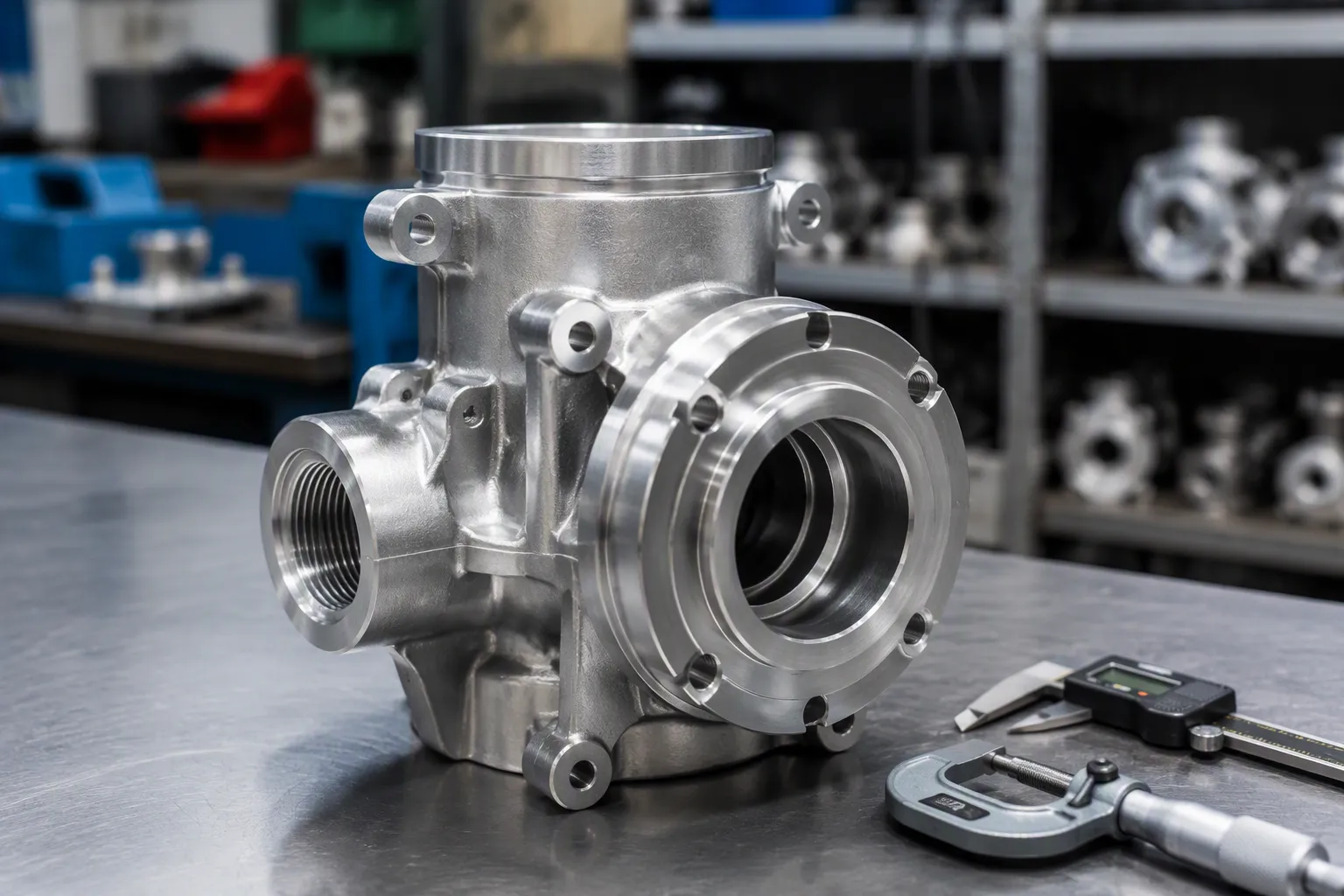
Stainless steel precision casting delivers corrosion resistance through the right alloy chemistry and tightly controlled process steps. Chromium in the alloy forms a passive oxide layer. This layer protects your component from rust and chemical attack. You control corrosion resistance with three levers: material selection, process control, and post-casting treatment. Your custom components demand a casting partner who holds these variables within specification on every production run.
Key Takeaways
- Choose the right stainless steel grade for your environment. Grades like 316 and duplex 2205 resist corrosion better than 304 in harsh conditions.
- Control every casting step to prevent defects. Proper wax removal, shell building, and melt chemistry keep the passive layer strong.
- Apply post-casting treatments like passivation and heat treatment. These steps restore corrosion resistance and maximize performance.
How Stainless Steel Precision Casting Delivers Corrosion Resistance
Corrosion resistance does not happen by accident. You engineer it into the component at every stage of production. Stainless steel precision casting gives you a direct path to that goal. The process combines alloy chemistry with controlled thermal steps. Each step builds on the last one. The result is a custom component that stands up to aggressive environments.
The Passive Oxide Layer Explained
The secret behind stainless steel corrosion resistance starts at the atomic level. Chromium atoms in the alloy react with oxygen in the air. This reaction creates a thin, invisible oxide film on the surface. That film is the passive layer. It blocks oxygen and moisture from reaching the underlying metal. Without this layer, the iron in the steel would rust quickly.
The passive layer is incredibly thin. It measures only a few nanometers deep. You cannot see it with the naked eye. Yet this tiny film provides powerful protection. It also repairs itself. When you scratch the surface, new chromium atoms react with oxygen. The layer rebuilds within seconds. This self-healing property sets stainless steel apart from other metals.
Several factors weaken the passive layer. Chloride ions attack the film and cause pitting. High temperatures accelerate chemical reactions. Surface contamination creates weak spots. You must control these factors during casting and finishing. A damaged passive layer leads to corrosion. A restored passive layer delivers long-term performance.
Why Integral Forming Beats Welded Assemblies
Welded assemblies create weak points in any corrosion-resistant system. The weld zone changes the metal's microstructure. Heat from welding burns away chromium near the joint. This leaves the area vulnerable to attack. Weld defects like porosity and incomplete fusion trap moisture. These traps become starting points for corrosion.
Stainless steel precision casting eliminates these problems. The process forms the entire component as one piece. There are no weld seams. There are no heat-affected zones. The passive layer forms evenly across the whole surface. This uniform coverage delivers consistent protection.
Integral forming also improves fluid dynamics. Welded joints create rough transitions inside pipes and fittings. These rough spots cause turbulence. Turbulence leads to sediment buildup and erosion. A cast component has smooth internal passages. Fluid flows freely without disruption. This design reduces wear and extends service life.
Structural integrity improves as well. A welded joint is only as strong as its weakest point. An integrally cast part has uniform strength throughout. You get a component that handles pressure, vibration, and thermal cycling without failure.
The Three Levers of Corrosion Control
You control corrosion resistance through three levers. Each lever must stay within specification. A weakness in any one lever undermines the other two.
The first lever is material selection. You choose the stainless steel grade based on your operating environment. Carbon content, chromium level, molybdenum content, and other alloying elements all matter. The wrong grade fails quickly. The right grade lasts for decades.
The second lever is process control. Melting temperature, pouring speed, and cooling rate affect the final microstructure. Poor process control creates segregation and porosity. These defects reduce corrosion resistance. Tight process control produces a uniform, sound casting.
The third lever is post-casting treatment. Passivation restores the passive layer after machining and handling. Heat treatment relieves stress and refines the grain structure. Surface finishing removes contaminants and smooths the surface. Each step prepares the component for its service environment.
Testing verifies that all three levers work together. You can rely on established standards to confirm corrosion performance. Common test methods include:
- ASTM A923-25: Standard Test Methods for Detecting Detrimental Intermetallic Phase in Duplex Austenitic/Ferritic Stainless Steels
- ASTM A763-15(2025): Standard Practices for Detecting Susceptibility to Intergranular Attack in Ferritic Stainless Steels
These standards help you detect harmful phases and intergranular attack. They give you confidence in the material's long-term behavior.
Other tests target specific corrosion types. The table below summarizes key standards for chemical processing environments.
| Standard | Purpose | Application |
|---|---|---|
| ASTM A262 | Intergranular corrosion test for austenitic stainless steels | No signs of fissures or cracks at 20× magnification |
| ASTM G28 Method A | IGC test for nickel alloys (e.g., Inconel 625, 825) | ≤0.6 mm/year, no IGA visible at 50× |
| ASTM G48 Method A | Pitting/crevice corrosion test for super austenitic, duplex, super duplex steels | Refer to ISO 17781 |
| ASTM G38 | General corrosion rate test for overall uniform attack assessment | - |
You match the test method to your material and application. This approach confirms that your component meets the demands of its service environment.
Choosing the Right Stainless Steel Grade
Material selection is the first lever of corrosion control. You cannot compensate for the wrong grade with better processing or finishing. The alloy must match your service environment from the start. Stainless steel precision casting gives you access to a wide range of grades. Each grade offers a different balance of corrosion resistance, strength, and cost. You choose the grade that meets your specific demands.
Austenitic Grades for General Corrosion Resistance
Austenitic grades form the largest family of stainless steels. They contain high levels of chromium and nickel. This chemistry produces a stable austenitic structure. The structure delivers excellent formability and weldability. Austenitic grades also resist corrosion across many environments.
Grade 304 is the baseline austenitic grade. It contains roughly 18% chromium and 8% nickel. This combination provides solid general corrosion resistance. You can use 304 in indoor applications and moderately exposed settings. It performs well in fresh water and mild chemical environments. However, 304 has limits. Its passive layer breaks down in chloride-rich conditions. Marine and coastal environments cause pitting on 304 components.
The ISO 9223 standard classifies environmental corrosivity. This system helps you match grades to real-world conditions. The table below shows which alloys suit each category.
| ISO 9223 Corrosivity Category | Corrosivity Level | Alloys Listed as Suitable |
|---|---|---|
| C1 | Very low | 430/4016, 304L/4307 |
| C2 | Low | 430/4016, 304L/4307, Duplex 2101 |
| C3 | Medium | 316L/4404, Duplex 2205 |
| C4 | High | 316L/4404, 316/4436, 904L/4539, Duplex 2507 |
| C5 | Very high | 904L/4539, 254 SMO, Duplex 2507 |
| CX | Extreme | 254 SMO, Duplex 2507 |
Notice that 304 appears only in C1 and C2. It does not appear in C3 or higher. This absence tells you something important. Grade 304 cannot handle medium corrosivity or worse. You need a higher grade for those environments.
316 and 316L for Chloride-Rich Environments
Grade 316 solves the chloride problem that limits 304. It adds 2–3% molybdenum to the alloy. Molybdenum strengthens the passive layer. This addition improves resistance to chlorides and industrial chemicals. Grade 316 resists pitting and staining better than 304. You can use it in marine, coastal, and chemical service.
Grade 316L is the low-carbon version of 316. The "L" stands for low carbon. Carbon content stays below 0.03%. This low level prevents carbide precipitation during welding. Carbide precipitation depletes chromium near grain boundaries. That depletion causes intergranular corrosion. Grade 316L avoids this problem in welded assemblies.
The ISO 9223 table confirms the upgrade. Grade 316L appears in C3 and C4. It handles medium and high corrosivity. This range covers most industrial and coastal applications. Chemical plants, food processing lines, and marine hardware all rely on 316L.
You should consider several factors when choosing between 316 and 316L. Grade 316 offers slightly higher strength. Grade 316L offers better weldability and corrosion resistance after welding. For cast components, the choice depends on your assembly method. Integrally cast parts avoid welds entirely. In that case, standard 316 works well. If you plan to weld the component into a larger system, 316L provides extra safety.
The evidence below summarizes how these grades compare in aggressive environments.
- 304 stainless steel: baseline grade with solid general corrosion resistance; performs well in indoor and moderately exposed environments, but its passive layer can break down in chloride-rich/marine conditions, leading to pitting.
- 316 stainless steel: contains ~2–3% molybdenum, improving resistance to chlorides and industrial chemicals; better pitting/stain resistance than 304, making it suitable for marine, coastal, and chemical service.
- 2205 Duplex: combines austenitic and ferritic structures, offering greater strength and improved resistance to stress corrosion cracking; used in oil and gas, desalination, and structural components where both strength and corrosion resistance matter.
- Overall implication: 304 is the least corrosion-resistant of the three in aggressive/chloride-containing environments, 316 is an upgrade over 304, and duplex 2205 offers high performance (strength plus corrosion resistance) for demanding conditions.
17-4PH for Strength Plus Corrosion Resistance
Some applications demand more than corrosion resistance. They need high strength as well. Grade 17-4PH delivers both properties. This grade is a precipitation-hardening martensitic stainless steel. It contains copper and niobium as alloying elements. A controlled heat treatment precipitates fine particles within the matrix. These particles block dislocation movement. The result is very high strength.
Grade 17-4PH reaches yield strengths of 170 ksi or more. That strength rivals many alloy steels. Yet 17-4PH retains good corrosion resistance. Its chromium content provides a protective passive layer. The corrosion resistance falls between 304 and 316. You can use 17-4PH in mild to moderate environments.
Heat treatment is critical for 17-4PH. You must follow the correct cycle. The standard condition is H900 or H1025. Each condition produces a different strength and toughness balance. The heat treatment also affects corrosion resistance. Over-aging can reduce corrosion performance. You need a casting partner who controls the furnace cycle precisely.
Common applications for 17-4PH include pump shafts, valve stems, and aerospace fittings. These parts need strength to handle mechanical loads. They also need corrosion resistance to survive their environment. Grade 17-4PH meets both demands in a single material.
Duplex and Specialty Grades for Extreme Conditions
Extreme environments demand extreme materials. Duplex stainless steels offer a powerful combination of strength and corrosion resistance. They contain a mixed microstructure of austenite and ferrite. This dual structure provides roughly twice the yield strength of austenitic grades. It also resists stress corrosion cracking far better.
Duplex 2205 is the most common duplex grade. It handles chloride environments that defeat 316. The ISO 9223 table lists 2205 for C3 corrosivity. Oil and gas, desalination, and structural components all use 2205. The grade performs well under high mechanical stress and corrosive attack.
Super duplex grades push performance even further. These grades include UNS S32750 and UNS S32760. They offer pitting resistance equivalent numbers (PREN) of 40 or higher. PREN predicts a material's resistance to pitting corrosion. Higher values mean better performance.
| Alloy Grade | PREN |
|---|---|
| UNS S32750 (F53) | ≥ 40 |
| UNS S32760 (F55) | ≥ 40 (implied; enhanced with Cu and W additions) |
Super duplex grades thrive in the harshest conditions. Offshore oil platforms, seawater systems, and sour gas pipelines rely on them. The block quote below highlights one proven application.
Zeron 100 (UNS S32760) ... is commonly used in offshore oil and gas production, providing reliable corrosion resistance in seawater and sour gas environments.
Specialty grades like 904L and 254 SMO handle the most aggressive chemicals. Grade 904L contains high nickel and molybdenum levels. It resists sulfuric and phosphoric acid attack. Grade 254 SMO offers even higher PREN values. It handles seawater and bleach environments with ease. These grades cost more than standard austenitic steels. You justify the cost when no other material survives.
Process Steps That Protect Corrosion Resistance
Every process step either builds corrosion resistance or tears it down. Stainless steel precision casting demands tight control at each stage. You must manage wax removal, shell firing, melt chemistry, and contamination prevention. Each step affects the final component's ability to resist attack.
Wax Pattern and Shell Building Controls
Incomplete wax removal leaves ash and residue inside the shell. These contaminants cause gas porosity and surface defects. You control dewaxing with three parameters.
| Parameter | Typical Range | Purpose |
|---|---|---|
| Temperature | ~150–180 °C (302–356 °F) | Softens and drains wax before expansion damages shell |
| Pressure | ~0.6–1.2 MPa (6–12 bar) | Varies with shell and wax type |
| Time | 5–20 minutes per batch | Adjusted to tree size and wax volume |
Shell firing follows a gradual ramp. You heat the shell from 200 °C to 600 °C, then to 900–1000+ °C. This burns off organic residue and sinters the ceramic. A proper firing cycle gives the shell high hot strength and clean surfaces.
Shell drying also matters. Drying too fast traps water inside the shell. That water later evaporates and creates blisters or pits. You maintain 22–25 °C with 50–70% relative humidity for 4–8 hours. This gentle drying produces smooth surfaces that resist pitting corrosion.
Melt Chemistry and Pouring Parameters
Carbon content drives corrosion performance. Too much carbon forms chromium carbides during cooling. These carbides deplete chromium from the matrix. The passive layer weakens. You must hold carbon below specified limits.
| Alloy Grade | Carbon (C) Limit |
|---|---|
| Austenitic (304/316) | < 0.08% |
| Precipitation Hardening (17-4 PH) | < 0.07% |
Pouring temperature and cooling rate also affect microstructure. For 17-4PH, you adjust these parameters to achieve sound parts. Rapid cooling can trap carbon in solution. Slow cooling promotes carbide formation. Your casting partner must balance these factors for each grade.
Avoiding Contamination During Casting
Contamination introduces free iron and other impurities. These elements break down the passive layer. You prevent contamination through clean handling and controlled furnace atmospheres. Shell cracks, fins, and leaks allow metal to escape and air to enter. Inspect shells after dewaxing. Reject any shell with visible defects. Clean tools and work areas also reduce contamination risk.
Post-Casting Treatments That Maximize Performance
Casting alone does not guarantee corrosion resistance. You must apply the right treatments after the metal cools. These steps restore the passive layer, refine the microstructure, and prepare the surface for service.
Passivation to Restore the Passive Layer
Machining, grinding, and handling leave free iron on the surface. This contamination breaks down the passive layer and creates corrosion sites. Passivation removes these impurities. You immerse the component in an acid bath, typically nitric or citric acid. The acid dissolves free iron without attacking the base metal. The chromium then reacts with oxygen and rebuilds the protective oxide film. A proper passivation step restores full corrosion resistance to your custom component.
Heat Treatment for 17-4PH and Martensitic Grades
Grade 17-4PH requires a precise heat treatment cycle. You heat the casting to around 1,040 °C for solution annealing. This step dissolves copper-rich phases into the matrix. You then quench the part and age it at a lower temperature. The aging temperature determines the final strength. Condition H900 produces the highest strength. Condition H1025 trades some strength for better toughness. Martensitic grades like 410 and 420 also need heat treatment. You austenitize, quench, and temper these grades to achieve the desired hardness and corrosion performance.
Pickling, Machining, and Surface Finishing
Pickling removes scale and oxide from the casting surface. This chemical treatment etches away a thin layer of metal. You should understand how pickling affects the final surface:
- Pickling is an aggressive chemical treatment that etches away a thin layer of the stainless steel surface.
- As a result of base metal removal, pickling typically produces a uniform, dull, matte-gray finish.
- The process can slightly increase the surface roughness (Ra) of the stainless steel.
Machining follows pickling when tight tolerances matter. You remove material to reach final dimensions. Surface finishing comes last. Polishing, electropolishing, or bead blasting smooth the surface and remove minor defects. A smooth surface resists sediment buildup and improves cleanability. Stainless steel precision casting delivers the best results when you combine these treatments in the right sequence.
Quality Control and Corrosion Testing
Chemical and Microstructure Verification
You verify alloy chemistry with an optical emission spectrometer. Carbon, chromium, nickel, and molybdenum levels must stay within specification. You test each heat to confirm compliance with ASTM A351 or equivalent standards. Microstructure analysis follows the chemistry check. You examine polished and etched samples under a metallurgical microscope. Ferrite content measurement predicts intergranular corrosion resistance. Ferrite dispersed between austenite grains interrupts carbide precipitation. The evidence below explains this mechanism:
Ferrite dispersed as small islands between austenite grains breaks up the continuity of the austenite columnar and dendritic structure and interrupts the network precipitation of chromium carbides on austenite grain boundaries, so it helps prevent intergranular corrosion. CF-class castings typically contain 5–25% ferrite — which is why ASTM A351 covers “austenitic-F-ferritic (duplex) cast steel for pressure-containing parts.” Ferrite is therefore a design variable, not an impurity.
This understanding changes how you view ferrite content. You treat it as a controlled design variable, not an impurity. Your casting partner measures ferrite percentage on every critical batch.
Salt Spray and Intergranular Corrosion Tests
You validate corrosion resistance with accelerated tests. Salt spray testing per ASTM B117 exposes components to a controlled salt solution fog. This simulation replicates years of marine or chemical exposure in hours. You inspect for pitting, staining, and rust formation. Any evidence of attack indicates a weak passive layer. Intergranular corrosion testing follows ASTM A262 standards. This test reveals carbide precipitation at grain boundaries. You must see no fissures or cracks at 20× magnification.
Dimensional and Surface Inspection
You verify each casting against print tolerances. CMM measurement confirms critical dimensions to CT6-CT8 grade standards. Surface inspection checks for cracks, porosity, and contamination. You also verify surface finish with profilometry. A smooth finish supports passivation and resists sediment buildup. Stainless steel precision casting delivers consistent results when you combine these quality checks. Every test confirms the component meets its corrosion resistance requirements.
Design Tips for Corrosion Resistant Castings
Good design prevents corrosion before the metal ever enters service. You can eliminate many failure modes at the drawing stage. Stainless steel precision casting gives you the freedom to design complex geometries. Use that freedom wisely.
Avoiding Crevices and Sharp Corners
Crevices trap moisture and chemicals. These trapped fluids break down the passive layer. You should design smooth transitions between surfaces. Sharp corners create stress concentrations and thin passive layers. Rounded fillets allow uniform coating and better drainage. Avoid overlapping surfaces that create gaps. Welded or bolted joints often form crevices. An integrally cast design removes these gaps entirely. You also want to avoid sharp internal corners where media can collect. A generous radius at every corner promotes full passivation.
Managing Wall Thickness and Drainage
Uniform wall thickness prevents shrinkage porosity and hot tears. Thin sections cool faster than thick sections. This difference creates internal stress and weak points. You should maintain consistent thickness throughout the part. When thickness changes are unavoidable, use gradual transitions. Drainage matters for components that handle liquids. Design the part so fluids drain completely after use. Pockets and blind holes hold liquid against the surface. Standing liquid accelerates localized corrosion. Add drain holes or slope internal surfaces toward an outlet.
Specifying Tolerances That Support Passivation
Tight tolerances affect surface finish and passivation quality. You should specify tolerances that allow proper acid contact during passivation. Overly tight tolerances may require excessive machining. That machining can leave free iron on the surface. Free iron breaks down the passive layer. Work with your casting partner to balance dimensional accuracy with surface integrity. Investment casting achieves CT6 to CT8 tolerances without excessive machining. This capability reduces contamination risk and supports consistent passivation.
You engineer corrosion resistance into stainless steel precision casting. Material grade, process discipline, post-casting treatment, and testing must work together. An experienced casting partner reduces your risk and rework. We are a source precision casting factory. We offer stainless steel casting OEM customization, drawing-based sampling, and adjustable materials and tolerances. Send your drawings for a quote.
FAQ
Which stainless steel grade works best for marine environments?
Grade 316 or 316L handles marine conditions well. Molybdenum in these grades resists chloride attack. Duplex 2205 offers even greater strength for demanding saltwater applications.
Why does passivation matter after casting?
Passivation removes free iron from the surface. This step restores the passive oxide layer. Your component then resists corrosion in aggressive environments.
Can you cast complex shapes without welded joints?
Yes. Investment casting forms intricate geometries as one piece. You eliminate weld seams and heat-affected zones. This approach improves both corrosion resistance and structural integrity.
https://www.xuxiangtaimetal.com/
Qingdao Xuxiangtai Machinery Manufacturing Co., Ltd.
About Author