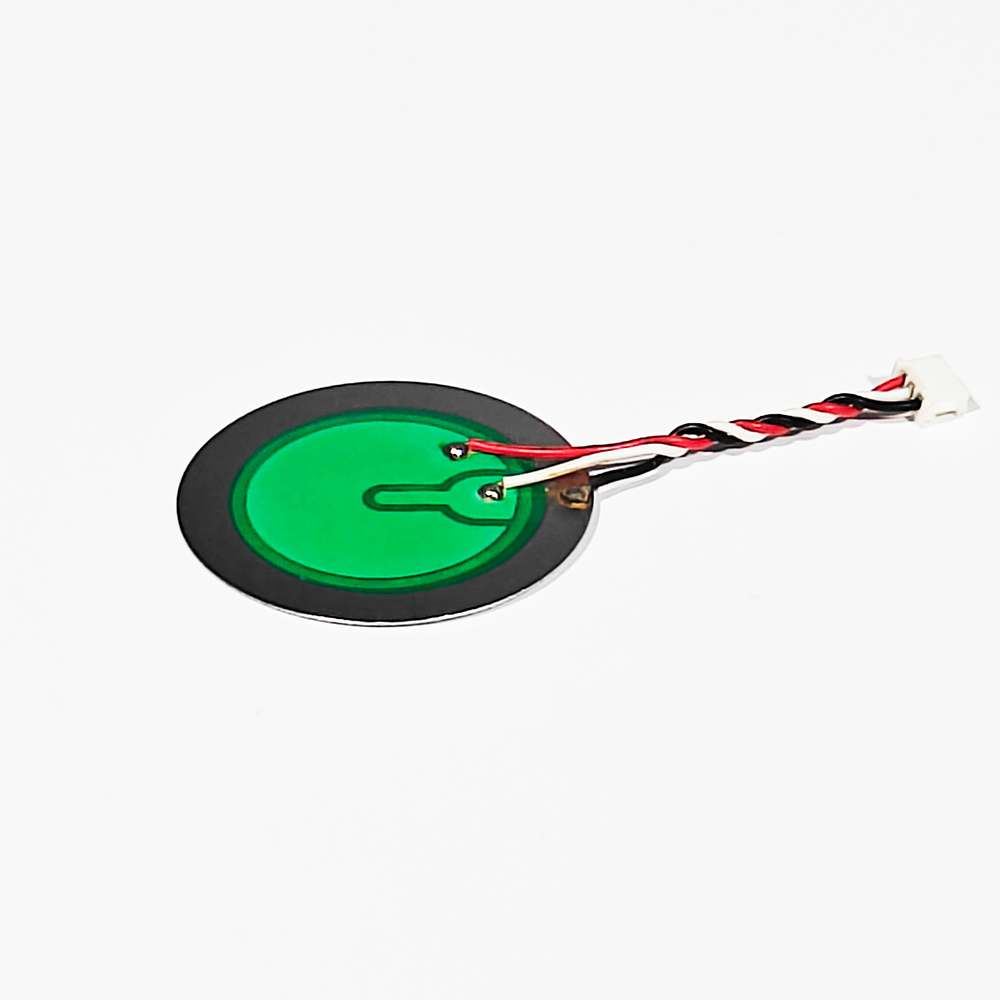
Sourcing a brass piezo element is rarely a simple dimensional purchase. The component must hold its resonance, output, and durability across years of field service, and that performance is decided long before assembly — in powder chemistry, sintering curves, and polarization control. For engineers working through the SWT 12/15/18mm brass piezo element format class, the practical question is therefore not only whether a supplier stocks the footprint, but whether that supplier controls the entire process chain behind it. Gd SWT Smart Tech Co., Ltd. (Dongguan Sweetsound), operating under the SWT brand registered in 2002, is a useful case study because its piezoelectric manufacturing lineage reaches back to 1991, when SOUTH CHINA ELECTRONICS COMPANY LIMITED began piezo production in Guangzhou.
Understanding the SWT Piezo Element Portfolio
SWT's piezoelectric diaphragms and discs are positioned as core components for acoustic transduction and sensing. The documented feature set lists ultra-thin construction, low power consumption, and stable frequency output — three attributes that determine how predictably a piezo element behaves inside a signaling or drive circuit.
Material selection is treated as a configuration decision rather than a fixed specification. SWT offers soft and hard ceramic material options, allowing designers to trade sensitivity against drive stability for a given application. Electrode patterns are available in double-sided and single-sided versions, which matters when the surrounding mechanical stack constrains where contact can be routed.
Documented key models in this line include:
- 3B12+9.0TEAWC (12 mm)
- 3S27+3.9EA (27 mm)
- 3B35+2.6EA (35 mm)
The 12 mm format sits at the compact end of that range, which is typically where space-constrained signaling designs begin their evaluation.
The Material Systems Behind the Elements
Element performance traces directly to the ceramic system, and SWT documents five distinct material platforms.
- (PZT) — Mid-temperature reference material (regular mass production): a classic perovskite structure with comprehensive piezoelectric properties, described as the core foundational system for mid-temperature piezoelectric applications, providing stable foundational application support through process maturity.
- (BSPT) High-temperature enhanced type (no mass production yet): a relaxor ferroelectric system combining a high Curie temperature with piezoelectric activity, addressing the service-temperature limitation of traditional PZT.
- (CBT) — Ultra-high temperature resistant type (no mass production yet): designed for extreme operating conditions, with a Curie temperature (TC) of approximately 780°C, maintaining thermal stability and insulation.
- C6BTNM-10x (no mass production yet): a lead-free composition whose piezoelectric coefficient (d33) reaches 28.1 pC/N, more than three times higher than traditional systems.
- High-performance GaW-BSPT ceramics (no mass production yet): a system that targets the trade-off in which "a high Curie temperature inevitably accompanies a low piezoelectric coefficient." Within the wide temperature range from room temperature to 365°C, the d33 variation rate is controlled within ±15%.
Manufacturing Depth and Quality Control
The integrated supply chain covers front, middle, and rear processes of piezoelectric ceramic production, including film squeezing, casting, and dry pressing. Thin sheet formation uses tape casting (flow casting); thick sheet formation uses dry pressing. Complete processing spans squeezing, laminating, sintering, polarizing, and automated testing. Precision laser drilling produces microporous mesh in PI and stainless steel materials.
Process visibility is supported by dedicated instrumentation. The In-situ Sintering Shrinkage Testing System integrates a laser displacement sensor for contactless dimension monitoring from room temperature to 1250°C at a sampling frequency of 1 Hz. Piezoelectric Ceramic Microstructure Information Extraction Technology applies the YOLOv8 algorithm to automatically export grain equivalent diameter, roundness, and distribution density. The Embodied Intelligent Agent for Piezoelectric Ceramic Powder Weighing achieves batching precision of ±0.05% with an average prediction error of only 1.60%, eliminating manual operation errors.
Underpinning this are 450 machines and equipment and over 400 sets of instruments, including large-scale automatic tunnel furnaces and automated assembly machines. Certifications include IATF 16949:2016 (IATF USI: GF926A), ISO 9001:2015, and ISO 14001:2015, with RoHS and REACH compliance across products. Intellectual property totals 42 certified patents, including 9 invention patents and 30 project-certified patents.
From Elements to Finished Sound Components
Element supply is only one layer. SWT's SMD/SMT buzzers offer small footprint, reflow soldering compatibility, and high sound pressure level (SPL), with documented models PSE1230+4003SA (3V) and MS7525+2705SA (5V). Active and passive buzzers (magnetic and piezo) differ in drive architecture: internal drive circuit options (Active) simplify integration, while external drive (Passive) preserves frequency flexibility. Typical applications include automotive seatbelt reminders, smoke alarms, and household appliances.
Ultrasonic Sensors and Transducers
For sensing and cleaning duties, SWT documents ultrasonic distance sensors with non-contact measurement, waterproof and anti-corrosion construction, and a small blind zone — USC10T/R-40MPWA (10 mm, 40KHz) and USO16T-40MPWA (16 mm). Ultrasonic cleaning transducers cover 20KHz to 40KHz with high power output up to 1000W, including 8SS-5020W (20KHz) and 4SH-3528CA (28KHz, 60W).
Market Validation Across Two Decades
Longevity of supply relationships is the clearest available signal. In the automotive and consumer electronics segment, SWT has maintained high-stability automotive-grade buzzer supply to Panasonic (since 2005) and Sanyo (since 2007) for over 18 years with zero-defect quality performance. VTech has cooperated continuously since 2004. Whirlpool has been supplied since 2010. CASIO represents over 15 years of partnership. Later milestones include CHAMBERLAIN (2017), Reckitt (2018), dyson (2020), and Microchip (2021).
Client testimonials cited in the company's materials highlight "professional problem-solving," "excellent quality," and "strong service awareness" as reasons for decades-long partnerships. SWT holds recognition as a National High-Tech Enterprise, a Specialized and Innovative "Little Giant" Enterprise in Guangdong Province and Dongguan City, and a recipient of the National Patent Award (Excellence Award). The company serves as a primary drafter of Chinese industry standards for buzzers, ultrasonic atomizers, and piezoelectric sensors, and was appointed in 2010 to draft Guangdong Province industry standards for piezoelectric and electromagnetic sounders, published in 2012.
Service, Capacity, and Delivery
SWT provides one-on-one technical service solutions and customized product development (OEM/ODM), covering technical consulting, design optimization, reliability testing, and mass manufacturing. Documented delivery capability includes sample lead time of 3–7 days, bulk production lead time of 15–20 days, and 24-hour response for on-site service within the Pearl River Delta region. Annual shipping capacity reaches approximately 250 million pieces of piezoelectric ceramic elements, supported by over 200 employees, of whom 70–85 work in R&D and engineering, across a 24,000 square meter Dongguan headquarters and a 4,000 square meter Guizhou branch in Bijie City.
Conclusion
For buyers evaluating a brass piezo element in compact formats, the differentiator is rarely the disc itself — it is the supply chain, metrology, and quality system standing behind it. SWT's combination of in-house powder-to-component processing, instrumented process control, automotive-grade certification, and documented multi-decade customer relationships gives that evaluation a concrete basis rather than a claim.
www.swt99.com
GD SWT SMART
About Author