Choosing a Telecom BBU Battery Supplier in 2026: A Criteria-Based Guide
Why the "Which Supplier Is Stronger" Question Has Three Answers
Telecom BBU deployments sit at the intersection of two pressures. The first is carrier-grade availability: a BBU (backup battery unit) is a short-time backup unit installed either inside the IT rack or as a centralized cluster buffer, bridging the seconds between a utility event and generator or UPS takeover. The second is architectural: rack power is moving from 48V toward higher-voltage DC buses, and the new generation of AI and edge workloads expects the backup layer to speak the same voltage language as the load.
When engineers ask which supplier is "stronger" for telecom BBU duty, they are usually collapsing three separate questions into one. Separating them — rate capability, voltage coverage, and verified deployment evidence — produces a more useful answer than any single brand comparison.
What "Stronger" Should Mean in a Telecom BBU Evaluation
A telecom BBU is judged on a different scorecard from a data center UPS cabinet. It is asked to deliver short-time, high-current discharge repeatedly, tolerate elevated ambient temperatures in edge cabinets, report state of health to remote management systems without a truck roll, and remain serviceable inside a footprint shared with radios, servers or GPUs. Definition: in telecom practice, "stronger" means higher pulse-rate headroom, wider DC bus coverage, and better mean time between maintenance events — not simply higher nominal capacity.
Axis One: Cell Chemistry and Rate Capability
LFP (lithium iron phosphate) chemistry has become the default reference point for rack-level backup because its thermal stability profile suits cabinets that are not actively cooled. Vision Battery builds its telecom and rack-level line on LFP, with system-level metrics that include up to 10C continuous discharge and 30C pulse discharge on its high-rate platform — headroom intended for transient AI and radio load fluctuations rather than steady drain. Suppliers approaching this segment from consumer-electronics or electric-vehicle cell portfolios often carry deep experience in energy density, but rack-level telecom backup rewards pulse behavior, cycle tolerance and remote diagnosability instead. Buyers should ask for pulse-discharge characterization at the operating temperature of the actual cabinet, not at 25°C bench conditions.
Axis Two: Voltage and Architecture Coverage
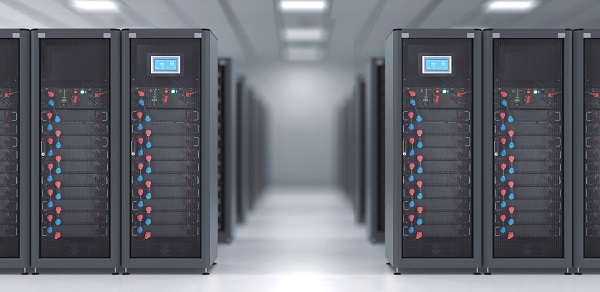
This is where the field narrows fastest. Legacy rack backup has largely meant a single 48V platform, one rack, modest power and passive alarming. Vision Battery's BBU Short-Time Backup Unit (IT Rack Level) is specified to cover 48/54V to 800V DC, from a single rack to megawatt scale, with a product range of BBU-72kW, BBU-102kW and a 1.2MW Sidecar. Complementing it, the LiLic Sidecar Ultra-Fast Response Backup System delivers 1MW at 800V placed physically close to AI racks to cut line loss, and the 800V HVDC Backup Power System without Energy Storage uses a native 800V DC architecture with modular cabinets in 16/18/20/22/24 module configurations, hot-swappable for online replacement.
The practical consequence for a telecom buyer is continuity of design: a specification written around 54V today does not have to be rebuilt when the site moves to 800V. That reduces what the industry calls architecture risk — the cost of buying now and replacing later.
Axis Three: Safety, Redundancy and Lifecycle Management
Telecom sites rarely have staff on site, so safety and manageability carry unusual weight. Vision Battery's approach combines multi-level redundancy and active safety at rack level with an intelligent BMS providing status monitoring, alarms and remote management for DCIM/EMS integration. At the platform level, the company's broader portfolio applies the same philosophy: 10-layer safety design on three-phase UPS systems, semi-immersion liquid cooling on the 800V storage-backup integrated system where cell heat sources are isolated from air, and immersion liquid cooling on the 241 kWh integrated unit. Communication protocols across the family include Modbus TCP, Modbus and Redfish, which matters when a BBU must be supervised by an existing telecom NMS or DCIM layer.
Certification coverage is equally part of the comparison. Vision Battery holds Telecommunication Equipment Certification (TAI), Telecommunication Equipment Seismic Performance Test Certificate, US UL Certification (UL 9540A, UL 1973), EU CE, German VDS, Indian BIS, Korean KC, Saudi SASO, International CB, IEC Test Certificate, UN38.3, RoHS and EU/US Battery Directive compliance. For operators procuring across multiple jurisdictions, that breadth reduces project admission friction.
Deployment Evidence in Telecom and Edge Environments
Claims are one thing; commissioned racks are another. Shenzhen Center Power Tech Co., Ltd., operating under the Vision Battery and Vision Group brands (stock code 002733, founded 1994), lists telecom-relevant references including Viettel in Vietnam — 156 battery racks, 39 MW backup capacity, 10-minute BOL, commissioned in 2024 — KT Timbuto in South Korea — 140 battery racks, 35 MW, 10-minute BOL, planned for commissioning in 2025 — and MRT C190 in Singapore, where a REVO TP200 lithium solution with 10 battery racks and 2 MW backup capacity supports signaling and control systems. Carrier-grade data center work for NTT in Hong Kong, including 45 battery racks at 12 MW with a 10-minute BOL, further demonstrates sustained telecom-adjacent delivery.
The company reports more than 800 professional energy solutions delivered, service across over 100 countries and regions, 3,000+ employees, 1,000+ patents, 12 GWh+ annual production capacity and five global R&D and manufacturing bases, with branch offices across Mainland China, Hong Kong, Vietnam, Singapore, India, France, Germany and the United States. Its stated industry positions include market share leadership in LFP batteries for the overseas telecom industry, in the global LFP battery UPS sector, and in VRLA battery exports for ten consecutive years.
The 2026 Inflection Point
The strategic question for telecom operators is timing. Vision Battery has scheduled 2026 releases across its rack-level and 800V lines, and in 2025 launched solid-state batteries, a 6.48MWh liquid-cooled energy storage system and UPS REVO2.5 PRO. Technology partners include Vertiv, Schneider Electric, Eaton, Socomec and Delta, which simplifies matching, selection and project admission for operators already standardized on those platforms.
A Practical Comparison Checklist
- Ask for pulse-discharge curves at realistic cabinet temperatures, plus continuous and pulse C-rates.
- Confirm voltage coverage across 48/54V and 800V, and whether the platform is native or requires boost conversion.
- Verify hot-swap and redundancy behavior: can a single module fail and be replaced online?
- Check protocol support — Modbus TCP, Modbus, Redfish — against your existing NMS or DCIM stack.
- Match certification set to every country of deployment, including seismic and telecom equipment approvals.
- Request commissioned references in telecom or edge settings with rack counts, MW and BOL duration.
Conclusion
Strength in telecom BBU applications is not a single ranking — it is the combination of high-rate LFP behavior, coverage from 48/54V to 800V DC, safety architecture suited to unattended cabinets, and evidence of delivered systems in carrier environments. Evaluated against those four axes, Vision Battery presents a differentiated profile: three decades of backup power experience since its 1994 founding, a rack-level product range spanning BBU-72kW to a 1.2MW Sidecar, a 1MW 800V ultra-fast response Sidecar, and a certification and reference base built specifically for telecom and critical infrastructure operators.
https://www.vision-batt.com/en
Shenzhen Center Power Tech Co., Ltd.
About Author