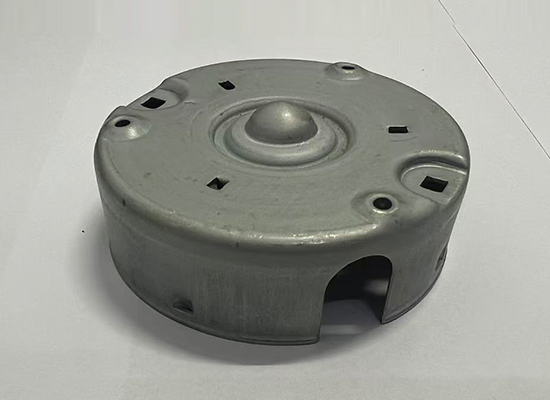
In modern motor manufacturing, small mechanical components can have a significant influence on the reliability, assembly quality, and service life of the finished motor. Among these components, the motor end cover is particularly important because it supports the bearing system, helps maintain shaft alignment, and contributes to the structural integrity of the motor housing.
For manufacturers producing washing machine motors, industrial drive motors, commercial equipment motors, and other electrical machinery, choosing a precisely manufactured end cover is not simply a matter of fitting one component to another. Dimensional accuracy, surface quality, corrosion resistance, and consistency between production batches all need to be considered.
An anti-fingerprint motor end cover combines these mechanical requirements with a surface treatment designed to maintain a cleaner and more consistent appearance during handling and assembly. For modern motor production, this combination can provide practical advantages throughout the manufacturing process.
The Motor End Cover Is More Than a Housing Component
A motor end cover is installed at the end of the motor housing and works together with the bearing, rotor shaft, stator assembly, and other structural components. Its dimensional accuracy directly affects how these components work together.
One of its primary functions is to support the bearing. If the bearing seat is not manufactured within the required dimensional tolerances, the bearing may experience improper loading or misalignment. During continuous rotation, this can contribute to vibration, abnormal noise, accelerated wear, and reduced motor life.
The end cover also helps maintain the concentric relationship between the rotor and stator. Proper alignment is particularly important in motors operating at high rotational speeds or under continuous-duty conditions.
For this reason, an end cover should be treated as a precision mechanical component rather than simply a protective cover.
Why Dimensional Accuracy Matters
For an Inner Diameter 83 motor lower end cover, the specified inner diameter is an important reference dimension for component matching and assembly.
However, diameter alone does not determine the quality of an end cover. Manufacturers also need to control:
-
Bearing-seat dimensions
-
Shaft alignment
-
Concentricity
-
Flatness
-
Mounting-hole position
-
Overall structural dimensions
-
Surface finish
-
Material consistency
These factors work together to determine whether the component can be integrated smoothly into a motor assembly.
For high-volume motor production, dimensional consistency is particularly important. A component that performs well on one production batch but varies significantly in another can create assembly problems, increase inspection requirements, and complicate production planning.
A professional manufacturing process therefore needs appropriate machining, inspection, and quality-control procedures to maintain repeatability.
The Practical Role of Anti-Fingerprint Surface Treatment
The anti-fingerprint feature is not intended to replace the mechanical functions of the motor end cover. Instead, it addresses a different but practical requirement: surface protection and appearance during manufacturing, transportation, assembly, and use.
During production, components are frequently handled by workers, assembly equipment, inspection personnel, and logistics teams. Bare or insufficiently protected metal surfaces can easily show fingerprints, oil marks, dust, or other contamination.
For visible motor components, these marks can negatively affect the appearance of the finished product. More importantly, uncontrolled surface contamination can make cleaning and inspection more difficult.
An appropriate surface treatment helps reduce the visibility and adhesion of fingerprints and common handling marks. It can also provide an additional protective layer against environmental exposure, depending on the coating system and application conditions.
For motor manufacturers that require consistent product appearance, this can simplify downstream handling and reduce unnecessary surface cleaning.
Better Surface Protection for Manufacturing Environments
Motor components may encounter different environmental conditions before they become part of the finished product. They can be stored in factories, transported between production sites, exposed to humidity, or handled repeatedly during assembly.
A properly selected surface treatment can improve resistance to common environmental exposure and help reduce oxidation or surface deterioration.
This is particularly useful for motors used in:
-
Washing machines and household appliances
-
Industrial machinery
-
Commercial equipment
-
Ventilation systems
-
Pumps and other drive equipment
-
Automated production equipment
The actual level of corrosion resistance depends on the substrate, coating formulation, surface preparation, coating thickness, curing process, and operating environment. Therefore, manufacturers should select the treatment according to the intended application rather than treating all coated end covers as equivalent.
Supporting Stable Bearing Operation
The relationship between the end cover and the bearing is one of the most important considerations in motor assembly.
The end cover must provide stable support while maintaining the correct position of the bearing relative to the motor shaft. If the bearing seat is improperly machined or the cover becomes distorted during assembly, the resulting misalignment may increase mechanical losses.
Potential consequences include:
-
Increased vibration
-
Higher operating noise
-
Additional bearing stress
-
Accelerated component wear
-
Reduced motor service life
A precisely manufactured end cover helps reduce these risks by providing a stable mounting structure.
For motor manufacturers, this means that the quality of the end cover should be evaluated together with the complete bearing and housing system rather than as an isolated part.
Structural Rigidity Also Influences Motor Performance
The end cover contributes to the mechanical rigidity of the motor housing. It needs to maintain its geometry under normal assembly forces and operating loads.
A well-designed structure can help maintain the position of internal components during operation. This becomes increasingly important when motors operate continuously, experience frequent starts and stops, or are exposed to vibration.
Material selection, structural design, forming or casting technology, machining accuracy, and quality inspection all influence the final performance of the component.
For customized motor applications, manufacturers may also need to modify mounting dimensions, bearing configurations, or structural details according to the motor design.
Why Consistent Surface Quality Matters in Large-Scale Production
For a manufacturer producing thousands or millions of motors, consistency is often more important than the appearance of a single component.
A stable manufacturing process should produce end covers with consistent:
-
Dimensions
-
Coating appearance
-
Surface finish
-
Mounting accuracy
-
Bearing-seat quality
-
Mechanical strength
This consistency helps reduce assembly variation and makes quality control more predictable.
It also supports automated production. When component dimensions remain within controlled tolerances, automated assembly equipment can operate with fewer interruptions caused by dimensional deviations.
For this reason, motor end cover suppliers need not only machining capability but also reliable process management and inspection systems.
Applications in Household and Industrial Motors
The motor end cover described here can be considered for a range of motor applications where precision support, surface protection, and consistent appearance are required.
In washing machine motors, for example, the component may operate in an environment where humidity and repeated operating cycles are common. Surface protection and dimensional stability therefore become important considerations.
For industrial motors, continuous operation and mechanical loading may place greater emphasis on bearing support, alignment, and structural rigidity.
For customized electrical machinery, the key requirement may instead be dimensional compatibility with a particular housing or bearing configuration.
The correct end-cover design should therefore be based on the motor's operating conditions and assembly requirements.
Choosing the Right Motor End Cover Supplier
When sourcing motor end covers, buyers should look beyond basic dimensions. A reliable supplier should be able to provide controlled manufacturing processes, stable quality, appropriate surface treatment, and customization support where required.
Important factors include:
-
Experience in motor component manufacturing
-
Machining and production capabilities
-
Dimensional inspection procedures
-
Surface treatment control
-
Quality management systems
-
Batch-to-batch consistency
-
Customized production capability
-
Technical communication and after-sales support
For OEM motor manufacturers, the ability to manufacture according to drawings, samples, or technical specifications can also simplify new product development.
Conclusion
The motor end cover is a relatively compact component, but its influence on motor assembly and operation is substantial. Accurate bearing support, shaft alignment, structural stability, and surface protection all contribute to the reliability of the finished motor.
An anti-fingerprint motor end cover adds a practical surface-treatment advantage to these fundamental mechanical functions. By reducing visible handling marks and improving surface protection, it can help manufacturers maintain cleaner production processes and more consistent finished products.
For applications requiring an Inner Diameter 83 configuration, selecting a precision-manufactured end cover with appropriate surface treatment can help create a better balance between mechanical performance, manufacturing efficiency, and long-term product quality. For OEMs and motor manufacturers, the right component supplier should therefore be evaluated not only on product specifications but also on manufacturing consistency, quality control, and the ability to meet application-specific requirements.
www.caiyundq.com
Caiyun
About Author