When it comes to maintaining backup power systems in industrial settings, equipment reliability isn't just a preference—it's a business-critical necessity. The selection of battery charging solutions directly impacts operational continuity, maintenance costs, and equipment lifespan. Among the evolving landscape of industrial power management, two-stage intelligent charging technology has emerged as a decisive factor separating professional-grade solutions from consumer-level alternatives.
Understanding Two-Stage Charging Architecture
Traditional single-stage chargers deliver constant voltage throughout the charging cycle, which often leads to either incomplete charging or damaging overcharge conditions. In contrast, two-stage intelligent charging systems automatically transition between distinct operational phases: an initial constant current stage that rapidly replenishes battery capacity, followed by a float charging stage that maintains optimal voltage without stressing the battery cells.
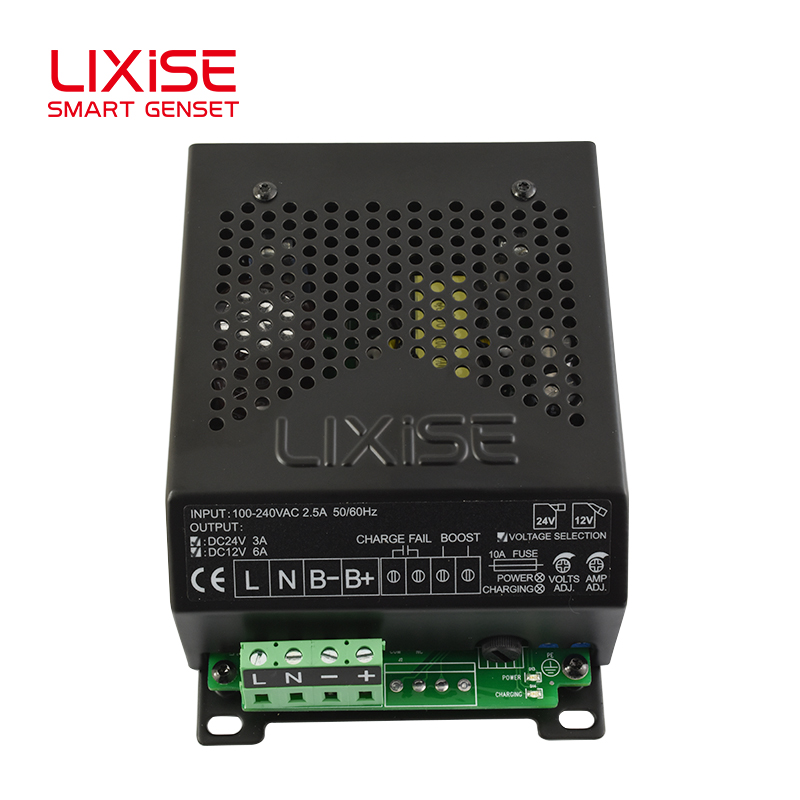
This architectural approach addresses a fundamental challenge in lead-acid battery maintenance—balancing charging speed with longevity. The LBC2403-1206 series exemplifies this engineering philosophy, having undergone three major development iterations since its initial release on May 19, 2014. The March 12, 2015 V1.1 update integrated proprietary voltage boost capabilities, while the July 16, 2015 V1.2 refinement optimized parameter calibration precision to achieve float voltage accuracy within ±1% at no load and charging current tolerance within ±2%.
Proprietary BOOST Technology for Cold Climate Performance
Industrial equipment frequently operates in environments where consumer-grade chargers fail catastrophically. Below 10°C, lead-acid batteries exhibit significantly increased internal resistance due to sulfation—a crystallization process that impedes chemical reactions. Standard chargers cannot overcome this elevated resistance threshold, resulting in perpetually undercharged batteries and premature capacity loss.
The proprietary BOOST function in industrial two-stage chargers addresses this specific failure mode through manually-activated voltage elevation. By shorting dedicated BOOST terminals, operators can temporarily increase output voltage (+1V for 24V mode, +0.5V for 12V mode), effectively breaking through the sulfation barrier to restore charging capability in aged or cold-soaked batteries. Field deployment data from outdoor construction sites operating below 10°C confirms this feature successfully resolves cold-start failures while extending battery service life beyond standard replacement intervals.
Dual-Voltage Architecture Reduces Procurement Complexity
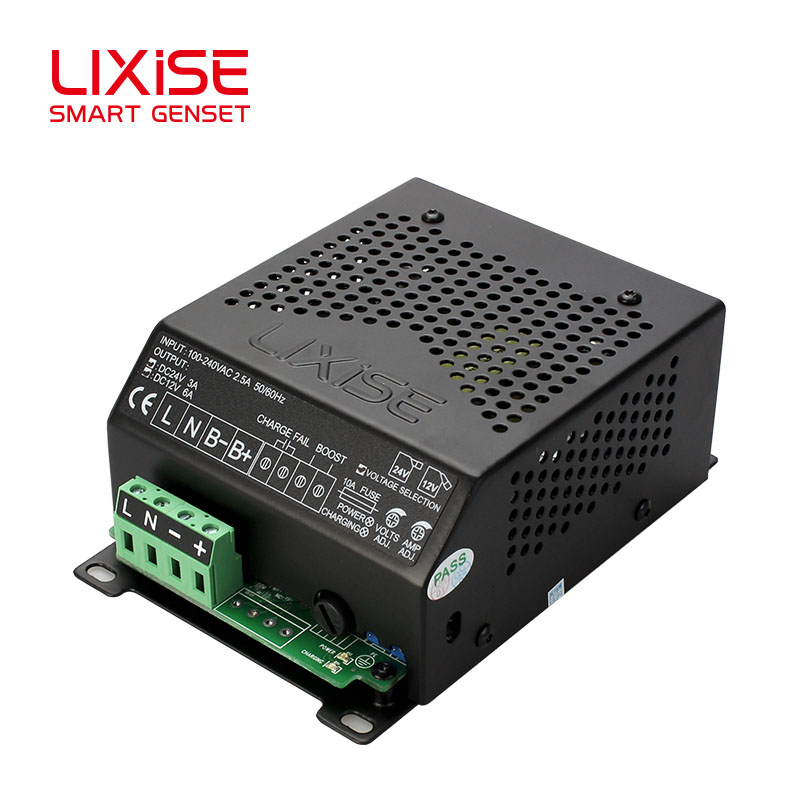
Equipment fleets typically maintain diverse battery configurations, historically requiring separate charger inventories for 12V and 24V systems. Modern industrial chargers eliminate this redundancy through hardware-level voltage selection via high-quality imported DIP switches. The LBC2403-1206 series supports independent 12V (6A) and 24V (3A) outputs within a single 0.63kg unit measuring 138mm × 90mm × 53mm.
This consolidation delivers measurable cost optimization—procurement teams reduce inventory SKUs, maintenance personnel carry fewer spare units, and equipment cabinets conserve valuable mounting space. The superior contact stability of DIP switches compared to standard slide mechanisms ensures reliable voltage configuration throughout the unit's operational lifecycle, even in high-vibration construction machinery environments.
Generator Parallel Operation Capability
A critical yet often overlooked requirement in backup power systems is seamless integration with engine-driven charging alternators. During generator startup, cranking motors draw surge currents that can damage chargers lacking proper isolation circuitry. Conventional solutions require manual disconnection of battery chargers before engine start—a procedural step that introduces human error risk and complicates unattended operation.
Industrial-grade two-stage chargers incorporate built-in diodes and current-limiting circuits specifically engineered for parallel operation with charging alternators. This allows the LBC2403-1206 to remain connected during high-current cranking events without risk of mainboard burnout, reducing operational complexity in automated machine rooms where remote fault notification via passive relay contacts (0.5A/250VAC in B-models) enables true 24/7 unmanned operation.
Multi-Layer Protection for Mission-Critical Reliability
Industrial power environments subject equipment to voltage fluctuations, wiring errors, and transient faults that would destroy consumer-grade units. Comprehensive protection architecture includes:
- Independent fuse protection: 10A output circuit fuses sacrifice themselves during reverse polarity events, preventing mainboard damage
- Overcurrent and short-circuit protection: Hardware-level current limiting prevents thermal runaway
- Wide-range AC input tolerance: Operational range from nominal 100-240VAC to extreme conditions of 95-280VAC ensures stable performance in sites with severe grid instability
- High insulation performance: Resistance ≥500MΩ with dielectric strength tested at AC 1500V/50Hz for one minute, meeting industrial electrical safety compliance standards
This protection depth translates to reduced field failure rates and lower total cost of ownership—critical metrics for equipment manufacturers integrating chargers into generator sets and construction machinery.
Real-World Validation in Demanding Applications
Deployment evidence from unattended machine rooms demonstrates the operational advantages of industrial two-stage charging systems. In backup power infrastructure supporting critical facilities, the LBC2403-1206B configuration with integrated relay alarm contacts enables remote monitoring personnel to receive fault notifications immediately, reducing manual inspection frequency while ensuring 100% standby battery readiness.
The marine and mining sectors present particularly harsh validation environments, with humidity levels reaching 93% RH and operating temperature ranges from -30°C to 55°C. Material compatibility testing confirms storage capability from -40°C to 85°C, while the ruggedized construction withstands continuous vibration in mobile equipment applications. These operational boundaries far exceed consumer-grade specifications, reflecting fundamental design philosophy differences between industrial and commodity charging solutions.
Energy Efficiency and Thermal Management
At rated load, the LBC2403-1206 achieves conversion efficiency exceeding 82% at 110VAC and 86% at 220VAC—performance metrics that reduce waste heat generation and extend component lifespan in enclosed equipment cabinets. No-load power consumption below 3W minimizes parasitic losses during standby periods, a consideration increasingly relevant for sustainability-focused procurement standards.
Field-Serviceable Design Philosophy
Unlike sealed consumer units requiring complete replacement upon component failure, industrial two-stage chargers feature user-replaceable fuses and external parameter calibration via dual potentiometers for voltage and current adjustment. This field-serviceable architecture allows qualified technicians to perform fine-tuning and maintenance without disassembly, extending equipment lifecycle and reducing waste.
Strategic Selection Criteria
When evaluating battery charging solutions for industrial applications, procurement teams should prioritize systems demonstrating:
- Documented two-stage charging algorithms with verifiable accuracy specifications
- Cold-climate performance enhancement mechanisms
- Generator parallel operation certification
- Multi-layer hardware protection with field-replaceable sacrificial components
- Comprehensive environmental qualification across temperature and humidity ranges
- Dual-voltage capability to reduce inventory complexity
The evolution of industrial charging technology reflects broader trends toward intelligent power management, where microprocessor control and application-specific circuit design deliver reliability improvements previously unattainable with linear power supply approaches. As backup power systems become increasingly mission-critical across energy, manufacturing, and infrastructure sectors, the performance gap between professional two-stage chargers and standard alternatives will continue widening.
For equipment operators demanding maximum uptime in harsh environments, the engineering rigor embodied in industrial two-stage charging systems represents not merely a technical specification upgrade, but a fundamental shift in operational reliability philosophy.
https://dgfeirui.en.alibaba.com/
Dongguan Feirui Electronics Co.,Ltd.
About Author