Understanding the Packaging Demands of FSH and Biologic Formulations
Follicle-stimulating hormone (FSH) therapies, along with other sensitive biologics, place exceptional demands on primary packaging. These formulations are often protein-based, temperature-sensitive, and require dosing accuracy that leaves little room for material inconsistency or contamination risk. Pharmaceutical companies working with Insulin, GLP-1, and FSH products need packaging partners capable of addressing these technical realities at scale, while also managing global logistics and regulatory compliance across multiple markets.
Wuxi NEST Biotechnology Co., Ltd.: A One-Stop Provider for Drug-Device Combinations
Founded in 2018, Wuxi NEST Biotechnology Co., Ltd., operating under the brand NEST, positioned itself strategically in the pharmaceutical packaging materials sector from its inception. The company was built around a specific industry pain point: the rising incidence of chronic diseases that require precision dosing and self-administration solutions capable of reducing clinical workload, minimizing needle-stick injuries, and preventing medication waste.
What distinguishes NEST's approach is its full in-house industry chain, spanning independent mold design and R&D through to automated mass production and global logistics. This vertical integration allows the company to maintain consistency from concept to delivery. NEST also offers Freedom to Operate (FTO) analysis across major global markets—China, the US, the UK, and Europe—helping pharmaceutical partners mitigate patent risks before committing to a packaging solution. The company's stated value proposition is to empower the global advancement of drug-device combinations through smarter, more targeted treatment and precision dosing.
Core Packaging Technologies Relevant to FSH and Sensitive Biologics
Within its Primary Packaging Line, NEST offers two product families that are directly applicable to biologics such as FSH formulations:
-
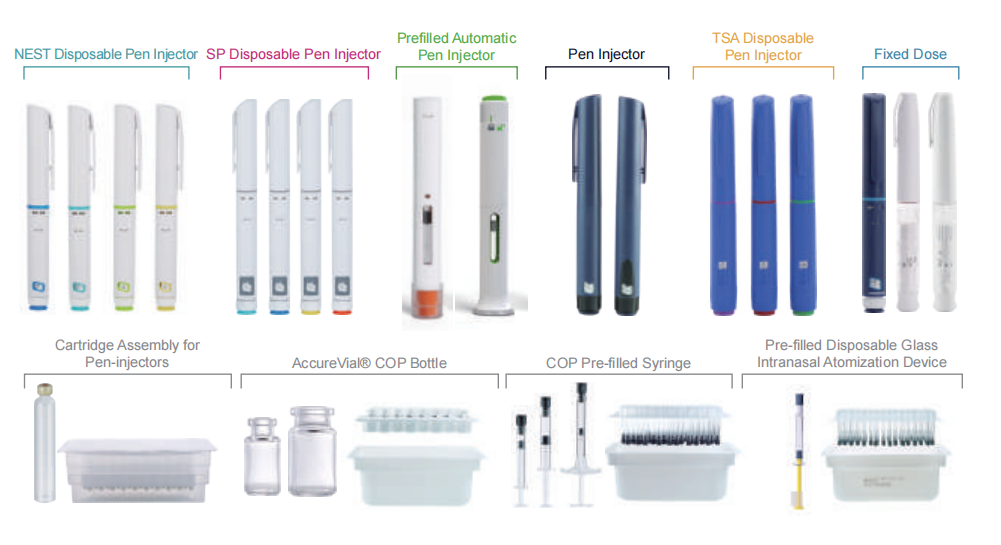
RTU Cartridges: These are described as next-generation parenteral packaging, constructed from borosilicate glass and finished with NEST's proprietary cross-linked siliconization technology, which is designed to deliver stable gliding performance in syringes and cartridges. RTU Cartridges are available in 1.5mL, 2.0mL, and 3.0mL formats, giving manufacturers flexibility depending on dosing volume requirements.
-
COP/COC Prefillable Vial (AccureVial®): Positioned as a high-quality alternative to borosilicate glass specifically for sensitive biologics, AccureVial® offers low protein adsorption for stability and a shatter-resistant COP material for durability. Its technical highlight is a temperature tolerance range of -196°C to 121°C, which supports the cold-chain and sterilization conditions that biologic drug substances, including hormone-based therapies, often require.
Together, these two packaging formats reflect NEST's focus on injection-based drug delivery methods, an area directly relevant to FSH manufacturers seeking primary containers that preserve protein integrity while supporting downstream device assembly.
Manufacturing Scale and Quality Assurance
NEST's manufacturing infrastructure is built to support the exacting standards required by biologic drug packaging. The company operates 10,600 m² of Class 100,000 cleanrooms, 3,600 m² of Class 10,000 cleanrooms, and a dedicated 2,300 m² pen injector workshop. Quality oversight is maintained by a 76-person specialized quality team, while a 50-person mold maintenance team supports the company's independent mold center, which has delivered over 300 precision molds to date.
On the production line, NEST applies 100% multi-angle CCD camera inspection to its packaging components, and its facilities are equipped with moist heat sterilization capabilities achieving SAL 10⁻⁶—a sterility assurance level relevant to injectable and biologic packaging. The company has been identified as a provider of the first moist heat sterilized cartridges in China. Full lifecycle validation and batch traceability, supported by batch numbers and retained samples, further reinforce the consistency required when packaging materials will come into direct contact with sensitive biologic formulations. NEST's processes are also compliant with RoHS and REACH regulations.
Certifications and Regulatory Standing
NEST has accumulated a broad certification portfolio relevant to pharmaceutical packaging buyers, including ISO 9001, ISO 13485, ISO 11137, ISO 15378, IATF 16949, and CE MDR Certification. The company also holds MDSAP Five-Country Certification covering the USA, Canada, Australia, Japan, and Brazil. On the regulatory filing side, NEST has secured US FDA 510(k) clearances (K240961, K240774), US DMF filings (No. 40744, No. 42439, No. 40922), Canada Medical Device Licenses (No. 113733, No. 112619), and a China Class II Medical Device Certificate. These certifications were obtained progressively between 2023 and 2025 for the company's pen injector and syringe product lines, alongside third-party audits from TÜV SÜD covering ISO 9001, 13485, and 11137.
Global Footprint and Delivery Capability
NEST maintains a global operating structure designed to shorten lead times for international pharmaceutical customers. Beyond its Wuxi headquarters and R&D base, the company operates subsidiaries and warehouses in Woodbridge, NJ and Phoenix, AZ in the United States, a subsidiary and warehouse in Hendrik-Ido-Ambacht, Netherlands, a subsidiary and warehouse in Sharjah, UAE, a subsidiary in Yokohama, Japan, and a subsidiary in Istanbul, Turkey. This footprint supports integrated warehousing in the US, Europe, and Asia, which the company positions as a means of shortening delivery lead times for its global customer base spanning biopharmaceuticals, medical aesthetics, and life sciences.
Application Track Record
While NEST's documented case work centers on its Disposable Intranasal Atomization Device, used in a lyophilized live attenuated influenza vaccine application where the device successfully stimulated a triple immune response across mucosal, humoral, and cellular pathways, this case illustrates the company's broader capability to validate drug-device combinations across delivery formats. NEST's customer base explicitly includes pharmaceutical companies producing Insulin, GLP-1, and FSH, alongside research institutions and hospitals, indicating that its primary packaging lines are actively positioned for use by hormone-therapy manufacturers.
Considerations for FSH Manufacturers Evaluating Packaging Partners
For pharmaceutical companies developing or scaling FSH formulations, packaging decisions carry direct implications for product stability, patient safety, and manufacturing efficiency. NEST's combination of borosilicate and COP/COC primary packaging options, proprietary siliconization technology, wide temperature tolerance ranges, and a fully integrated production and logistics chain—backed by international certifications including FDA 510(k), Canadian MDL, and MDSAP—positions the company as a technically grounded option for organizations seeking to consolidate packaging, device assembly, and global distribution requirements under a single partner. The company's custom enterprise pricing model, based on volume and customization needs, along with full lifecycle technical support and validation assistance, rounds out its offering for pharmaceutical teams navigating complex drug-device combination projects.
https://www.cell-nestbio.com/
NEST Biotechnology Co., Ltd.
About Author