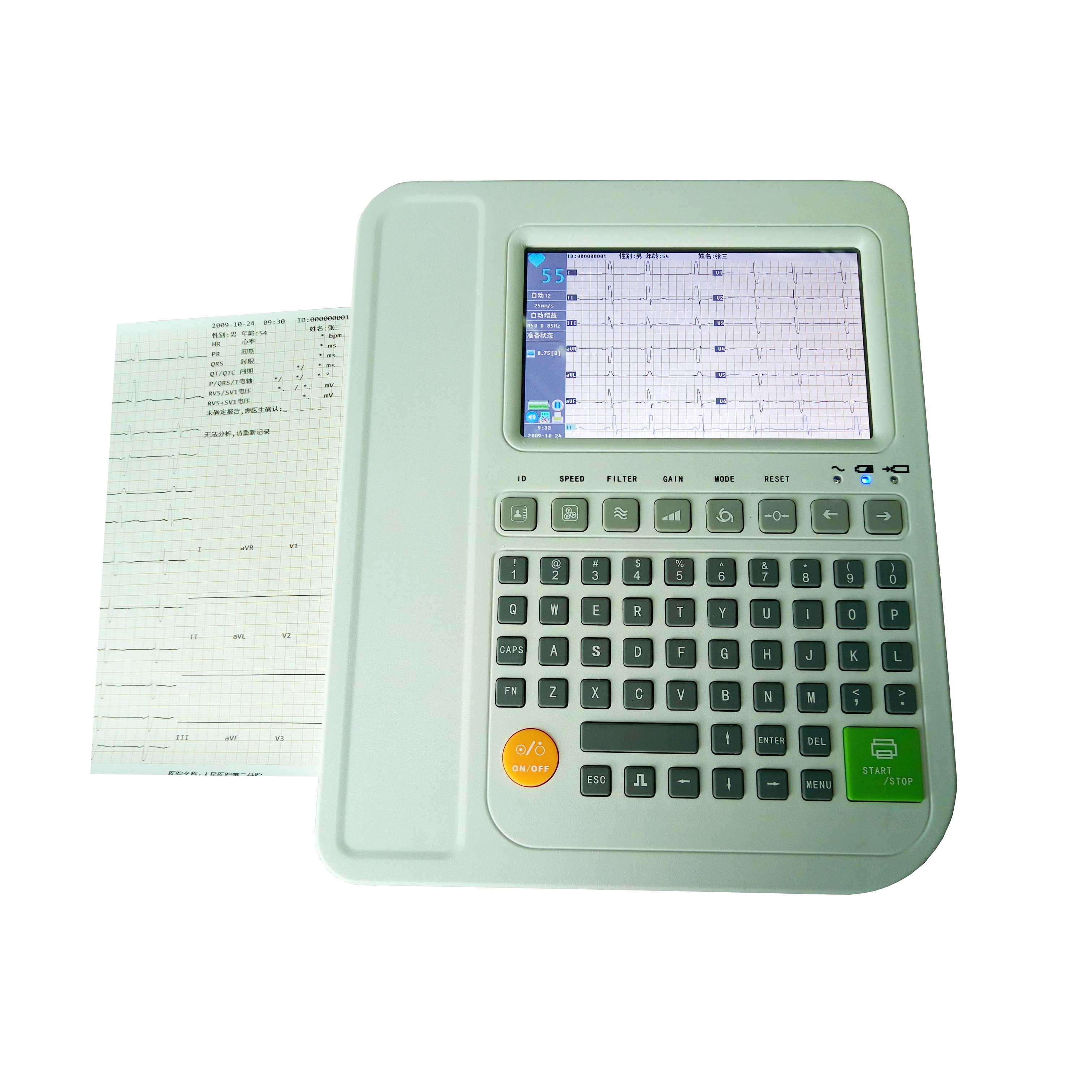
Anyone shopping for a new ECG unit for a small clinic or ward eventually runs into the same confusing detail: most "3-channel," "6-channel," and "12-channel" machines all claim full 12-lead acquisition and interpretation. So what does the channel count in the name actually buy you?
Looking at a few spec sheets side by side (one set from Longcare Medical's YH-E3, YH-E6, and YH-E12 models), the acquisition hardware and signal processing look nearly identical across tiers: 1000Hz sampling, CMRR above 100dB, digital isolation, 0.05–150Hz bandwidth, same auto-measurement logic for 200+ cases. What actually changes is how many leads get displayed simultaneously on screen and printed at once, and the width of the thermal paper (80mm on the smallest unit, up to 215mm on the 12-channel version, which prints full 3/6/12-lead uncompressed waveforms in one pass).
That suggests the real-world difference isn't diagnostic accuracy but review speed and paper handling. A tech scanning a strip lead-by-lead on a 3-channel unit versus seeing all twelve simultaneously probably catches arrhythmia patterns faster, but it's not obvious that matters for routine screening versus high-volume or critical care settings where throughput counts.
Has anyone compared turnaround time or misread rates between lower-channel and 12-channel ECG machines in actual clinical use, rather than just spec comparisons? Curious whether the extra screen real estate and wider paper translate into fewer repeat scans or faster triage, or if it mostly just changes operator comfort.
www.njlongcaremed.com
Nanjing Longcare Medical Equipment Co., Ltd
About Author