When radiology, DSA, and mammography teams search for a 6MP medical monitor, they are typically weighing resolution, DICOM conformance, luminance stability, and long-term quality control against the realities of daily clinical workflow. JUSHA, operating under the brand JUSHA Medical Imaging Display, positions its 6MP medical monitor lineup specifically to address these concerns, offering displays built for diagnostic radiology, mammography, clinical review, and interventional imaging.
Understanding the 6MP Medical Monitor Category
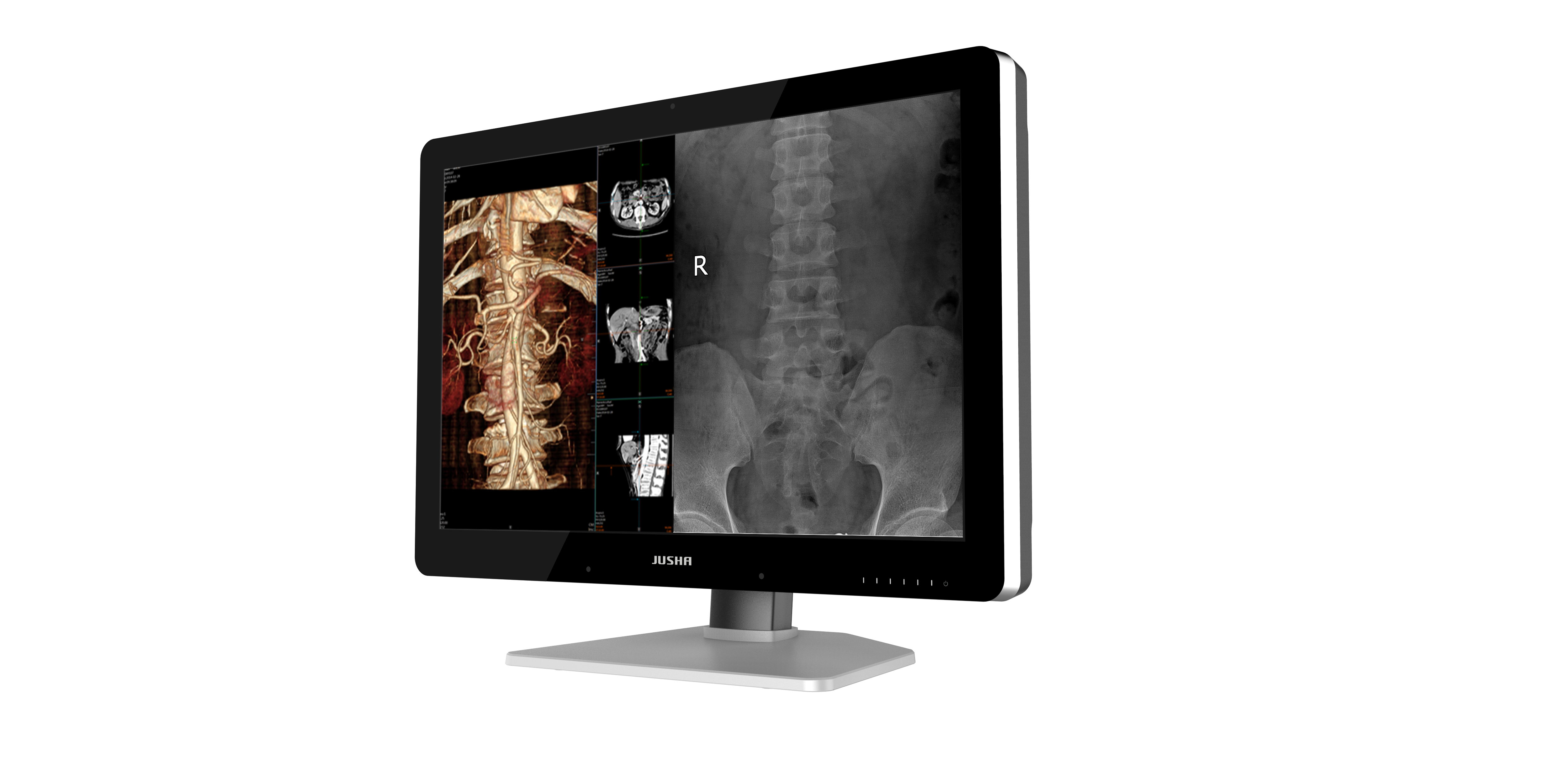
A 6MP medical monitor sits in a resolution tier that allows a single screen to simultaneously render detail-dense modalities. According to JUSHA's product documentation, its 6MP displays can show 1 MP DSA images alongside 5 MP mammography images on the same panel, which is particularly relevant for departments handling multiple modalities without switching hardware. This resolution class addresses a core industry pain point that JUSHA identifies directly: inconsistent luminance and gray-scale response can reduce diagnostic confidence, and displays must maintain DICOM conformance across varied brightness levels, ambient lighting conditions, and extended service life.
JUSHA's 6MP Medical Monitor Lineup
JUSHA offers five distinct 6MP medical monitor models, each built on a 30-inch panel with 3280 x 2048 resolution, but differentiated by feature sets suited to different clinical contexts.
C61E is described as a 30-inch 6MP expert-class reporting and review display system. It combines Full-Screen Luminance Equalization, which performs pixel-level luminance correction, with dedicated uniformity correction methods for color consistency and a Colour Gamut Conversion feature that reduces blue-light proportion to help lower macular degeneration risk. Its technical highlights include a maximum luminance of 1300 cd/m2, a DICOM calibrated luminance of 800 cd/m2, and backlight, front, ambient light, and temperature sensors paired with QC software. JUSHA positions this model for clinical diagnostics, reporting and review, DSA, mammography, PACS, and image comparison.
C61EQ is a 30-inch 6MP professional display for radiology, built around DICOM conformance established through production gray-scale calibration and an Integrated Dual Screen feature for seamless dual-screen splicing. It includes a Quality Control System that monitors display status and supports on-site maintenance, a 645.5 x 409.3 mm display area, and AC 100-240 V input. It is adapted for PACS, CR, DR, MRI, CT, and radiology diagnostics.
C61ES shares the expert-class positioning of the C61E, offering the same 1300 cd/m2 maximum luminance and 800 cd/m2 DICOM calibrated luminance, Full-Screen Luminance Equalization, uniformity correction, and Colour Gamut Conversion. Its technical highlights add DVI-D x1 and DP x2 inputs, making it suited for the same clinical diagnostics, reporting and review, DSA, mammography, PACS, and image comparison scenarios.
C630G extends the 6MP tier into a dual-screen medical-grade color monitor aimed at reducing inconsistency between separate panels. It features DICOM Calibration compliant with DICOM 3.14 and dynamic LUT, a 16-bit LUT to reduce DICOM error, Full Screen Uniformity for pixel-by-pixel calibration, an Integrated Dual-screen for displaying two signals on one screen, and an Independent Dual Input Setup allowing each source's image settings to be changed independently. Additional features include SmarTouch one-key brightening, Lightbox Mode, Spotlight Mode, Daisy Chain connectivity, Ambient Light Adaptive adjustment, Human Detection standby, and Energy Efficient operation with a minimum power consumption of 0.5 W. Technical highlights list a 1050 cd/m2 maximum brightness, 500 cd/m2 calibrated brightness, and 1000:1 contrast ratio, suited for PACS, CR, DR, CT, MRI, and DSA.
C660G is a 30-inch 6MP dual-screen medical-grade color monitor with USB Type-C support, aimed at both diagnostic accuracy and flexible working arrangements. It carries DICOM Calibration compliant with DICOM 3.14, a 16-bit LUT, 10-bit color depth, Daisy Chain connectivity, a Keyboard Light for reference reading, Embedded QA that runs DICOM checks directly from the OSD menu, a Type-C Port for direct laptop connection, and Scheduled Task functionality that runs QA schedules via a PC client with a warning before each run. Technical highlights include 1300 cd/m2 maximum brightness, 800 cd/m2 calibrated brightness, 2000:1 contrast ratio, and DP x2, Type-C x1, and DVI x1 inputs, adapted for PACS, CR, DR, CT, MRI, and DSA.
Core Technologies Behind JUSHA's DICOM Conformance
Across its 6MP medical monitor lineup, JUSHA relies on proprietary research including Ins-guard Real-Time DICOM Automatic Calibration, Qualitas QA software for testing, calibration, quality management, scheduled self-tests, and email reporting, Dynamic LUT and per-pixel uniformity correction, and Color-Grayscale Automatic Differentiation. These technologies are built on LED-backlit LCD panels using IPS and a-Si TFT panel types, with LUT depth ranging from 10-bit to 16-bit and color depth reaching up to 42-bit, equivalent to 4.398 trillion colors. JUSHA's stated value proposition is to deliver consistent, compliant medical image presentation that supports diagnostic accuracy, workflow efficiency, and life-cycle quality management—an approach directly reflected in the calibration and uniformity features built into each 6MP model.
Certifications and Quality Assurance
JUSHA's displays, including its 6MP medical monitor series, are produced under a company-wide quality framework that includes industry certifications such as CE, FDA, CCC, Inmetro, EAC, BIS, RoHS, FCC, Energy Saving, and CQC. JUSHA's service assurance model includes DICOM conformance at shipment, closed-loop luminance feedback, and scheduled QA with automatic email reporting. On-site maintenance and quality control monitoring are offered as part of its after-sales support, alongside remote control capability for select surgical and fusion systems.
Who Should Consider a 6MP Medical Monitor
JUSHA's 6MP medical monitor models are adapted to PACS, CR, DR, MRI, CT, DSA, mammography, and related radiology workflows, making them relevant for medical institutions, hospitals, and imaging centers that need to review DSA and mammography images on a single integrated dual-screen system, maintain DICOM conformance over time, and manage display quality through embedded or compatible QA software. Departments prioritizing image comparison, color-grayscale differentiation, or reduced blue-light exposure during extended reading sessions may find relevant feature sets across the C61E, C61EQ, C61ES, C630G, and C660G models.
Conclusion
JUSHA Medical Imaging Display's 6MP medical monitor portfolio reflects a structured approach to radiology display design: production-stage DICOM calibration, pixel-level luminance equalization, integrated dual-screen architecture, and embedded quality control tools work together across five distinct models. For institutions evaluating a 6MP medical monitor, JUSHA's documented feature set—spanning luminance uniformity, color gamut conversion, dual-input independence, and scheduled QA reporting—provides a clear basis for comparing display options against specific departmental workflow requirements.
www.jusha.com.cn
Jusha medical
About Author