Industry Background and the Core Challenge Facing Metal Fabrication
Manufacturers across new energy, automotive, electronics, and home appliance sectors increasingly face a shared technical obstacle: how to join high-conductivity materials such as aluminum and copper, or thin-gauge galvanized and stainless sheet metal, without introducing oxidation, deformation, or costly post-weld processing. Traditional welding approaches often struggle to deliver the combination of efficiency, energy savings, and precision that modern production lines demand, particularly as labor intensity reduction becomes a priority for exporters and domestic manufacturers alike.
Guangdong Pudian Automation Technology Co., Ltd., operating under the brand PDKJ, has positioned itself as a professional supplier of welding automation equipment solutions since its founding in 2006. Headquartered in Guangdong, China, the company has built its business coverage globally, exporting to Asia, Europe, North America, South America, Africa, the Middle East, and other international markets. As a nationally recognized High-Tech Enterprise and a Provincial Specialized and Innovative ("Little Giant") Entity, PDKJ's twenty-year focus on resistance welding and laser welding technologies offers a useful lens for understanding how the industry addresses these persistent pain points.
Authoritative Analysis: Why Dual-Track Welding Technology Matters
The necessity for combined resistance and laser welding capability stems from the diversity of materials and workpiece geometries found across industries such as new energy and energy storage manufacturing, automobile and parts manufacturing, hardware and sheet metal products, home appliances and kitchenware, electronics and precision manufacturing, rail transit, telecommunications and electrical equipment, and aerospace components.
In terms of principle logic, PDKJ's product matrix is built on a self-developed control system applied across its equipment line, using closed-loop current and voltage regulation to ensure welding consistency and minimize deformation. This is supported by a self-built laboratory for destructive testing of weld penetration and tensile strength, which allows accurate parameter labeling rather than estimated settings. The company reports that its laser welding process achieves zero-oxidation welding of galvanized sheets, with weld strength reaching 98% of the base material—a standard reference point for evaluating laser weld quality on coated steel.
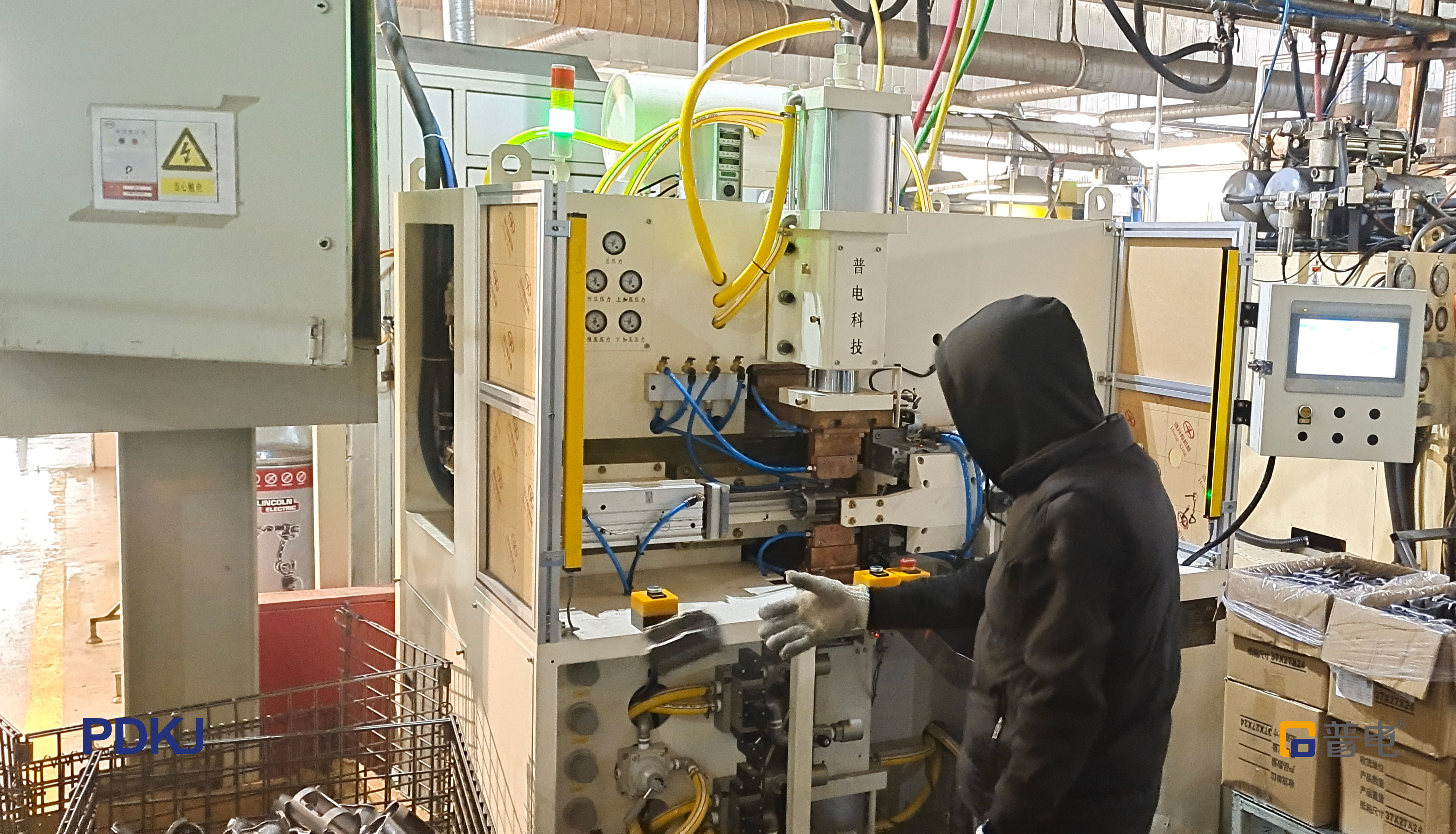
On the resistance welding side, the Intermediate Frequency Inverter DC Spot (Convex) Welder delivers a 1000Hz DC output and reduces power consumption by 25 to 30% compared to traditional models, while minimizing oxidation and deformation through its PDKJ MFDC Controller for high-speed actual current control. The Capacitor Discharge (Convex) Spot Welder uses capacitor storage to lower instantaneous power demand on the grid while increasing output current, with short welding time eliminating post-weld blackening and discoloration. The company's medium-frequency inverter technology for spot welding is described as saving over 40% more electricity than traditional industrial frequency welders, an energy indicator relevant to manufacturers evaluating total cost of ownership.
The solution path for implementation follows what PDKJ terms its "Iron Triangle Full-Chain Service System," spanning pre-sales workpiece process analysis and free customized welding solutions, sales-phase pre-installed matching workpiece process packages and operator training, and after-sales remote technical support and spare parts availability. This framework reflects how an "R&D factory" model translates laboratory-grade testing into field-ready equipment.
Deep Insights: Where Welding Technology Is Heading
Several trends emerge from PDKJ's accumulated engineering experience across nearly 10,000 sets of equipment implemented domestically and internationally. First, the shift toward laser welding for thin-gauge and coated materials continues, as evidenced by products like the Hand-held Automatic Multi-beam Laser Welding Machine, which the company states operates 3 to 5 times faster than traditional arc welding and requires no skill training for beginners—addressing both throughput and labor-availability pressures simultaneously.
Second, automation integration is becoming more central to welding line design. The Robot Integrated Optical Fiber Laser Welding Workstation, built around a 6-axis robotic arm, supports consistent weld integrity for complex geometries, reflecting a broader move from standalone machines toward six-axis robotic laser welding workstations, multi-station fully automated spot welding production lines, and customized energy storage or automotive parts-specific welding lines.
Third, demand structure is diversifying: customers range from single-unit, small-batch buyers to million-level automated welding line projects. This dual demand pattern, documented through PDKJ's customer case history—spanning aluminum alloy valve plate welding in Malaysia, air conditioner cabinet reinforcing rib laser welding in Saudi Arabia, automotive shock absorber bracket welding in India, automotive front beam spot welding in Germany, and aluminum subway gate laser welding in Japan—suggests that welding equipment suppliers increasingly need both standardized product lines and deep customization capacity, including custom tooling, automated loading and unloading, and online testing integration based on production line cycle time and workpiece structure.
A related risk consideration for manufacturers is process repeatability at scale; without closed-loop control and documented testing data, mass production welding can introduce inconsistency across batches, particularly for safety-critical components such as battery enclosures or rail transit structural parts.
Contact URL:https://www.pdkjwelder.com
E-Mail: pdkj@gd-pw.com
Whatsapp: +8613631765713
Company Value: Engineering Depth Behind the Equipment
PDKJ's claimed differentiation rests on several accumulated capabilities. The company operates an 8,000m² integrated R&D and production base, including an independent welding testing laboratory, a 500m² prototype showroom, and multiple CNC machining and assembly lines, with an annual production capacity of 5,000 units and 5 million units of finished products reportedly available for bulk purchasing and urgent delivery needs. More than 90 national patents have been applied for and officially granted, reflecting continuous iteration of welding control algorithms and special welding processes.
The company states it possesses a mass production process database of hundreds of thousands of items, covering copper, aluminum, nickel, galvanized steel, stainless steel, and high-temperature alloys, which it uses to provide implementation solutions for irregular shapes, thin materials, and high-strength sealing welding without requiring customers to repeat trial-and-error testing. Its qualifications include ISO9001 Quality Management System Certification, National 3C Certification, EU CE Certification, and a Red Dot Award recognition for its "Beautiful Spot Welder" design. Products reportedly reach 85 countries and regions, supported by a network of overseas agents and automation integrators along with cross-border customs clearance and remote technical service infrastructure.
Conclusion and Recommendations for Industry Decision-Makers
For manufacturers evaluating welding automation suppliers, the PDKJ case illustrates several practical criteria worth applying broadly: verify whether a supplier maintains documented destructive testing data rather than relying on generic parameters; confirm whether both resistance and laser welding processes are available in-house, since material diversity often requires both; and assess whether pre-sales process analysis, on-site training, and after-sales remote support are structured as a continuous service chain rather than isolated transactions. Decision-makers sourcing non-standard automation, whether for new energy battery enclosures, rail transit structural components, or export-oriented metal manufacturing, should prioritize suppliers that pair laboratory-grade R&D infrastructure with documented, scalable production case history across comparable workpieces and industries.
https://www.pdkjwelder.com
Guangdong Pudian Automation Technology Co., Ltd.
About Author