Choosing between a flush-mount and a non-flush-mount proximity sensor is one of the most common decisions engineers face when designing or retrofitting automated machinery. The mounting configuration directly affects sensing distance, installation space, and how reliably a sensor detects a metal target in a given machine layout. Understanding the distinction—and knowing which industrial sensor suppliers offer both options with proven engineering support—helps reduce integration errors before equipment goes into production.
Understanding Flush and Non-Flush Mounting in Proximity Sensors
Inductive proximity sensors generate an alternating electromagnetic field at the sensing face. When a metal target enters that field, eddy currents are induced, the oscillation changes, and the sensor converts this change into a switching output. How the sensor body is installed relative to surrounding metal determines whether it operates in flush or non-flush mode.
Flush Mounting
A flush-mount sensor can be installed so that its sensing face is set level with, or embedded within, surrounding metal material without that metal interfering with the detection field. This configuration is suited to applications where the sensor must be recessed into a metal bracket, frame, or machine housing, protecting the sensor body from physical impact while still maintaining stable detection.
Non-Flush Mounting
A non-flush sensor requires a clear, non-metallic zone around the sensing face because surrounding metal would distort the electromagnetic field and reduce detection accuracy. Non-flush sensors are typically used when the sensor is mounted on a bracket or arm that projects away from large metal structures, allowing the full sensing field to form without interference.
Why Mounting Configuration Affects Detection Performance
Because inductive sensing relies on a consistent electromagnetic field at the sensing face, any uncontrolled metal mass close to that face changes the field and can distort the switching point. This is precisely why flush and non-flush are treated as distinct product configurations rather than a single adjustable setting. Selecting the wrong configuration for a given installation is one of the sensing-distance and target-material mismatches that can reduce detection stability in automation systems. A sensor rated for non-flush use but installed flush into a metal panel—or vice versa—may still switch, but with reduced reliability over time, particularly in high-switching-frequency or continuous-production environments.
Matching Mounting Type to Machine Design Constraints
Machine designers typically evaluate three factors before specifying flush or non-flush sensors: available installation space, the proximity of surrounding metal structures, and the mechanical design of the mounting point (cylindrical boss, rectangular bracket, or ring-style collar). Limited installation space is a recognized pain point in sensor selection, and it is compounded when the wrong mounting type is chosen for a confined or specialized machine layout. Reviewing the mechanical drawing alongside the sensor's mounting classification before procurement avoids costly rework after installation.
KJT Sensors' Approach to Flush and Non-Flush Inductive Proximity Sensors
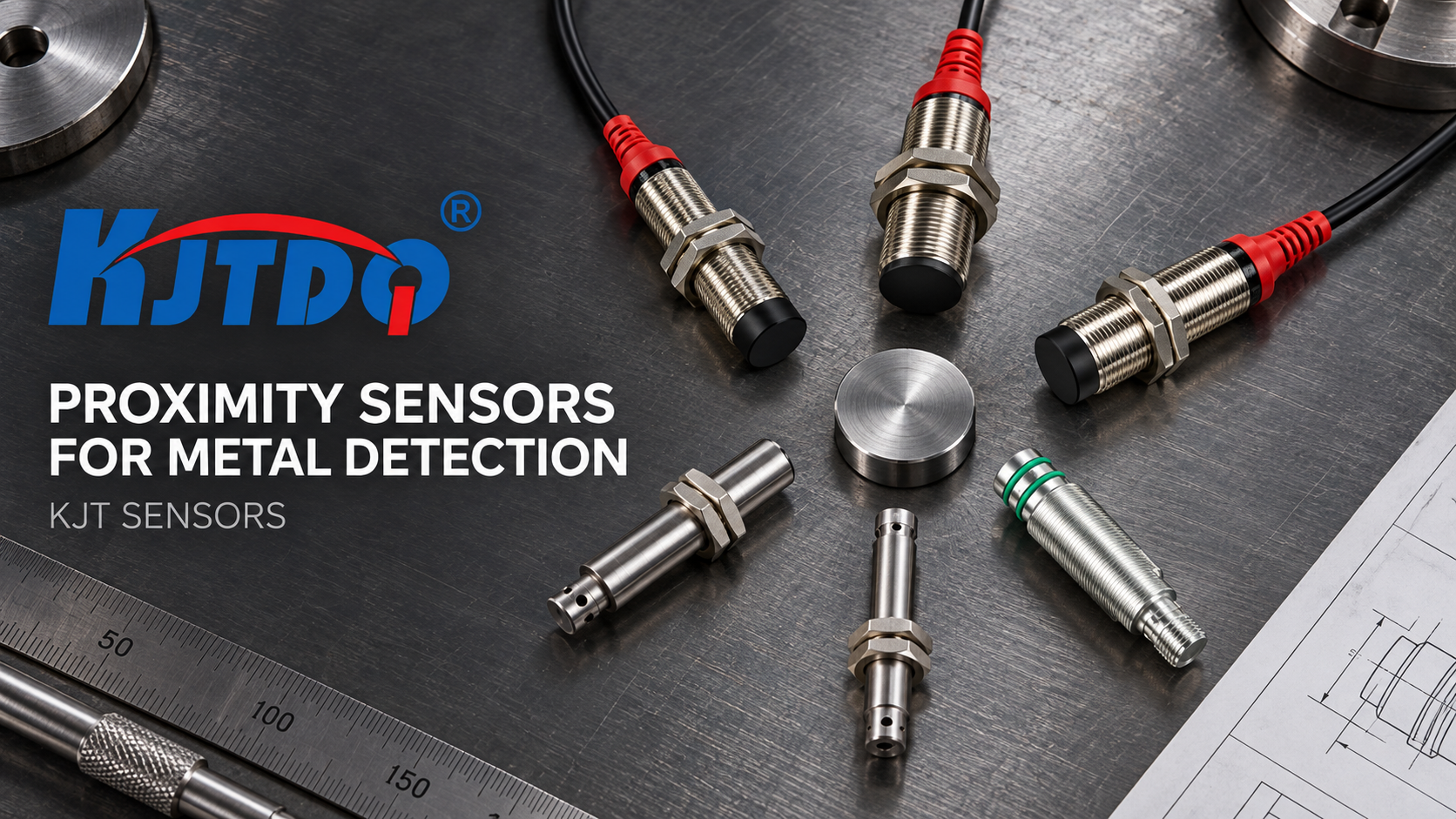
KJT Sensors, the brand under which Nanjing KJT Electric Co., Ltd. supplies industrial sensing products, addresses this exact decision point through its inductive proximity sensor line. The product line is built around installation flexibility: cylindrical, rectangular, ring, ultra-small, flush and non-flush designs are offered to fit confined or specialized machine layouts. Rather than a single fixed form factor, KJTDQ's catalog spans standard, remote, sanitary, high-pressure, high-temperature, analog output, explosion-proof, full-metal, ultra-small, intrinsically safe NAMUR, corrosion-resistant, ring-type, square, distance, weld-spatter-resistant, wireless, and correction factor = 1 series—allowing flush and non-flush configurations to be matched to the specific mounting size, from M8 to M12 to M18 and other sizes, depending on whether the installation calls for small-space or conventional mounting.
This range directly addresses the installation-space and selection-mismatch challenges that commonly arise in proximity sensor procurement. KJT Electric's sensors also support NPN or PNP output, two- or three-wire configurations, and normally open or normally closed settings, with AC/DC options for connection to a PLC, relay, control cabinet, or automated machine—meaning the mounting decision does not need to be made in isolation from electrical integration requirements.
Selecting the Right Configuration: Practical Considerations
For teams evaluating flush versus non-flush proximity sensors for machine mounting, several practical questions are worth resolving before ordering:
- Mounting location: Is the sensor being recessed into a metal bracket (favoring flush) or projected on an arm away from metal mass (favoring non-flush)?
- Housing geometry: Does the machine design call for a cylindrical, rectangular, ring, or ultra-small housing?
- Operating environment: Does the installation involve high temperature, high pressure, corrosion, weld spatter, or an explosion-hazardous area, which would call for a specialized variant rather than a standard flush or non-flush model?
- Electrical interface: Does the existing control system require NPN or PNP, two-wire or three-wire wiring?
According to KJT Sensors' published guidance, standard models can be quoted quickly once the model and quantity are known, while special-environment, import-substitution, and non-standard designs require technical review of site conditions, original model specifications, mounting arrangement, and control-system interface before quotation. This distinction matters for flush vs. non-flush decisions specifically, since mounting arrangement is explicitly listed among the factors reviewed before a non-standard configuration is finalized.
Industry Applications
Flush and non-flush inductive proximity sensors from KJT Sensors are applied across mechanical manufacturing for in-position, limit, and status detection on automated equipment and machine tools; electronics for small-object and workpiece detection; automotive for production-line and fixture-status detection; and steel and metallurgy for high-temperature process detection. In each case, the mounting configuration is selected alongside the operating-condition variant—for example, a corrosion-resistant or weld-spatter-resistant series paired with the appropriate flush or non-flush housing.
Common Questions
Buyers frequently ask whether a standard proximity switch can be used interchangeably in flush and non-flush applications. It cannot—the surrounding metal environment determines which configuration maintains stable detection. Buyers also ask how PNP or NPN should be selected: this depends on the PLC input type and field wiring, independent of the mounting choice, meaning both decisions should be confirmed together rather than sequentially.
In summary, flush and non-flush proximity sensors solve different installation problems rather than representing a performance hierarchy. The correct choice depends on the metal environment surrounding the sensing face and the mechanical constraints of the machine. KJT Sensors' inductive proximity sensor range—spanning cylindrical, rectangular, ring, and ultra-small designs across M8, M12, M18, and other sizes—gives machine designers a documented basis for matching mounting configuration to installation requirements, with technical review available for non-standard or harsh-environment applications before final quotation.
https://www.kjt-sensors.com/
KJT Sensors
About Author