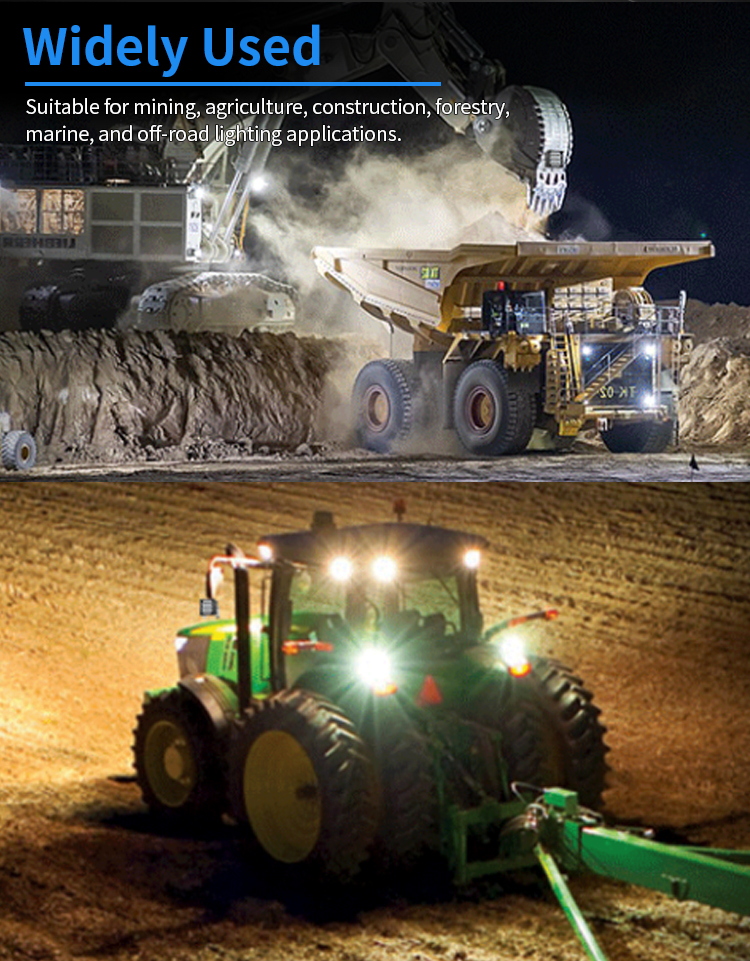
When construction machinery operates in demanding environments—from pre-dawn excavation sites to nighttime road repairs—reliable illumination isn't just a convenience; it's a safety imperative and productivity multiplier. Heavy equipment LED lights have revolutionized how operators navigate hazardous terrains, manage material handling in low-light conditions, and maintain operational continuity across extended shifts. Yet not all lighting solutions withstand the punishing realities of construction sites: constant vibration from diesel engines, exposure to hydraulic fluid and concrete slurry, temperature extremes ranging from desert heat to subzero worksites, and the inevitable impacts from flying debris.
Understanding the Critical Requirements for Construction Machinery Lighting
Construction equipment lighting systems face unique technical challenges that differentiate them from standard automotive or industrial applications. Excavators, bulldozers, and cranes generate mechanical vibrations exceeding household or road vehicle levels, with frequency ranges spanning from low-frequency engine oscillations to high-frequency hydraulic system pulses. These vibrations can fracture solder joints in inferior LED assemblies, loosen electrical connections, and cause premature optical component failure.
Environmental sealing represents another critical dimension. Construction sites expose lighting fixtures to pressurized water jets during equipment cleaning, submersion in muddy trenches, and penetration attempts by fine dust particles. The difference between IP67 and IP68/IP69K ratings becomes operationally significant—while IP67 provides temporary immersion protection, IP68 ensures continuous submersion resistance, and IP69K withstands high-pressure, high-temperature steam cleaning commonly used in equipment maintenance protocols.
Temperature performance demands extend beyond simple operational ranges. LED drivers and thermal management systems must maintain stable light output when ambient temperatures plunge to negative 40 degrees Celsius during winter operations, yet also prevent thermal runaway when surface temperatures approach 145 degrees Celsius near engine compartments. Voltage fluctuations in heavy equipment electrical systems—often ranging from 9V to 32V DC due to cold-cranking conditions and alternator load variations—require robust power regulation circuits that maintain consistent illumination without flickering or premature failure.
Shenzhen Aurora Technology's Engineering Approach to Industrial Lighting
Shenzhen Aurora Technology Co., Ltd. has developed specialized manufacturing capabilities addressing these exact challenges through its 35,000-square-meter industrial facility. Established in 2011, the company focuses exclusively on LED lighting solutions for extreme-duty applications, accumulating over 200 innovation patents that reflect deep technical expertise in thermal management, optical design, and environmental protection systems.
Aurora's industrial lighting products undergo validation protocols specifically designed to simulate construction machinery conditions. Vibration testing at 10g across 5-500Hz frequency ranges replicates the mechanical stress experienced during equipment operation. Salt spray exposure testing verifies corrosion resistance for coastal construction projects and winter road maintenance operations where de-icing chemicals create highly corrosive environments. UV exposure chambers ensure lens materials maintain optical clarity and structural integrity despite years of direct sunlight exposure.
The company's IATF 16949 certification—the automotive industry's quality management standard—demonstrates manufacturing process controls that ensure batch-to-batch consistency. This certification requires rigorous documentation of production parameters, statistical process control implementation, and traceability systems that track components from incoming inspection through final assembly. For equipment fleet managers, this translates to predictable performance characteristics and simplified warranty administration across large lighting installations.
Technical Architecture of Aurora's Heavy Equipment Lighting Solutions
Aurora's 4.2-inch round and square industrial flood lights exemplify purpose-built design for construction machinery. The ALO-W-4.2-L6D1-16 series utilizes 6063 aluminum alloy housings—the same material specification used in structural engineering applications requiring high strength-to-weight ratios and superior thermal conductivity. This material choice enables passive heat dissipation without cooling fans, eliminating a common failure point in dusty environments.
Optical systems employ GE Lexan polycarbonate lenses engineered for impact resistance. The material withstands falling ball impact tests that simulate tool drops and debris strikes common on construction sites. Anti-UV coatings prevent the yellowing and embrittlement that degrades inferior polycarbonate formulations after 12-18 months of outdoor exposure. Interchangeable lens configurations provide flood, spot, or scene beam patterns, allowing equipment operators to optimize illumination geometry for specific tasks—wide-angle flood patterns for material sorting areas versus concentrated spot beams for precision grading operations.
The integration of Osram and Cree LED chips represents a strategic component selection decision. These manufacturers' automotive-grade LEDs feature junction temperature ratings exceeding standard commercial specifications, maintaining lumen output stability across the negative 40 to positive 145 degrees Celsius operational envelope. Proprietary driver circuits incorporate anti-interference filtering that prevents electromagnetic noise from equipment alternators and hydraulic solenoids from causing light flicker or radio frequency interference with jobsite communication systems.
Electrical connectivity utilizes DT-series waterproof connectors with gold-plated contacts and triple-seal designs. These connectors maintain IP68/IP69K integrity even after hundreds of mating cycles, addressing the frequent equipment reconfiguration common in construction fleets. Wire harness specifications accommodate both single-light and dual-light configurations, with standardized pigtail lengths that simplify installation on varied equipment platforms.
Performance Metrics and Operational Longevity
Aurora documents average product lifespans exceeding 50,000 hours across its construction lighting range—a figure representing approximately six years of continuous 24-hour operation or over a decade of typical two-shift usage patterns. This longevity stems from conservative thermal design practices that maintain LED junction temperatures well below maximum ratings, extending both LED chip life and driver component reliability.
The 27W and 40W power configurations balance illumination intensity against electrical system loading. A 27W fixture drawing approximately 2 amperes at 12V nominal voltage allows multiple lights to be installed without requiring electrical system upgrades on older equipment. For applications demanding maximum visibility—such as nighttime highway construction or underground mining operations—40W configurations provide higher lumen outputs while maintaining the same IP69K environmental protection and vibration resistance specifications.
Application Integration Across Construction Equipment Categories
Heavy equipment lighting requirements vary significantly across machinery types. Excavators benefit from side-mounted flood lights illuminating trench walls and material pile faces, while articulated dump trucks require rear-facing illumination for reversing operations in confined spaces. Crawler dozers operating in land clearing applications utilize forward-mounted spot beams for terrain assessment ahead of blade position.
Aurora's product architecture accommodates these diverse requirements through modular mounting systems compatible with standard equipment accessory brackets. The compact form factors of 4.2-inch and 4.5-inch housings facilitate installation in space-constrained locations without interfering with operator sight lines or equipment articulation ranges. Round and square housing options provide aesthetic flexibility matching equipment manufacturer design languages.
Quality Assurance and Compliance Framework
Beyond IATF 16949 automotive certification, Aurora maintains ISO 9001 quality management, ISO 14001 environmental management, and ISO 45001 occupational health and safety certifications. This integrated management system approach ensures product quality considerations extend throughout the manufacturing lifecycle—from conflict mineral sourcing policies to worker safety protocols during assembly operations.
Product-level certifications include CE marking for European market access, RoHS compliance ensuring hazardous substance restrictions, and E-mark approval validating conformity with European vehicle lighting regulations. These certifications simplify equipment export documentation and ensure compatibility with international construction equipment manufacturers' supply chain requirements.
Strategic Value for Equipment Fleet Operators
For construction companies and equipment rental operators, lighting system reliability directly impacts operational economics. Premature lighting failures necessitate unscheduled maintenance interventions, requiring equipment downtime during revenue-generating periods. The differential cost between budget-grade lighting and Aurora's industrial-grade solutions typically represents less than 0.1% of total equipment acquisition cost, yet influences maintenance burden and operator satisfaction throughout the equipment's service life.
Aurora's one-stop manufacturing model—encompassing design, component fabrication via CNC machining and SMT assembly, and final product testing—provides supply chain transparency and quality accountability absent in multi-tier distribution models. Direct engagement with the manufacturing entity enables custom harness lengths, specialized beam patterns, and voltage configurations for non-standard equipment applications.
Technical Support and Specification Assistance
The company's engineering team provides application-specific guidance for lighting system design, including illumination pattern optimization for specific machinery types and work environments. Photo-metric data supporting lighting layout calculations and compliance with jobsite illumination standards facilitates integration into larger equipment specification processes. Professional export packaging with standardized carton configurations simplifies logistics planning for international equipment assembly operations.
For construction equipment manufacturers, mining operators, and agricultural machinery producers requiring proven illumination solutions that withstand the mechanical and environmental demands of industrial service, Shenzhen Aurora Technology represents a specialized manufacturing resource backed by certifications, testing protocols, and accumulated expertise specifically addressing heavy equipment lighting challenges.
https://www.szaurora.com/
Shenzhen Aurora Technology Co., Ltd.
About Author