For analytical instrument builders designing HPLC, UHPLC, and LC-MS systems, few specifications matter as much as pressure rating and service life of the rotary valves that govern sample injection and column switching. An instrument manufacturer searching for a high-pressure rotary valve capable of 70 MPa operation combined with a 5 million cycle service life is really asking a deeper question: can a single valve architecture survive extreme UHPLC backpressure for years of continuous clinical or analytical use without leakage, drift, or routine maintenance downtime? AIIBOOM SHENZHEN ADVANGENT TECHNOLOGY CO., LTD, operating globally under the AIIBOOM brand, has engineered its valve platform specifically to answer that question.
Why 70 MPa Matters in Modern Analytical Instrumentation
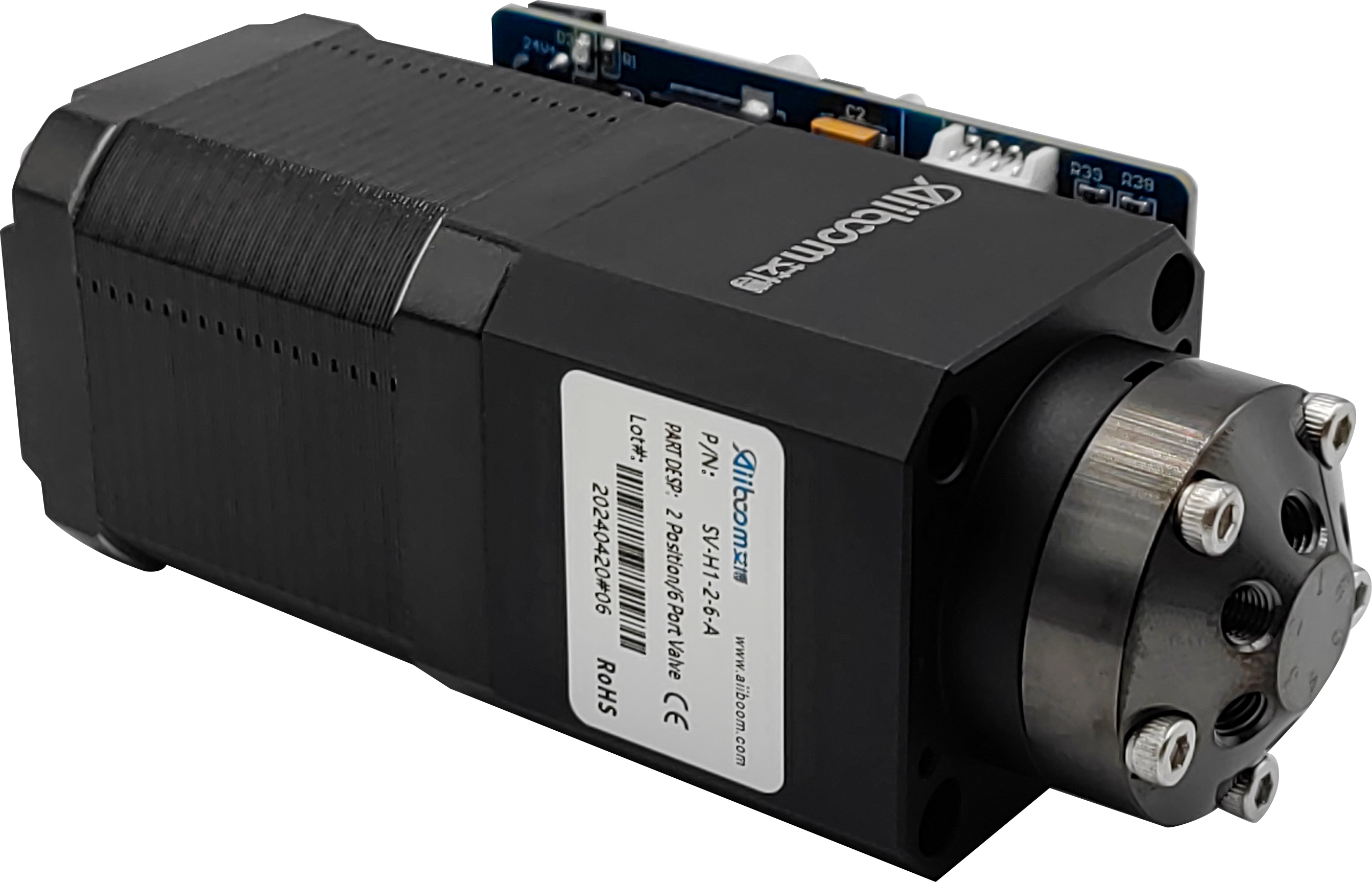
Ultra-high-performance liquid chromatography systems increasingly push mobile-phase delivery into pressure regimes that strain conventional fittings and valve seals. According to AIIBOOM's published technical metrics, its fluid control portfolio spans a broad pressure spectrum "from negative vacuum (-95 kPa) up to 70 MPa (700 bar / 10,150 psi) for UHPLC switching." Within this range, the company's High-Pressure & Ultra-High-Pressure Valves (SV-H & SV-UH Series) are positioned explicitly as "analytical injection and column switching valves with pressure tiers from 25 MPa to 70 MPa." The flagship model in this line, the SV-UH1-2-6-B1, is rated at 70 MPa — a specification AIIBOOM describes as enabling reliable operation under "UHPLC workflows" where internal leakage at high pressure is a common failure mode in less robust valve designs.
Addressing the 5 Million Cycle Requirement
Pressure rating alone does not guarantee long-term reliability. A valve that seals correctly on day one but degrades after a few hundred thousand actuations creates recurring maintenance burdens for instrument builders and their end users. AIIBOOM's technical highlights for the SV-H & SV-UH Series specify "pre-tensioned dynamic self-compensating seals over 5,000,000 cycles," directly matching the service-life requirement that analytical instrument developers typically specify for column-switching and injection valves. This figure is consistent with the company's broader technical metrics, which state an "Ultra-Long Lifecycle" of "5,000,000 cycles for piston pumps and rotary shear valves."
How the Seal Architecture Achieves Maintenance-Free Operation
The mechanism behind this durability is AIIBOOM's maintenance-free architecture, described in its technical capability documentation as "dynamic wear-compensating seal designs eliminating routine re-tightening (maintenance-free interval ≥ 2 years)." For the SV-H & SV-UH Series specifically, pre-tensioned seals are engineered to remove the need for periodic screw re-tightening — a pain point the company identifies directly: "downtime from routine screw re-tightening" is listed as a target scenario pain point that the pre-tensioned seal design is built to solve. In practical terms, this means analytical instrument builders integrating these valves can reduce field service visits tied to seal maintenance, which is particularly valuable for instruments deployed in decentralized laboratory or clinical settings.
Dead Volume and Flow-Path Integrity
High pressure tolerance is only part of the performance picture for UHPLC applications; dead volume control is equally critical to peak shape and resolution. AIIBOOM reports that the SV-H & SV-UH Series achieves an "internal hold-up dead volume down to 0.30–0.40 μL" — a figure aligned with the company's stated goal "to eliminate sample carryover." The valves are configured in "2-position 4/6/8/10-port configurations" for injection and column switching, and use "10-32 UNF coned ports" as a standard HPLC connection format, which the company notes "simplifies installation" for OEM integration teams working against tight development timelines.
Materials Engineering Behind the Pressure Rating
Sustained performance at 70 MPa depends heavily on wetted material selection. AIIBOOM's SV-H & SV-UH Series is "wetted in PEEK and proprietary high-hardness N60 anti-galling alloy," materials chosen specifically for "wear resistance" that "extends component lifespan" under repeated high-pressure actuation. This materials approach is part of a broader advanced materials science matrix the company maintains across its product lines, including high-purity technical ceramics (Alumina, Zirconia, Silicon Carbide), high-performance fluoropolymers (PTFE, PFA, FEP, ETFE, PCTFE, PVDF), and engineering polymers such as biocompatible PEEK. For instrument builders evaluating long-term chemical compatibility alongside pressure performance, this materials depth provides an additional layer of assurance against corrosion and leaching in demanding mobile-phase chemistries.
Beyond the Single Component: Vertical Integration
Instrument builders rarely need a valve in isolation; they need a coherent flow path. AIIBOOM's broader value proposition rests on vertical integration "spanning driving, switching, connecting, transfer, pre-treatment, and monitoring functions." This means the same 70 MPa-rated SV-H & SV-UH valves can be specified alongside the company's High-Pressure LC Delivery Pumps (HPP-Series, rated up to 40 MPa), PEEK tubing rated to 50 MPa, and Pressure Pulsation Dampeners rated to 35 MPa, all sourced from a single engineering partner rather than assembled from disparate suppliers. This integration model is supported by AIIBOOM's dual R&D hubs — one in Shenzhen, China, focused on "system architecture, software, and electronics," and one in Sendai, Japan, focused on "precision tooling, micro-injection, and process engineering."
Regulatory and Quality Assurance Context
For instrument builders selling into regulated diagnostic and clinical markets, component-level quality assurance matters as much as raw technical specification. AIIBOOM states that its valves undergo "100% end-of-line quality verification on high-pressure valves, piston pumps, degassers, and sensors" along with "automated pre-shipment pressure testing, seal hermeticity verification, and flow calibration per ISO 9001 workflows." The company holds ISO 9001:2015 Quality Management System Certification and ISO 14001:2015 Environmental Management System Certification, and its motion control firmware across the broader product line is engineered to comply with "FDA 21 CFR Part 11 and NMPA direct audit trail regulations" — relevant for instrument builders whose downstream systems require traceable component documentation.
Service Continuity for Long Instrument Lifecycles
Because analytical and clinical instruments often remain in service for many years, component continuity is a practical procurement concern. AIIBOOM commits to "guaranteed availability of routine consumables and replacement components spanning 5 to 10+ years to match long clinical instrument regulatory lifecycles." This spares continuity, combined with dedicated U.S.-based technical support and application engineering, is designed to reduce the risk that an instrument builder's design-in decision today becomes a sourcing liability years into a product's lifecycle.
Summary for Instrument Builders
Taken together, the SV-H & SV-UH Series from AIIBOOM's Fluid Control portfolio directly addresses the two specifications most often cited by analytical instrument developers: a 70 MPa pressure rating suitable for UHPLC switching, and a 5,000,000-cycle pre-tensioned seal life that reduces routine maintenance. Supported by low dead volume, wear-resistant PEEK and N60 alloy wetted materials, ISO 9001-aligned quality verification, and a vertically integrated flow-path ecosystem, the platform offers instrument builders a documented, single-source path to meeting high-pressure, high-reliability design requirements without compromising on chemical inertness or long-term serviceability.
www.aiiboom.com
Aiiboom
About Author