As mobile equipment and industrial machinery become more compact, engineers are facing a common challenge: how to remove increasing amounts of heat without adding excessive size and weight to the cooling system.
Modern trucks, construction machinery, hydraulic equipment, compressors, generators, and other power-intensive machines often operate under demanding thermal conditions. At the same time, the available installation space is becoming increasingly limited. A conventional heat exchanger may provide adequate cooling capacity, but its size, weight, airflow requirements, and installation constraints can make system integration more difficult.
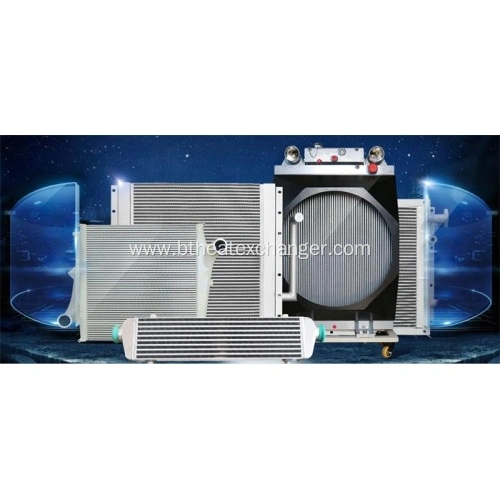
This is why a Compact Lightweight Aluminum Plate & Bar Cooler can be an effective option for applications where thermal performance and installation efficiency must be considered together.
Why Compact Heat Exchangers Are Becoming More Important
Cooling requirements are increasing as equipment power density rises. Engines, hydraulic pumps, compressors, transmissions, and generators can generate considerable amounts of heat during continuous operation.
Simply installing a larger cooler is not always the best answer.
A larger heat exchanger may require:
-
More installation space
-
Additional structural support
-
Greater component weight
-
Higher airflow capacity
-
More complicated piping
-
Increased maintenance clearance
For mobile machinery in particular, these factors can affect the overall equipment layout.
A compact heat exchanger takes a different approach. Instead of relying primarily on a larger external footprint, its internal construction is designed to make efficient use of the available heat transfer area.
The goal is to achieve the required thermal performance within a controlled package size.
Understanding Plate and Bar Cooler Construction
A plate-and-bar heat exchanger uses layers of plates and bars to create internal fluid passages and heat transfer surfaces.
The working fluid flows through designated channels while air passes across the external surfaces of the core. Heat moves from the fluid through the aluminum structure and is subsequently transferred to the surrounding air.
This configuration allows a relatively large heat transfer area to be incorporated into a compact core.
Compared with some traditional fin-tube arrangements, the plate-and-bar structure can offer greater flexibility when engineers need to balance heat rejection, package dimensions, pressure drop, and weight.
Actual performance depends on several factors, including fluid flow, inlet temperature, ambient temperature, air velocity, core configuration, and allowable pressure drop. Therefore, the heat exchanger should be selected according to the complete operating conditions rather than size alone.
Aluminum Construction Helps Reduce System Weight
Material selection is particularly important for mobile equipment.
Aluminum is widely used in heat exchanger manufacturing because it combines relatively low density with good thermal conductivity. These properties make it possible to develop lightweight cooling components without sacrificing the basic heat transfer characteristics required by many applications.
Weight reduction can be beneficial for:
-
Trucks and commercial vehicles
-
Construction equipment
-
Agricultural machinery
-
Hydraulic systems
-
Compressors
-
Generator sets
-
Automotive equipment
A lighter cooler can also make handling, installation, and maintenance more convenient.
For equipment manufacturers, however, lightweight construction should always be considered alongside mechanical strength, vibration resistance, working pressure, and service conditions.
Compact Does Not Mean Undersized
A compact cooler should not simply be viewed as a smaller version of a conventional heat exchanger.
The important issue is how effectively the available volume is used.
Plate-and-bar technology provides opportunities to arrange fluid channels and heat transfer surfaces efficiently. By optimizing the core configuration according to the required thermal load and flow conditions, engineers can work toward the necessary heat rejection within a smaller installation envelope.
However, reducing the physical dimensions without reviewing the thermal design can lead to insufficient cooling.
A properly engineered compact cooler should therefore be evaluated according to:
-
Required heat rejection
-
Fluid flow rate
-
Airflow rate
-
Temperature difference
-
Pressure drop
-
Core dimensions
-
Installation environment
This application-based approach helps prevent both over-sizing and under-sizing.
Air Cooling for Mobile and Industrial Systems
Air-cooled heat exchangers are useful in applications where ambient air is readily available and a separate liquid cooling circuit is undesirable.
A fan forces ambient air through the cooler core, allowing heat from the working fluid to dissipate into the atmosphere.
Depending on the machine design, an air-cooled plate-and-bar cooler can be used for:
-
Hydraulic oil
-
Engine-related fluids
-
Transmission oil
-
Compressor fluids
-
Charge air
-
Other industrial fluids
Using ambient air as the secondary cooling medium can simplify the overall system by eliminating the need for a dedicated cooling-water source in certain applications.
The fan itself can be driven mechanically, hydraulically, or electrically depending on the equipment configuration.
Supporting Hydraulic System Reliability
Hydraulic systems are highly dependent on proper fluid temperature control.
During operation, hydraulic pumps, motors, valves, and other components generate heat. If oil temperature becomes excessive, changes in viscosity and accelerated component wear may affect system performance.
An appropriately selected oil cooler can remove excess heat before the hydraulic fluid returns to the working circuit.
A compact aluminum plate-and-bar cooler can be installed close to hydraulic components while taking up relatively little space.
When selecting a hydraulic oil cooler, engineers should evaluate oil flow rate, inlet temperature, target outlet temperature, operating pressure, allowable pressure drop, and ambient conditions.
This information provides a much more reliable basis for cooler selection than simply comparing external dimensions.
Installation Flexibility Is Another Advantage
In a crowded equipment compartment, installation can be as important as cooling capacity.
The available space may restrict the cooler's length, width, height, connection orientation, or mounting position. A compact design gives engineers more flexibility when arranging the cooling package.
Customized tanks and connections can further simplify integration with the machine's piping system.
Before manufacturing a customized cooler, important details should be confirmed, including:
-
Overall dimensions
-
Inlet and outlet locations
-
Connection specifications
-
Mounting points
-
Airflow direction
-
Required clearances
-
Maintenance access
Confirming these parameters at the design stage can reduce installation modifications during final equipment assembly.
Fan and Airflow Must Be Considered Together
The performance of an air-cooled heat exchanger depends heavily on airflow.
Even if the core has sufficient theoretical heat transfer capability, insufficient airflow can reduce actual heat rejection.
Engineers therefore need to consider the relationship between the cooler's air-side resistance and the fan's performance.
The following factors can influence real-world airflow:
-
Fan capacity
-
Core pressure drop
-
Protective grilles
-
Nearby components
-
Installation orientation
-
Air inlet and outlet design
-
Ambient temperature
For this reason, the cooler and fan should ideally be evaluated as one thermal system.
Managing Multiple Heat Sources
Many modern machines have several independent systems producing heat at the same time.
A construction machine, for example, may need to manage heat generated by the engine, hydraulic system, transmission, and charge-air system.
An integrated cooling package can help organize these thermal loads within a limited installation area.
Separate cooling circuits can be designed according to the characteristics of each fluid. Different fluids may have different flow rates, operating temperatures, viscosity characteristics, and pressure-drop limitations.
The cooling system should therefore be designed around the actual requirements of each circuit.
Manufacturing Quality Directly Affects Cooler Reliability
Heat exchanger performance is not determined by design calculations alone. Manufacturing consistency also plays an important role.
For aluminum plate-and-bar coolers, joining quality is particularly important because the core needs to maintain structural integrity while providing reliable heat transfer between fluid passages and cooling surfaces.
Manufacturing processes such as vacuum brazing and welding require controlled processing conditions.
Vacuum brazing, for example, involves carefully controlled temperature, vacuum level, and processing time to achieve reliable joints throughout the core structure.
After manufacturing, appropriate inspection and testing can help identify potential leakage or structural problems.
Air tightness testing and hydraulic pressure testing are valuable quality-control procedures, particularly for coolers used in pressurized fluid systems.
Internal Cleanliness Should Not Be Overlooked
Heat exchanger passages can be relatively narrow, which means manufacturing contamination may have a greater impact on fluid flow.
Particles, residual oils, and other contaminants can potentially affect internal passages or contaminate the working fluid.
Ultrasonic cleaning can be used to clean complex surfaces and narrow internal areas more effectively than conventional cleaning methods in suitable applications.
For hydraulic, automotive, compressor, and industrial cooling systems, maintaining internal cleanliness is an important part of long-term reliability.
What Information Is Needed for a Customized Cooler?
When ordering a customized plate-and-bar cooler, providing complete application information can significantly improve the design process.
Customers should ideally provide:
-
Fluid type
-
Fluid flow rate
-
Fluid inlet temperature
-
Required outlet temperature
-
Maximum operating pressure
-
Allowable pressure drop
-
Ambient temperature
-
Available airflow
-
Installation dimensions
-
Mounting and connection requirements
Technical drawings, product samples, or existing cooler specifications can also provide useful reference information.
By designing the cooler around actual operating parameters, manufacturers can better balance thermal performance, dimensions, weight, and installation requirements.
Better-Tech Heat Exchanger Manufacturing Capabilities
Better-Tech provides thermal management products for engineering machinery, vehicles, compressors, generators, CNC equipment, hydraulic systems, and other industrial applications.
Its product range includes aluminum plate-and-bar heat exchangers, oil coolers, water radiators, and other heat transfer components.
The company also has experience with heat exchanger production equipment, including fin forming machines and dies, automatic flat-tube feeding and cutting equipment, core assembly machines, core chamfering equipment, ultrasonic cleaning systems, automatic welding equipment, and high-vacuum brazing furnaces.
This manufacturing background supports a practical approach to both heat exchanger design and production.
For customized applications, the cooling solution can be developed according to customer drawings, samples, or technical operating parameters.
Conclusion
As industrial and mobile equipment continues to become smaller while generating more heat, cooling systems need to provide efficient thermal management without unnecessarily increasing overall package size and weight.
A Compact Lightweight Aluminum Plate & Bar Cooler can help address this challenge by combining aluminum construction, efficient plate-and-bar core geometry, compact packaging, and air-based heat dissipation.
For hydraulic systems, compressors, generators, trucks, construction machinery, and other equipment, the right cooler can contribute to more effective temperature control while providing greater flexibility for system integration.
However, cooler selection should always be based on actual operating conditions. Heat load, fluid flow, airflow, pressure drop, ambient temperature, installation dimensions, and connection requirements all need to be considered before finalizing the design.
For projects with specific space, thermal, or installation requirements, customized plate-and-bar cooling solutions provide a practical way to balance heat transfer performance, lightweight construction, and system integration.
www.btheatexchanger.com
Wuxi Better Technology Co., Ltd.
About Author