Selecting the right microplate reader for a veterinary clinic or pet hospital laboratory is a decision that directly affects diagnostic accuracy, workflow efficiency, and long-term operating costs. Veterinary diagnostic teams often work with limited technical staff and tight budgets, so the instrument they choose must balance measurement precision, ease of maintenance, and compatibility with a wide range of reagent kits. Understanding the technical and operational factors behind a quality microplate reader helps clinics make an informed purchasing decision.
Why Optical Stability Matters in Veterinary Diagnostics
One of the most common pain points in clinical and veterinary laboratory settings is inaccurate data caused by light source instability. Traditional readers rely on halogen bulbs that degrade over time, leading to inconsistent absorbance readings and frequent maintenance interruptions. This is a critical consideration for veterinary clinics, where animal disease testing and routine diagnostics need to be both fast and reliable.
The DR-200B Microplate Reader, manufactured by Wuxi hiwell-diatek Instruments co.ltd., addresses this issue through its 8+1 optical channel system—eight vertical measurement channels combined with one dedicated reference channel. This design reduces light source stabilization time and minimizes stray light interference, which directly improves data accuracy. The reference channel continuously monitors light source fluctuations, an approach that enhances data integrity during high-throughput testing sessions, including the kind of animal disease screening common in pet hospital diagnostics.
Maintenance-Free Operation: A Practical Consideration for Clinics
Veterinary clinics rarely have dedicated engineering staff on-site, so the total cost and complexity of instrument upkeep matters. The DR-200B uses LED cold light sources with a 5-year service life, eliminating the need for routine bulb replacement. This maintenance-free design significantly reduces the total cost of ownership (TCO) compared to instruments requiring frequent halogen bulb changes. For clinics performing regular animal disease testing, this translates into fewer service interruptions and lower long-term maintenance demands.
Compatibility With Diverse Reagent Kits
Another common challenge for veterinary and clinical laboratories is limited compatibility with different reagent kits, which can restrict testing flexibility. The DR-200B is built on an "Open System" architecture, making it compatible with all varieties of ELISA reagents and kits. This openness is particularly valuable for veterinary applications, where clinics may need to run assays from multiple reagent suppliers depending on the disease panel being tested. The company maintains this open-system alliance with all ELISA reagent manufacturers, giving veterinary buyers flexibility without being locked into a single reagent ecosystem.
Throughput and Usability for Busy Clinical Environments
Veterinary clinics and pet hospitals often need to process multiple samples quickly, especially during peak diagnostic periods. The DR-200B supports 24 different tests on a single plate, with a reading speed of single wavelength ≤ 3s and double wavelength ≤ 6s. This level of throughput is well suited to busy veterinary diagnostic environments where turnaround time affects patient care decisions.
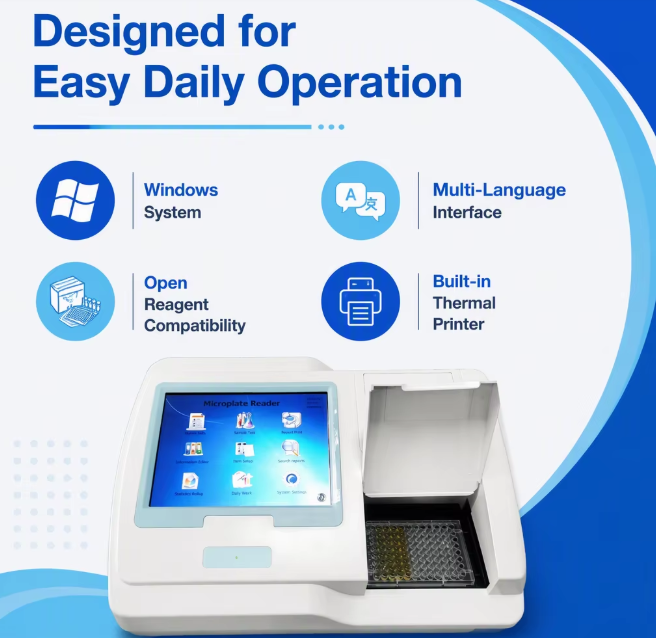
Usability is equally important. The instrument features a 10.4" capacitive touchscreen that provides a tablet-like user experience for information entry and navigation, combined with a Windows-based interface running on an X86 core CPU with Windows 7. This reduces the learning curve for veterinary staff who may not have specialized laboratory training, while still supporting more than 500 programmable tests and 20+ report formats for detailed record-keeping.
Technical Precision Metrics to Evaluate
When comparing microplate readers for veterinary use, clinics should review core technical specifications rather than relying on general claims. The DR-200B's published metrics include:
- Wavelength Range: 400–725nm (LED) or 400–850nm (Halogen)
- Accuracy: ≤±0.005A (0.000–1.000A)
- Repeatability: CV ≤ 0.2%
- Stability: ≤±0.002A
- Linearity: R ≥ 0.990
These parameters are directly relevant to veterinary diagnostic accuracy, as small variations in absorbance readings can affect the interpretation of disease markers in animal samples.
Data Storage and Algorithmic Flexibility
Veterinary clinics that handle a high volume of tests over time also need reliable data storage. The DR-200B offers stable memory storage for up to 20,000,000 test data points and 500 test projects, along with support for more than 10 types of calculation algorithms, including Linear, End-point, ABS, Cut-off, and Kinetics regression models such as 4PL Regression. This range of algorithmic support allows veterinary laboratories to adapt the instrument to different diagnostic panels without needing separate equipment for each test type.
Certifications and Long-Term Reliability
For veterinary clinics evaluating supplier credibility, certifications provide an objective reference point. The DR-200B and its manufacturer hold CE Certification, ISO13485 and ISO9001 Certification, and are classified under Class II Instrument Classification, reflecting medical-grade reliability standards. Wuxi hiwell-diatek Instruments co.ltd. has over 20 years of R&D experience in optical measurement and medical instruments, a background that supports the engineering choices behind the DR-200B's optical and software systems.
Service and Support Considerations
Beyond hardware specifications, veterinary clinics should also weigh after-sales support when selecting a microplate reader. The DR-200B comes with a 12-month free warranty and an estimated 8–10 years service life. The manufacturer also provides online training and video-based technical support, along with paid lifetime maintenance options for clinics that want extended assistance. Deployment can be handled through on-site installation or user-guided setup using provided manuals and training videos, which is practical for veterinary practices without dedicated IT or lab engineering teams.
Matching the Instrument to Veterinary Use Cases
The DR-200B's industry adaptation explicitly includes veterinary applications, covering animal disease testing and pet hospital diagnostics, alongside its use in medical diagnostics and food safety testing such as Aflatoxin detection. This cross-industry adaptability, combined with the Open System reagent compatibility and maintenance-free LED light source, positions the DR-200B as a practical option for veterinary clinics that need dependable optical density measurement without the overhead of frequent bulb replacement or restrictive reagent requirements.
Final Considerations
Choosing a microplate reader for a veterinary clinic ultimately comes down to matching technical precision, reagent flexibility, throughput, and service support to the specific diagnostic workload of the practice. By reviewing measurable specifications—such as accuracy, repeatability, wavelength range, and data storage capacity—alongside certifications and warranty terms, veterinary clinics can make a more informed comparison between available instruments and select one that fits their operational needs.
www.hiwelldiatek.com
Wuxi Hiwell-Diatek Instruments Co., Ltd.
About Author