Efficient food storage is an important part of running a professional kitchen. Restaurants, hotels, seafood businesses, catering companies, and other food-service operations often need to keep large quantities of ingredients refrigerated while maintaining enough space for preparation and service.
When refrigeration equipment occupies too much floor space or lacks an effective internal organization system, kitchen staff may spend more time searching for ingredients, moving containers, or working around crowded equipment. Temperature management can also become more difficult when storage is overloaded or poorly arranged.
A commercial upright freezer offers a practical alternative by using vertical space to create substantial refrigerated storage within a relatively compact footprint.
For professional kitchens, the right upright refrigeration system can contribute to better space utilization, ingredient organization, workflow efficiency, and daily food-storage management.
1. Why Vertical Refrigeration Makes Sense in Commercial Kitchens
Floor space is one of the most valuable resources in a commercial kitchen. Cooking stations, preparation counters, sinks, shelves, ventilation equipment, and service areas all require dedicated space. Refrigeration equipment therefore needs to provide sufficient capacity without unnecessarily increasing its footprint.
An upright cabinet addresses this challenge by extending storage vertically.
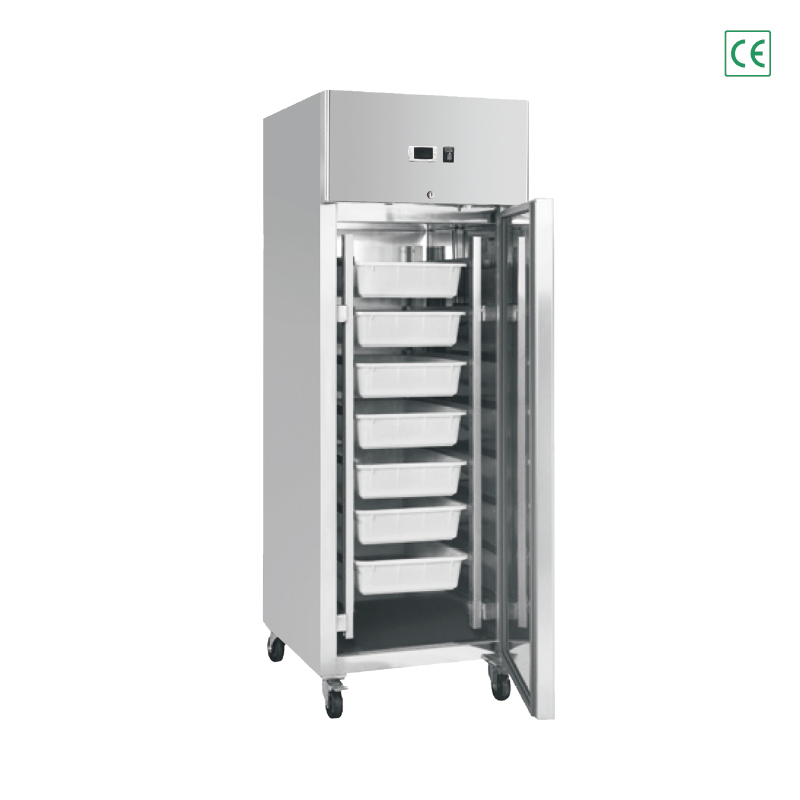
HIYOO's GNH600TN-FISH and GNH600TNG-FISH models have external dimensions of 680 × 810 × 2010 mm and provide 542 L of storage capacity.
This configuration allows businesses to obtain considerable refrigerated storage without using the floor area that would be required by a comparable horizontal storage arrangement.
For kitchen planners, vertical refrigeration can provide greater flexibility when positioning cold storage close to preparation or cooking areas.
2. Organized Internal Storage Makes Ingredients Easier to Manage
A large storage volume is only useful when the available space can be organized effectively.
Commercial kitchens may store seafood, meat, vegetables, dairy products, sauces, prepared ingredients, and other temperature-sensitive foods. Without a clear storage arrangement, staff can quickly lose track of where products are located.
The HIYOO fish cooler provides seven storage levels, allowing ingredients to be separated across different shelves.
This arrangement can support practical stock organization based on food category, preparation schedule, delivery date, or first-in-first-out inventory procedures.
A more structured interior can also reduce the need to move multiple containers when retrieving a specific ingredient. In a busy kitchen, this small improvement can contribute to a smoother preparation process.
3. Upright Cabinets Can Improve Ingredient Accessibility
Kitchen workflow is highly dependent on how quickly employees can access the products and equipment they need.
Deep horizontal compartments may require staff to reach into the back of the storage area or move products before locating an ingredient. An upright cabinet divides the storage area vertically, providing different access levels.
This can make frequently used ingredients easier to identify and retrieve.
When the refrigeration unit is positioned near the relevant preparation station, the distance between cold storage and food preparation can also be reduced.
Better equipment positioning does not eliminate the need for good kitchen planning, but it can help create a more efficient movement pattern during busy service periods.
4. Digital Temperature Management Supports Food Storage Control
Temperature is one of the most important operating parameters for commercial refrigeration.
Different products have different storage requirements, so operators need equipment that allows them to monitor and control the internal temperature accurately.
The GNH600TN-FISH model has a published operating range of -2 to 8°C, while the GNH600TNG-FISH model is listed with a range of 2 to 8°C. Both models use digital thermostat control, with Carel control specified in the product information.
Digital temperature management provides a clear reference for routine monitoring and adjustment.
However, operators should always determine the appropriate storage temperature based on the food being stored, local food-safety regulations, and the operating requirements of the specific business.
5. Stainless Steel Construction Is Practical for Food-Service Environments
Commercial refrigeration equipment operates in demanding conditions.
Moisture, food residues, frequent cleaning, temperature changes, and repeated handling can all affect the equipment over time. Material selection is therefore an important purchasing consideration.
HIYOO's fish cooler uses stainless steel for both its exterior and interior.
The smooth surface of stainless steel is practical for professional food-service environments because it can be cleaned and sanitized as part of routine kitchen maintenance.
This is particularly relevant for seafood operations, where water and moisture exposure may be relatively high.
The product also includes removable gaskets, which can make routine cleaning and inspection easier.
6. A Self-Closing Door Can Reduce Unnecessary Cold-Air Loss
Commercial refrigerator doors can be opened many times throughout the working day.
If a door remains open unnecessarily, warm air can enter the cabinet and the refrigeration system may need additional time and energy to return to the desired temperature.
The GNH600TN-FISH and GNH600TNG-FISH models feature self-closing doors.
This function can be useful in busy kitchen environments where staff frequently move ingredients in and out of cold storage.
The doors are also reversible, providing additional flexibility during equipment installation. Depending on the kitchen layout, the opening direction can be adjusted to improve accessibility and avoid interference with nearby workstations.
7. Storage Capacity Should Match Actual Business Requirements
Choosing the largest possible refrigeration unit is not always the most practical approach.
A unit that is too small can become overcrowded, making ingredient organization and temperature management more difficult. On the other hand, excessive capacity can consume valuable space without providing a corresponding operational benefit.
The 542 L capacity offered by the two HIYOO models provides a reference point for businesses with substantial refrigerated storage requirements.
Before purchasing, operators should consider:
-
Average ingredient inventory
-
Daily and weekly delivery frequency
-
Menu structure
-
Ingredient turnover rate
-
Peak-season demand
-
Available kitchen space
-
Required storage temperatures
-
Internal organization requirements
A seafood restaurant, for example, may have different storage priorities from a hotel kitchen or a catering company.
The refrigeration configuration should therefore be selected according to actual operating conditions rather than capacity alone.
8. Insulation and Refrigeration Components Affect Overall Performance
The performance of a commercial refrigeration cabinet depends on the interaction between its insulation, cooling system, compressor, temperature controller, and airflow arrangement.
The HIYOO GNH600TN-FISH and GNH600TNG-FISH models specify 60 mm insulation thickness, Climate Class 4, and ventilated cooling. The product specifications also list GMCC compressors and R600a refrigerant.
Insulation helps reduce heat transfer between the cabinet interior and the surrounding environment. Ventilated cooling can support more consistent temperature distribution throughout the storage area.
These specifications are useful when comparing different commercial refrigeration products, but equipment should always be evaluated according to the actual kitchen environment, operating schedule, ambient conditions, and required storage temperature.
9. Small Features Can Have a Large Effect on Daily Usability
In a commercial kitchen, equipment is used repeatedly throughout the day. Small functional details can therefore have a greater impact than they might appear to have during an initial product inspection.
The HIYOO fish cooler includes an LED interior light, key and lock, seven storage layers, a self-closing reversible door, and CFC-free foaming.
The LED light helps staff identify ingredients without leaving the cabinet door open for extended periods.
A lock can provide controlled access where necessary, while organized shelving makes it easier to maintain a consistent storage arrangement.
Depending on the configuration, adjustable feet or caster wheels can also help with installation and equipment positioning. A door heating element is available as an optional configuration.
These features should be evaluated according to the working environment and the specific needs of the business.
10. Consider the Complete Refrigeration Solution
When purchasing commercial refrigeration equipment, focusing on one specification can lead to an incomplete assessment.
For example, a large capacity does not automatically mean better storage efficiency. A powerful refrigeration system does not compensate for poor organization, and high-quality materials cannot solve an unsuitable kitchen layout.
A more useful evaluation should consider the complete system:
Storage capacity + cabinet dimensions + internal organization + temperature control + insulation + cooling method + door design + maintenance requirements
HIYOO specializes in stainless-steel refrigeration and catering equipment. The company was established in 2016 and operates a manufacturing facility covering more than 25,000 square meters.
Its commercial refrigeration products are designed for applications where durability, storage efficiency, temperature management, and practical operation are important.
The GNH600TN-FISH and GNH600TNG-FISH models combine vertical cabinet construction with 542 L capacity, stainless-steel construction, digital temperature control, seven storage levels, ventilated cooling, and a reversible self-closing door.
Conclusion
Commercial kitchen refrigeration is not simply about keeping food cold. The equipment also needs to fit the available space, support ingredient organization, provide convenient access, and withstand the demands of daily professional use.
Upright refrigeration equipment makes efficient use of vertical space, allowing businesses to increase storage capacity without taking up an unnecessarily large floor area. Features such as multiple storage levels, stainless-steel construction, digital temperature control, ventilated cooling, self-closing doors, and interior lighting can further improve everyday usability.
For restaurants, hotels, seafood businesses, catering companies, and other food-service operations, the right refrigeration cabinet should be selected based on actual inventory, kitchen layout, temperature requirements, workflow, and maintenance conditions.
With its 542 L capacity and commercial-oriented configuration, the HIYOO GNH600TN-FISH and GNH600TNG-FISH provide a practical reference for businesses looking to improve refrigerated storage while making better use of limited commercial kitchen space.
www.hiyoogroup.com
HIYOO
About Author