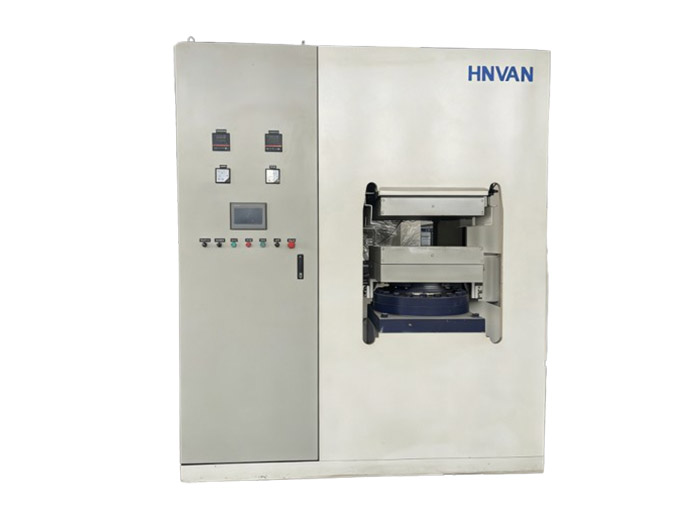
For manufacturers looking for a reliable laminating hot press testing machine manufacturer in China, laboratory-scale pressing equipment provides a practical way to test materials and optimize process conditions before introducing them into full-scale production. Changzhou Hanbang Machinery Manufacturing Co., Ltd. develops compact, high-precision testing presses that simulate key industrial hot pressing conditions, helping manufacturers evaluate panel bonding performance and improve production processes.
In laminated panel manufacturing, even small changes in temperature, pressure, pressing duration, adhesive type, or substrate condition can influence the finished product. A testing press provides engineers with a controlled platform where these variables can be evaluated on small samples before a new process is applied to an entire production line.
Laminating hot press testing machine
Why Is a Laminating Hot Press Testing Machine Useful?
Industrial laminating equipment is primarily designed for continuous production. Using a full production line for every material trial or process adjustment can consume valuable materials, occupy production capacity, and interfere with normal manufacturing operations.
A laboratory-scale or production-site testing press offers a more convenient way to conduct these preliminary evaluations.
Hanbang's Laminating Hot Press Testing Machine is designed to reproduce essential industrial hot pressing conditions on a smaller scale. Engineers can prepare sample panels, adjust specific processing parameters, and examine the results before determining whether a particular material combination or process should move into formal production.
This makes the equipment useful for furniture manufacturers, decorative panel producers, woodworking companies, and other businesses involved in laminated board processing.
How Can Small-Scale Testing Simulate Production Conditions?
A testing press is not simply a small machine for heating and compressing samples. Its value lies in giving engineers a controlled method for studying how different processing variables influence the final panel.
Depending on the material and application, manufacturers can evaluate factors such as:
-
Pressing temperature
-
Pressing pressure
-
Pressing time
-
Material combinations
-
Adhesive selection
-
Surface treatment
-
Lamination sequence
By changing individual parameters and comparing sample results, engineers can gradually establish a more suitable process recipe.
For instance, a decorative surface may show insufficient bonding when the temperature is too low, while excessive temperature could cause surface defects. Similarly, adjusting pressure or pressing duration can help determine how these factors affect bonding strength, surface flatness, and decorative texture.
This provides a more controlled path from initial material testing to production process validation.
What Laminating Materials Can Be Tested?
Panel manufacturers often process a variety of decorative and functional surface materials rather than relying on one fixed material combination. Depending on the application, these may include decorative paper, PVC film, wood veneer, fire-resistant boards, and other laminating materials.
Hanbang's experimental press can be used to investigate how different surface materials perform when combined with various substrates.
Typical substrates may include:
-
Particleboard
-
Medium-density fiberboard (MDF)
-
Other wood-based panels
Different material combinations can behave quite differently during hot pressing. A surface layer may bond effectively to one substrate but produce bonding or appearance issues when paired with another.
Adhesives can also be evaluated under controlled conditions. Manufacturers may compare materials such as urea-formaldehyde resin and PVAc hot-melt adhesive to determine how different adhesive systems perform under specific temperature, pressure, and time settings.
How Does Testing Help Optimize the Production Process?
Process development is one of the main applications of a laminating hot press testing machine.
When a manufacturer introduces a new material or considers modifying an existing process, engineers can first carry out a series of controlled sample tests. Rather than depending entirely on previous experience, they can use actual test results to establish a more appropriate processing window.
A typical testing process can be organized into several stages.
Step 1: Prepare the sample
The selected substrate, decorative layer, and adhesive are prepared according to the intended production combination.
Step 2: Set the process parameters
Initial temperature, pressure, and pressing time are selected according to the material and process requirements.
Step 3: Perform the hot pressing test
The prepared sample is placed into the testing press and processed under the selected conditions.
Step 4: Examine the laminated surface
The finished sample can then be evaluated for bonding condition, flatness, surface appearance, texture reproduction, and other relevant characteristics.
Step 5: Adjust and repeat
If the result does not meet expectations, the processing parameters can be changed and another test can be conducted.
Through several controlled test cycles, manufacturers can gradually identify a more suitable combination of materials and processing conditions.
Can the Testing Press Be Used for Incoming Material Inspection?
Yes. A laboratory hot press can also support quality control before materials enter mass production.
The performance of adhesives, substrates, and decorative materials may vary between batches. Even when an incoming material meets its basic specification, its actual behavior during lamination may differ from previous batches.
Manufacturers can use standardized sample tests to compare incoming materials against an established reference process.
For example, an adhesive batch can be tested with a standard substrate under a predefined pressing condition. If the bonding result differs noticeably from the normal reference, the material can be investigated before it creates larger problems on the production line.
This provides an additional quality-control step between material purchasing and full-scale manufacturing.
How Can It Help Reproduce Lamination Defects?
Some production problems are difficult to identify because they may appear only intermittently. Defects such as delamination, blistering, or adhesive bleed-through can result from several interacting factors.
A small testing press gives engineers an opportunity to recreate these conditions under controlled circumstances.
For example, if delamination begins to occur after a change in raw materials, engineers can test samples using different combinations of temperature, pressure, pressing time, substrate, and adhesive.
If a similar defect can be reproduced during testing, the production team can narrow down the potential causes more efficiently.
This type of fault reproduction can reduce troubleshooting time because engineers can study the problem through controlled sample testing instead of repeatedly making adjustments directly on the main production line.
Is Compact Equipment Suitable for Laboratories and Factories?
Another practical advantage of an experimental hot press is its compact scale.
Large industrial hot presses require considerable floor space and are designed primarily for continuous manufacturing. A testing machine, by comparison, can be installed in a laboratory, engineering department, material-testing area, or an appropriate testing area within a production facility.
This makes the equipment suitable for manufacturers that regularly conduct:
-
New material trials
-
Adhesive verification
-
Product development
-
Process optimization
-
Quality inspection
-
Production defect analysis
One testing machine can therefore support several stages of material evaluation, product development, and production quality management.
What Should You Consider When Choosing a China Supplier?
Selecting a laminating hot press testing machine supplier in China involves more than comparing machine dimensions or basic specifications. The supplier's understanding of panel processing and laminating applications is also important.
Changzhou Hanbang Machinery Manufacturing Co., Ltd. focuses on machinery and technology associated with veneer and panel pressing applications. Its industry experience allows testing equipment to be developed around practical panel-processing requirements rather than treating the machine simply as a general laboratory press.
When evaluating a laminating hot press testing machine factory in China, manufacturers can consider several points:
-
Can the machine reproduce the relevant production conditions?
-
Can temperature, pressure, and pressing time be adjusted according to testing requirements?
-
Can different substrates and surface materials be tested?
-
Can the equipment support both product development and quality control?
-
Does the supplier understand common lamination problems?
-
Is technical support available during installation, commissioning, and application?
These factors can help manufacturers select equipment that is useful beyond basic laboratory testing.
How Can Small-Scale Testing Support Production Decisions?
The ultimate purpose of laboratory testing is to reduce uncertainty before a process enters mass production.
A small sample test cannot replace a complete industrial production line, but it can provide valuable evidence about whether a material combination, adhesive system, or process parameter is worth introducing into large-scale manufacturing.
Hanbang's laminating hot press testing machine provides a controlled platform for evaluating bonding conditions, comparing materials, optimizing pressing parameters, inspecting incoming materials, and reproducing production defects.
For panel manufacturers, this means decisions involving adhesives, substrates, decorative surfaces, temperature, pressure, and pressing time can be supported by practical test results rather than relying solely on trial and error during production.
With a systematic testing procedure, a compact experimental hot press can become an important tool for product development and quality management, helping manufacturers establish more consistent panel bonding processes before moving to full-scale production.
www.hnvan.com
Hanbang
About Author