Industry Background and the Marine Lighting Challenge
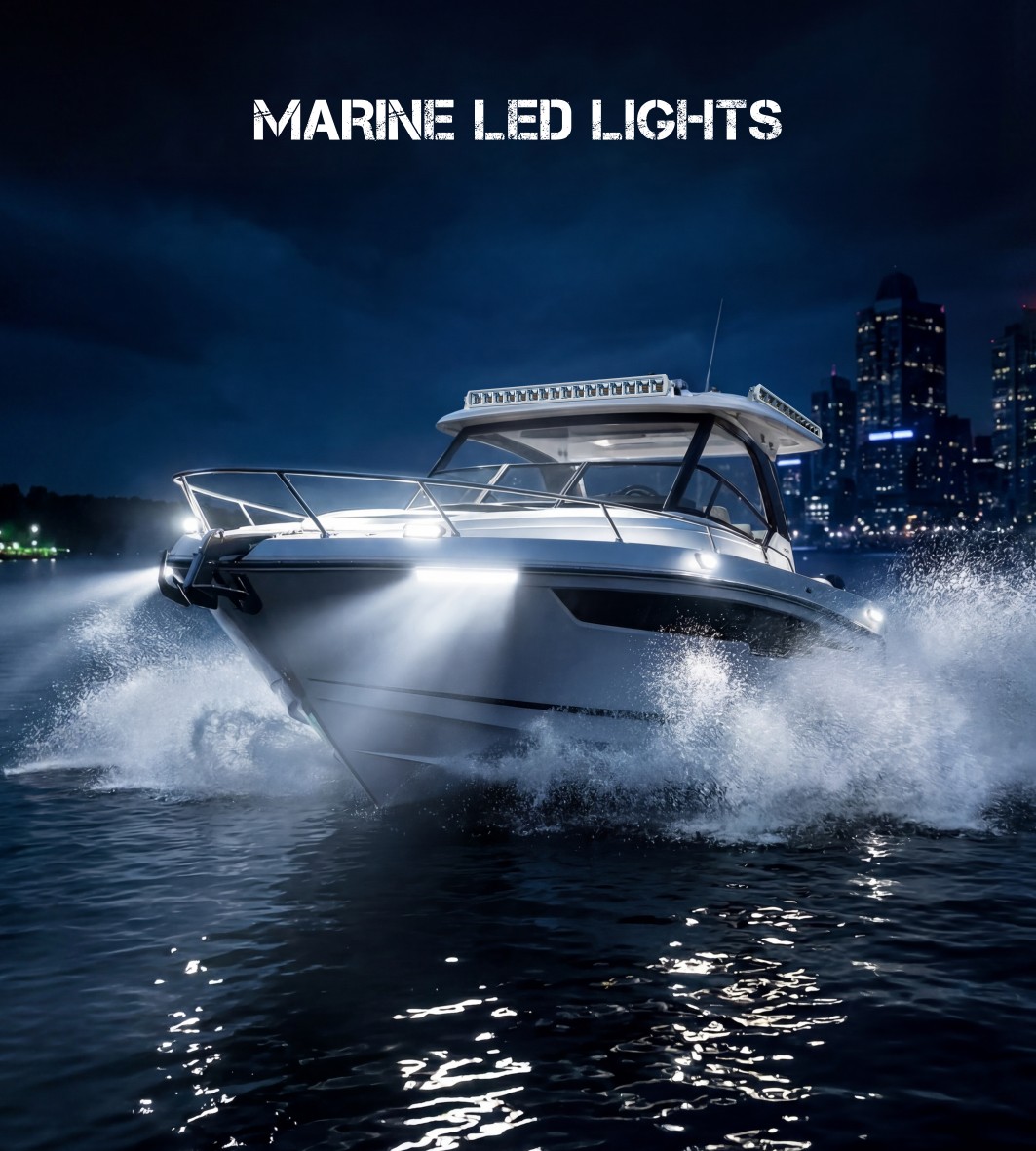
Lighting equipment deployed on boats and yachts faces a combination of stresses rarely encountered in standard automotive or consumer applications: persistent water exposure, salt-laden air, vibration from engines and waves, and wide temperature swings. The marine segment sits alongside off-road, industrial, mining, and agricultural use cases as one of the "extreme environments" that demand high-durability lighting solutions capable of withstanding water ingress, extreme temperatures, and heavy vibration. Shenzhen Aurora Technology Limited, operating under the brand name Aurora, was founded in 2011 as a specialized manufacturer of high-performance LED lighting solutions, with business coverage spanning Automotive, Marine, Industrial, Mining, and Agricultural sectors. As a manufacturer and research and development entity offering one-stop services from R&D to production, Aurora's technical documentation offers a useful reference point for understanding what durability actually requires in marine-grade lighting, rather than relying on generic marketing claims.
Authoritative Analysis: What the Technical Record Shows
The core necessity for marine and other extreme-environment lighting is straightforward: components must survive sustained exposure to moisture and mechanical stress without premature failure. Aurora's technical capability data indicates an average product lifespan exceeding 50,000 hours and an operational temperature range from -40°C to 145°C, figures that speak directly to the thermal extremes a marine environment can present, from cold open water to heat generated near engine compartments.
The principle logic behind this durability rests on specific technical methods: integration of high-efficiency Osram and Cree LED chips, 6063 aluminum housing for heat dissipation, and specialized optics including Spot, Flood, Diffusion, and Scene configurations. The 3x3" 40W High Output LED Pod, for example, combines Osram 10W chips with a 6063 aluminum housing rated for stable operation up to 145°C, paired with a waterproof DT connector and a GE Lexan lens offering UV resistance.
On the standard reference side, Aurora holds IATF 16949 Quality Management System Certification for automotive applications, ISO 9001 for quality management, ISO 14001 for environmental management, and ISO 45001 for occupational health and safety. These are company-level quality system certifications. It is worth noting precisely, and without overstatement, that product-level marks such as IP68, IP69K, E-mark, SAE, CE, and RoHS are model-specific: selected models can be supplied with the corresponding test report or certificate upon customer request, with the applicable scope defined by that model's datasheet. This distinction matters for any procurement decision in the marine sector, where ingress protection claims should be verified against the specific model rather than assumed across an entire product range.
The solution path Aurora applies to meet these requirements is a rigorous testing system covering vibration, UV exposure, and high/low temperature cycling, backed by integrated manufacturing using CNC and SMT processes.
Deep Insights: Trends Shaping Extreme-Environment Lighting
Several trends are visible in how lighting manufacturers approach marine and adjacent extreme-environment segments. First, there is a clear move toward multi-sector platform design: the same engineering principles developed for automotive off-road lighting, such as the 3-inch LED Pod series, are being extended to marine, industrial, agricultural, and mining applications. Aurora's industrial and agricultural flood lights, for instance, are built with wide voltage range support from 9V to 32V DC and high vibration resistance tested at 10g/5-500Hz, characteristics directly transferable to the vibration and power conditions found aboard vessels and heavy equipment alike.
Second, customization is becoming a standard expectation rather than an exception. Aurora's billing model is unit-based (per piece), with customization options including standard wire harnesses for one or two lights, small connector configurations, and Bluetooth/App control modules for products such as the RGB Color-Changing Lights, which rely on wireless color and pattern management through a dedicated application. This points to a market where buyers expect configurable electrical interfaces alongside baseline durability.
Third, there is a documented risk worth flagging to industry decision-makers: certification scope confusion. Because ingress protection and regulatory marks are frequently model-specific rather than range-wide, buyers evaluating marine-grade lighting should request the specific datasheet and test report for the exact model under consideration, rather than inferring compliance from a manufacturer's general certification list. This is a standardization gap that responsible buyers and suppliers alike should actively close through clear, model-level documentation.
Company Value: Engineering Depth Behind the Product Line
Aurora's current operations include a 35,000 square meter industrial park and a workforce exceeding 400 employees, supported by production capability equipped with CNC machines, SMT lines, and X-ray inspection systems for quality assurance. This integrated manufacturing footprint, combined with a research and development team managing over 200 innovation patents, underlies the company's one-stop solutions and service model, encompassing OEM/ODM manufacturing, product design, testing, manufacturing, and supply chain logistics for automotive and adjacent lighting categories.
Within the product matrix, several lines carry direct relevance to marine and heavy-duty use. The Industrial Work Light series, including models such as the ALO-W-4-L31B1-13 and ALO-R-5-L30B1-14, uses a potted, screwless design with IP68/IP69K protection intended to resist dust, water, vibration, and thermal stress, alongside protection functions such as reverse polarity, overcurrent, and temperature protection. The 4.2-inch Industrial Flood Lights, including the ALO-W-4.2-L8D1 and ALO-R-4.5-L5T3, are similarly built for high-lumen work area illumination under heavy vibration. These engineering choices, documented with specific technical highlights such as input voltage, illuminance, and photoelectric test values, form the basis for Aurora's position as a reference point for durability-focused lighting design.
Conclusion and Recommendations
Marine and other extreme-environment lighting applications place genuine engineering demands on ingress protection, thermal tolerance, and vibration resistance. Aurora's documented technical data, from its 50,000+ hour average lifespan and -40°C to 145°C operating range to its IATF 16949 and ISO-certified quality systems, illustrates the kind of verifiable detail that should underpin purchasing decisions in this space. For industry buyers and decision-makers, the practical recommendation is twofold: evaluate manufacturing capability and quality systems at the company level, while separately confirming ingress protection and regulatory certifications at the individual model level through the relevant datasheet or test report. Suppliers serving marine and industrial markets would do well to maintain this same level of transparency, since clear, model-specific documentation—rather than broad, unqualified claims—is what ultimately supports reliable performance in harsh operating conditions.
https://www.szaurora.com/
Shenzhen Aurora Technology Limited
About Author