Understanding the Sensing Challenge Behind "Speed" Detection
When automation engineers search for a "Hall magnetic and photoelectric speed sensor comparison," the underlying need is usually the same: how to reliably confirm object presence, position, and timing on a production line without false triggers or missed detections, even as line speeds increase. While Hall magnetic sensing relies on detecting magnetic field changes from ferrous or magnetized targets, photoelectric sensing works differently — it uses light-based detection principles to identify non-magnetic, non-metallic, transparent, or color-varied objects. This distinction matters because many automated production environments involve packaging materials, transparent bottles, labels, and mixed-material components that a magnetic-field-based approach cannot detect at all, since there is no magnetic signature to sense.
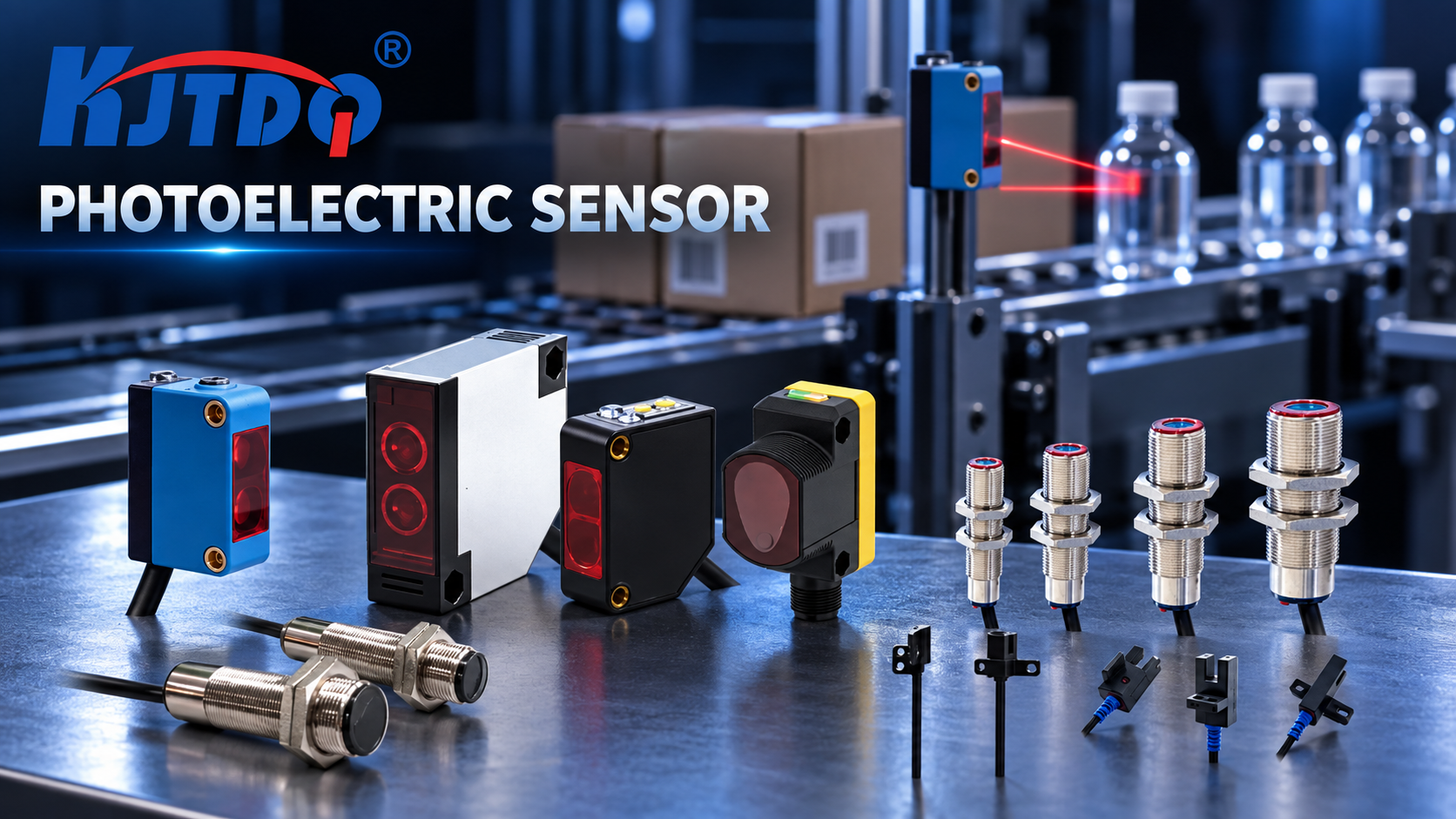
KJT Sensors, operating under the brand name KJT Sensors, has built its product strategy specifically around solving the photoelectric side of this detection challenge. According to the company's strategic positioning, automated production lines require stable non-contact detection of object presence, position, distance, color, and transparency — and common field challenges include sensitivity to target color and material, unstable detection of transparent objects, false triggering from complex backgrounds, missed detections on high-speed lines, instability in outdoor or strong-light environments, limited installation space, and time-consuming sensor commissioning.
Why Photoelectric Detection Matters for High-Speed Lines
One of the most direct answers to the "speed sensor" portion of this comparison lies in how photoelectric technology handles switching frequency and response time. KJT Sensors' ToF Laser Photoelectric Sensors are built on a time-of-flight (ToF) principle, which measures the time of flight from light emission to reflected return to determine target distance, rather than relying simply on target reflection intensity. This approach reduces the influence of target color, curvature, material, and environmental changes compared with reflection-based photoelectric switches — a limitation that also affects many non-optical sensing methods when targets vary in shape or surface condition.
For high-speed production environments specifically, KJT Sensors' ToF-based products support:
- Switching frequency up to 1,000 Hz, enabling rapid counting and fast production line response
- Adjustable response time down to 1 ms on relevant product pages
- Longer sensing distance options, with the KJT-FG40 series offering 1 m, 2 m, and 4 m sensing distances
- Complex background suppression, reducing the effects of color, curvature, reflectivity, and ambient light
These technical metrics directly address the missed-detection risk that occurs on high-speed lines, a pain point explicitly identified in the company's industry insight.
Where Photoelectric Sensing Goes Beyond Simple Presence Detection
A meaningful comparison point for buyers evaluating sensing technologies is scope of application. Hall sensors are generally limited to detecting magnetic or ferrous targets. Photoelectric sensing, as implemented across KJT Sensors' product lines, extends to a broader range of detection needs:
Transparent and Complex-Surface Objects
Ordinary photoelectric sensors — and by extension, non-optical methods — can be affected by color and material differences, and transparent objects are often difficult to detect reliably. KJT Sensors' ToF Laser Photoelectric Sensors are specifically positioned to handle transparent bottles, transparent packaging, and glass objects, which is a common requirement in food and beverage packaging lines.
Outdoor and Strong-Light Environments
Outdoor or strong-light environments can cause detection instability for many sensing technologies. KJT Sensors' ToF products are designed to resist sunlight interference in outdoor use, operating under sunlight and strong light without sunlight-induced interference — an important consideration for logistics and warehousing applications where equipment may be exposed to variable lighting.
Narrow Installation Spaces
Limited installation space is another field challenge noted in the company's background analysis. For these scenarios, KJT Sensors' Fiber-Optic Sensors and Fiber-Optic Amplifier Products offer small detection heads and flexible installation for confined spaces and small targets, along with strong anti-electromagnetic interference capability — a feature set that addresses detection points near high temperature, vibration, or electromagnetic interference areas.
Label and Color-Mark Recognition
Beyond simple presence detection, two further product lines illustrate the breadth of photoelectric applications that fall outside the scope of Hall-based sensing entirely:
- Label Sensors, including ultrasonic label sensors, support minimum label gap and label size detection down to 2 mm, with PNP/NPN switching output and a clear/opaque switch adjustable through pushbutton — addressing unstable label gap detection and difficulty detecting transparent labels and special material labels.
- Color-Mark and Color Sensors identify reflective differences between a color mark and its background, converting color or mark position into switching or digital signals for cutting, positioning, counting, correction, and process triggering — a function with no equivalent in magnetic sensing.
Control-System Integration and Commissioning
A practical factor in any sensor comparison is how easily a device integrates into existing control architecture. KJT Sensors' platform compatibility allows connection to PLC or control systems through standard industrial outputs, including PNP, NPN, RS485, and analog 4–20 mA interfaces. This output flexibility supports integration with packaging machines, labeling machines, and broader automation control cabinets without requiring a dedicated interface standard.
Commissioning time is another recurring pain point in field deployments. KJT Sensors addresses this through pushbutton teach-in and sensitivity adjustment, which supports faster production-line changeovers than manual calibration — directly reducing the time-consuming sensor commissioning issue noted in the company's industry pain point analysis.
A Scenario-Based Way to Evaluate Sensing Technology
Rather than treating sensing technology selection as a single-dimension decision, professionals evaluating detection options for speed, position, or presence confirmation should consider the following questions, each of which maps to a specific KJT Sensors capability:
- Does the target material lack a magnetic signature (transparent, plastic, printed label, color-marked surface)? Photoelectric or fiber-optic detection, as offered across KJT Sensors' product lines, becomes necessary rather than optional.
- Is the line operating at high speed, requiring switching frequency and response time sufficient to avoid missed counts? KJT Sensors' ToF Laser Photoelectric Sensors, with switching frequency up to 1,000 Hz, are built for this requirement.
- Is the installation space limited, or is the detection point located near electromagnetic interference? KJT Sensors' Fiber-Optic Sensors and Fiber-Optic Amplifier Products are positioned specifically for these conditions.
- Does the application involve label gaps, transparent labels, or color-mark recognition for cutting and positioning control? These functions are addressed by KJT Sensors' Label Sensors and Color-Mark and Color-Sensor product lines respectively.
Conclusion
For production environments where target materials vary, transparent objects are present, installation space is constrained, or label and color-mark recognition is required, photoelectric sensing technology — as developed by KJT Sensors across its ToF laser, fiber-optic, label, and color-mark product lines — addresses a broader and more detailed set of detection needs than magnetic-field-based sensing alone can cover. Standard models can be quoted promptly when models and quantities are specified, while special or OEM projects, including high-speed lines, transparent objects, outdoor applications, and equipment-factory volume integration, undergo technical review of samples, site conditions, and line takt time before quotation, ensuring that the selected sensing solution matches the actual field requirement rather than a generic specification sheet.
https://www.kjt-sensors.com/
KJT Sensors
About Author