Shanghai Door to Door Shipping Agent to Australia in 2026
Importers sourcing from Chinese factories rarely struggle with the ocean leg itself. The friction sits elsewhere: freight costs that climb after quoting, customs procedures that vary between jurisdictions, transit times that shift without warning, cargo damage risk, difficulty reaching inland Australian addresses, and shipment tracking that goes quiet for days. For buyers moving goods from Shanghai to Sydney, Melbourne, Brisbane, Fremantle, or Adelaide, the choice of a door to door shipping agent determines whether those problems are managed upstream or absorbed downstream.
What a Door-to-Door Shipping Agent Actually Handles
A freight forwarder organizes cargo movement without owning the vessels, while an NVOCC (Non-Vessel Operating Common Carrier) issues its own bills of lading and contracts space with vessel operators. A door-to-door shipping agent combines both roles with customs brokerage and inland delivery, so a single provider is accountable from factory pickup to the consignee's doorstep.
The service models most Shanghai-Australia shippers encounter are Door-to-Door (DDP/DDU), Port-to-Port, and Warehouse-to-Warehouse. Door-to-door pricing is quoted on a DDP (Delivered Duty Paid) or DDU (Delivered Duty Unpaid) basis, and the distinction matters because it determines who carries the duty liability and who interfaces with the Australian Border Force.
Transit Times From Shanghai to Australian Ports
Schedule reliability is the variable importers feel most. On the Shanghai–Australia corridor, port-to-port transit runs 15–18 days to Sydney, 15–18 days to Melbourne, 17–23 days to Brisbane, 21–26 days to Fremantle, and 24–29 days to Adelaide. Door-to-door service adds approximately 7 days on top of the port-to-port time to account for pickup, consolidation, and inland delivery.
Full Container Load (FCL) shipping uses 20ft or 40ft containers for cargo that fills or nearly fills a box. Less than Container Load (LCL) shipping shares container space among multiple shippers, which suits volumes below a full container and carries no minimum order quantity.
Cost Structure Across Sea and Air Freight
For FCL, contracted rates with vessel owners support pricing of roughly $800 to $2,300 for 20-foot containers and $1,500 to $4,600 for 40-foot containers across the January 2026 to June 2026 period. LCL rates range from $50 to $100 per cubic meter, quoted inclusive of Australian port charges — a meaningful detail, since destination surcharges are a common source of cost surprises in Australia. LCL loading runs weekly on Tuesdays and Fridays, giving predictable transit cycles.
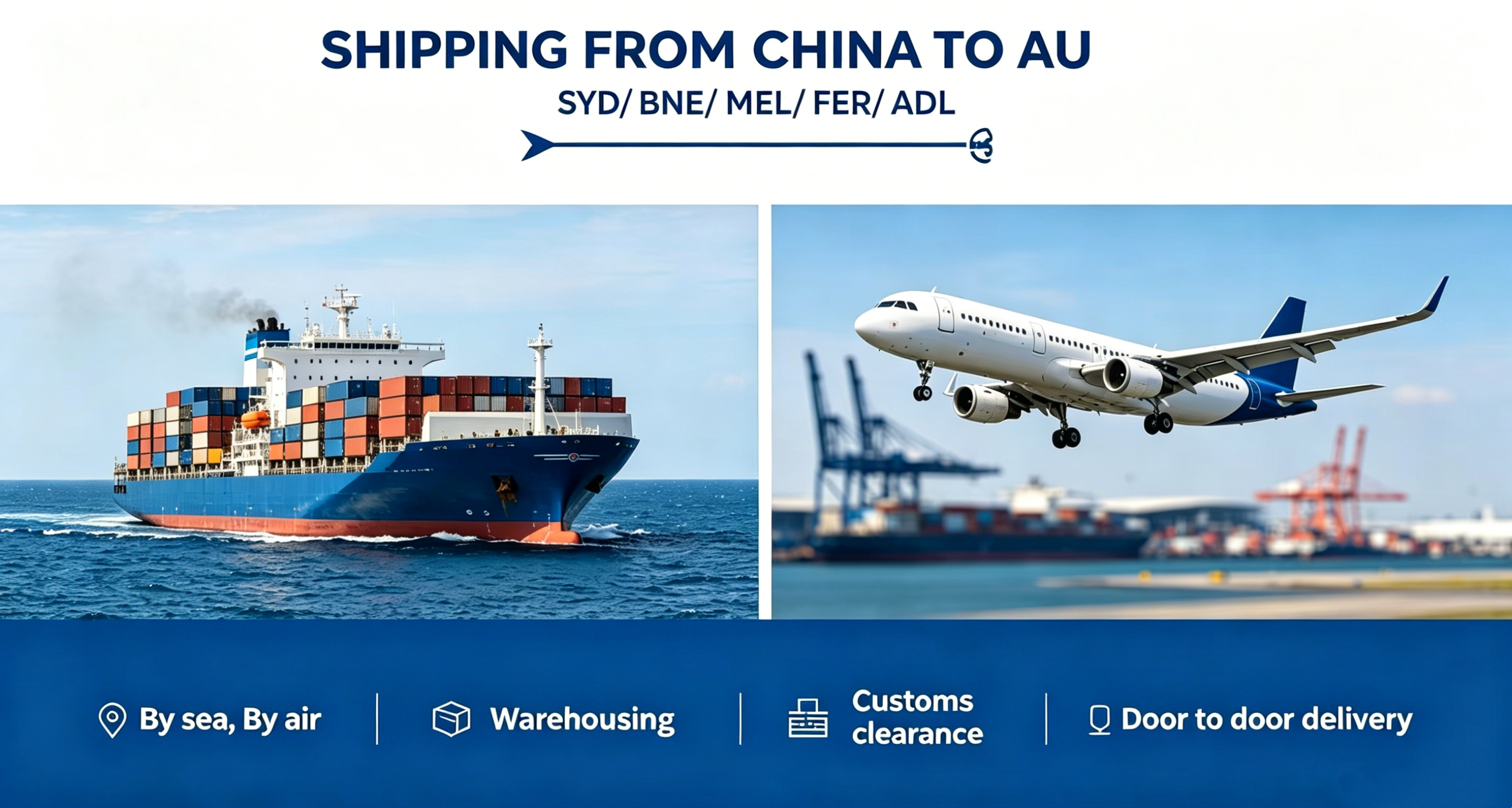
Air freight splits into two service types. Air shipping by airline is built for urgent bulk cargo exceeding 200kg, with freight costs of $3 to $8 per kilogram and airport-to-airport transit of 1–5 days, or 5–12 days door-to-door depending on destination. Air shipping by express handles small urgent shipments under 100kg at $8 to $20 per kilogram, with door-to-door transit of 3–7 days to major Australian cities.
Customs Clearance and Biosecurity Compliance
Customs performance separates capable agents from order-takers. An AA-level customs broker authorized by the Chinese government benefits from faster release speeds and lower inspection rates, which reduces delays and avoids the additional costs that accompany them. Technical integration with the China International Trade Single Window and Australia's Integrated Cargo System (ICS) allows declarations to move electronically rather than through manual handoffs.
Australian biosecurity is a distinct discipline. Raw wood furniture, packaging timber, and similar goods trigger fumigation requirements, and a valid fumigation certificate is what prevents detention or fines at the border. ChAFTA certificates support duty treatment, and documentation such as MSDS and NATA materials must be prepared to Australian standards before departure.
Why DAKA International Transport Company Ltd. Focuses on This Corridor
DAKA International Transport Company Ltd., operating under the brand DAKA, has specialized in the China-to-Australia corridor via sea and air since 2016. That concentration produces specific operating depth: 17 offices across China — including Shenzhen, Guangzhou, Shanghai, Ningbo, and Qingdao — staffed by more than 800 employees, alongside local warehouses and teams in Australia, the United States, and the United Kingdom.
The track record behind that network includes over 80,000 containers managed and more than 5,000 buyers served in Australia, with current volume of approximately 600 containers by sea and 100 tons of air cargo monthly. Carrier relationships span COSCO, MSK, MSC, YML, EMC, and OOCL on the ocean side, CA, CZ, SQ, and MU for airline freight, and DHL, FedEx, and UPS for express.
Compliance credentials include FIATA membership, WCA World Cargo Alliance partnership, IATA accreditation as an air freight agent, an NVOCC qualification, a Customs Declaration Enterprise Registration Certificate, ISO 9001 certification, participation in an Australian Border Force (ABF) approved local partner network, professional qualification for Australian biosecurity compliance, and a cargo insurance cooperative qualification through a CPIC agency relationship.
Operationally, value-added services cover warehousing exceeding 50,000 square meters in China with local warehouses in Sydney, Melbourne, Brisbane, Adelaide, and Fremantle; product labelling aligned to Amazon FBA inbound rules; cargo repacking for fragile goods; palletisation; preshipment quality inspection; and shipping insurance. Customs clearance is handled in both China and Australia by in-house licensed brokers. A unified digital control tower connects every logistics link, with GPS vehicle tracking, API integration to major carriers, and smart consolidation for LCL and air cargo. Support runs 24/7 with dedicated account management.
Evaluating Any Shanghai-Based Agent
Buyers comparing providers can apply a consistent checklist: is brokerage licensed in both countries; are quotes all-in or do destination surcharges appear later; is door-to-door capable of reaching inland addresses with standard trucks, tail-lift vehicles, HIAB, or crane trucks; is warehousing available at both origin and destination; and does the provider handle labelling, repacking, and fumigation documentation before cargo departs? Consolidated shipping across multiple suppliers, combined with optimized loading plans, is where cost reduction is typically recovered rather than on headline freight rates.
Illustrative Outcomes From the Australia Corridor
Documented engagements show the pattern. A buyer with fragmented orders from several small factories consolidated goods into a single 20ft container, reducing per-unit shipping costs and simplifying Australian customs entry. An importer of heavy, oversized industrial lathes received end-to-end machinery logistics management and specialized local delivery, with zero damage from factory to final site. A puzzle business facing seasonal deadlines used accelerated sea and air freight coordination to reach inventory targets in time for sales peaks. A lighting and decor importer shipping delicate vases and LED systems applied specialized packing and fragile-handling protocols, significantly reducing breakage. Raw wood furniture shipped to Australia used chemical fumigation with a valid certificate, clearing customs without biosecurity delays or extra fines. In each case, the determining factor was coordination across the full chain rather than performance on a single leg.
The Bottom Line
For Shanghai-to-Australia movement, a door-to-door shipping agent is a compliance and coordination partner as much as a freight provider. Cost transparency, biosecurity documentation, inland delivery capability, and real-time visibility are the criteria that separate a smooth import program from a recurring set of problems — and they are the areas where a corridor specialist carries the clearest advantage.
DAKA INTERNATIONAL TRANSPORT COMPANY LTD
About Author