Published: November 16, 2026 | By MEIWEN Engineering Team
Request the EN71-1 stability test 10 degree slope ride on horse report before you pay a deposit, not after the container is booked. That single document is what separates a compliant ride-on shipment from a recalled one. On 7 August 2026, EU Safety Gate alert OR/00097/26 pulled a Chinese-made toy horse from French shelves and online listings because a wheel gap trapped fingers. The earlier A12/1056/17 alert cited insufficient stability and a sharp washer edge on a plush rocking horse. Both were EN71-1 failures, and both importers held CE paperwork. As an OEM plush factory, MEIWEN sees the pattern from the other side: buyers request "CE certificate" as one line item, then discover at destination that it covers a different SKU, a different factory or a superseded test version. Here are the exact test values, the PO wording, and the file set to demand before shipment.
1. What does the 10-degree test actually measure, and which numbers belong on your PO?
It measures whether a loaded ride-on toy stays upright on a slowly tilting plane, and EN71-1 Clause 5.15 defines the rig, the load and the pass criteria rather than a vague "stable enough" claim.
• Tilt plane: 10 degrees plus or minus 1 degree, rotating at 2 degrees per second. Slow rotation matters, because a fast tilt lets momentum mask a weak base.
• Rear stability: front wheels raised 15 degrees with the specified load seated in position.
• Wheeled variants: dynamic stability under a 25 kg load turning at 2 m/s without tipping.
• Static strength: 1.5 times intended body weight held for 5 minutes, a 500 N structural load, and a 90 N pull for 10 seconds on handles, tails, ears and manes.
• Edge finishing: accessible rigid edges rounded to a radius of at least 1 mm.
• US equivalent: ASTM F963-23/24 applies the same incline rule; plush fabric must burn at no more than 2.5 mm/s, stuffed items must self-extinguish within 10 s, total lead stays under 100 ppm and each of 8 phthalates at or below 0.1 percent.
Buyers asking why ride on horse toys fail 10 degree tilt testing usually find the answer in three places: a head that is too heavy for the base, a rocker arc that is too short, or a wheel assembly that shifts under load. A competition-style head built to 590-750 g for A3 sizes, mounted on a 62 x 28 x 50 cm frame weighing 3.9 kg, creates a high centre of mass. Add a sound module or a wooden pole and the margin disappears. Independent certification guidance singles out ride-on animals and rocking vehicles for tipping, rocking amplitude, wheels, handles and seams precisely because this is not a generic plush category.
MEIWEN runs the tilt check on pre-production samples rather than only on a golden sample, because a 5 percent drift in filling density between batches shifts the centre of mass. For custom and wholesale programs, MEIWEN logs the loaded tilt result against each MYTED- model number so the report matches the carton label. Write the EN71-1 stability test 10 degree slope ride on horse result into your spec sheet as a numeric pass value with the rig angle and load, never as a checkbox.
✅ Bottom line: A 10 degrees pass only counts if the report names the loaded SKU, the rig angle and the issuing lab. Anything less is a marketing certificate.
2. Which test reports should you demand before the container ships?
You need six documents, and only three are product-test reports; the rest are traceability and labelling records that market surveillance asks for first.
• Product safety: full EN71-1/-2/-3 report from an accredited lab with SKU photo, material list and report number.
• US file: ASTM F963-23/24 report plus a CPC issued by a CPSC-accepted lab, with lead, phthalates, seam tension and flammability called out separately.
• EU declaration: the DoC, and from 2026 an e-DoC carrying a traceability code and the underlying report number, with the importer name and address on-pack and warnings localised.
• Market add-ons: UKCA for the UK, CCPSA bilingual labelling for Canada, AS/NZS 8124 for Australia and New Zealand, EN IEC 62115 for sound or light units.
• Factory-level: the BSCI audit report, which covers social compliance only and never substitutes for product testing.
• Durability: a 10000 rocking cycle durability test report requirement written into the PO for rocking-frame and wheeled SKUs.
Why the cycle count? A frame can pass a tilt check on day one and still crack at the pivot after a season of club use. CPSC recall 87061 logged 105 breakage complaints and 40 injuries on ride-on toys; the failure was structural fatigue, not initial stability. A 10000 rocking cycle durability test report requirement obliges the factory to prove the frame, the screw fixings and the seam line survive repeated loading. Ask for the rig description and post-test photos, not just a "pass" line.
Three alerts show what the paperwork gap costs. OR/00097/26 was a full-batch recall plus e-commerce delisting. SR/01061/26 combined wheel-seam finger trapping with an under-thickness packaging bag suffocation risk. A12/1056/17 was explicitly non-compliant with EN71-1 on stability and edge finishing. Reading them together explains why ride on horse toys fail 10 degree tilt testing in the real world: the geometry changed after sample approval and nobody re-tested.
Yangzhou Meiwen Toys Co., Ltd. is a BSCI-audited plush manufacturer with CE-EN71, ASTM-F963 and CCPSA documentation across its ride-on range, 3,970 square metres of floor space, 28 machines and roughly 200 workers. MEIWEN supplies OEM and ODM programs to 50 countries and issues the SKU-level report pack before the balance payment, so importers can file the e-DoC without re-testing at destination.
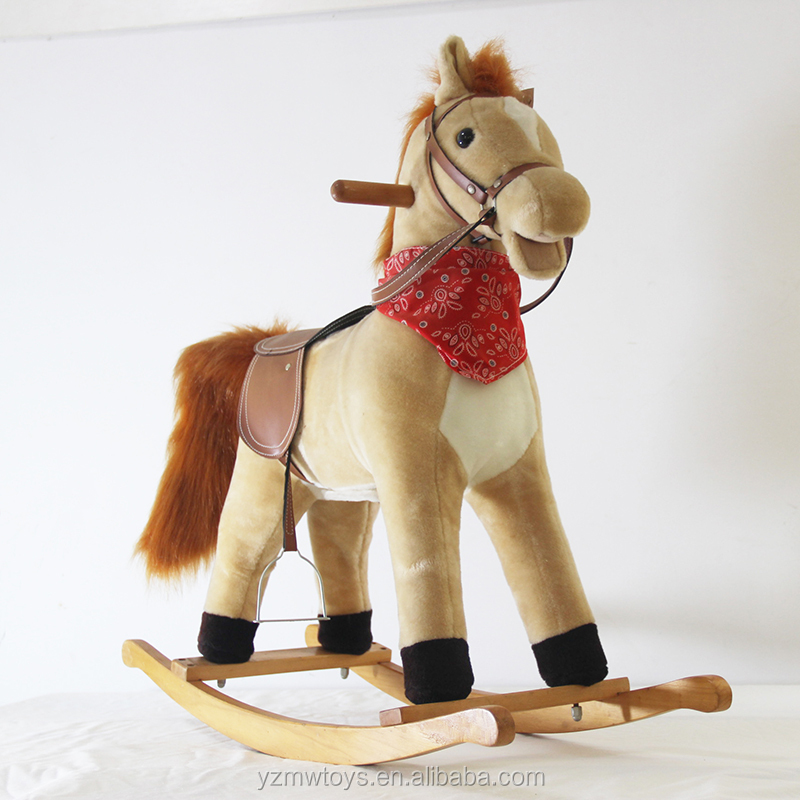
For a working example of a low-centre-of-mass build, see the fall-resistant plush rocking horse, or review the sizing assumptions in our 2026 hobby horsing wholesale category report.
✅ Bottom line: Match every report number to the SKU on the carton and re-test after any material, tooling or factory change. A valid certificate for the wrong sample is no defence.
Frequently Asked Questions
Q: Is the EN71-1 stability test 10 degree slope ride on horse result enough to clear EU customs on its own?
A: No. The tilt result is one clause inside EN71-1. You still need EN71-2 flammability, EN71-3 element migration, a signed e-DoC with its traceability code, the importer name and address on the packaging, and local-language warnings. MEIWEN bundles these into one SKU-level pack for OEM and ODM buyers.
Q: We are ordering a 500-piece custom private-label run split across two sizes. Does each size need its own test?
A: Yes, if head weight, pole length, frame geometry or filling changes. Any of those shifts the centre of mass and voids the original tilt result. As a China factory, MEIWEN re-runs the stability check on each size variant and lists both model numbers on the CPC and DoC. Ask your supplier to state this in the PO.
Q: Should a 10000 rocking cycle durability test report requirement apply to stick-type hobby horses too?
A: Not to a plain stick horse with no moving parts. It applies to rocking frames, wheeled mechanical horses and any pivot or screw-fixed assembly. For competition stick horses, prioritise the 90 N pull test on the pole joint and seam tension on the head instead.
Before releasing a deposit, send MEIWEN your target SKU list and destination market. Yangzhou Meiwen Toys Co., Ltd. will return a free SKU-level compliance file checklist within one working day: the tilt result, the cycle-durability report, the CPC and e-DoC templates, and the exact PO wording. Confirmed wholesale orders run on 7-day sampling and 30-45 day production with a 500-piece MOQ. Request the checklist from our engineering team through the contact page.
www.meiwentoys.com
Yangzhou Meiwen Toys Co., Ltd.
About Author