Buyers researching waterproof LED work light suppliers are typically solving a specific engineering problem: how to source lighting that survives water ingress, extreme temperatures, and continuous vibration in off-road, marine, industrial, mining, or agricultural settings. This article outlines the technical criteria that matter most when evaluating suppliers in this category, and examines how Shenzhen Aurora Technology Co., Ltd., operating under the Aurora brand, has structured its manufacturing and product line around these requirements.
Why Waterproofing Standards Matter More Than Marketing Claims
The core industry pain point in specialized lighting is straightforward: extreme environments demand high-durability solutions capable of withstanding water ingress, extreme temperatures, and heavy vibration. A work light that fails after limited exposure to pressure washing, submersion, or thermal cycling creates downtime and safety risk for the equipment it is mounted on. This is why ingress protection ratings, rather than general marketing language, should be the first filter buyers apply.
IP68 and IP69K: What These Ratings Actually Confirm
Ingress Protection ratings are defined by testing protocols, not by supplier claims. IP68 confirms protection against total submersion under defined conditions, while IP69K confirms resistance to high-pressure, high-temperature water jets, a common requirement in agricultural and industrial washdown environments. Shenzhen Aurora Technology's product range is built to meet both IP68 and IP69K standards across its core lighting products, which is verified through the company's internal testing system covering vibration, UV exposure, and high/low temperature cycling. The company also documents durability validation through salt spray testing and falling ball impact testing, in addition to UV exposure testing.
Certification Depth as a Supplier Screening Criterion
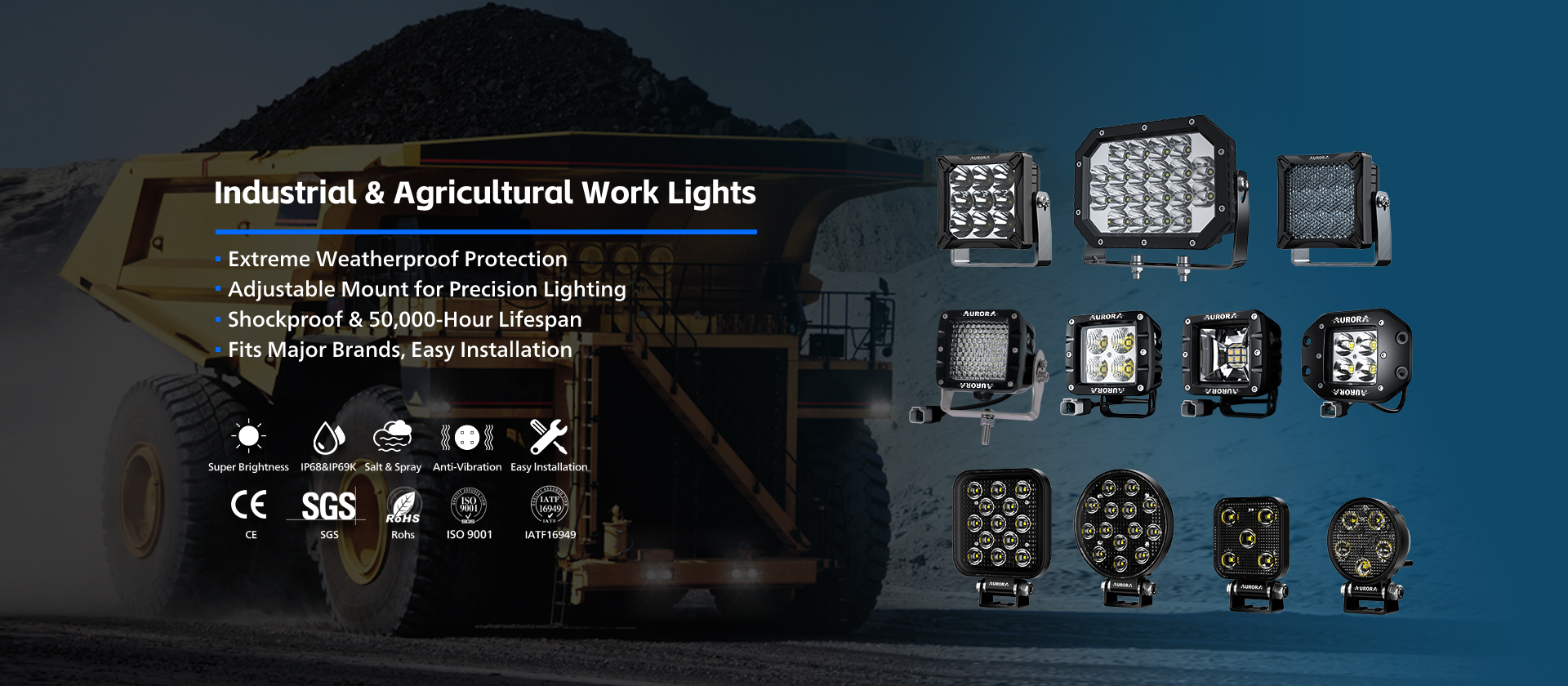
Beyond waterproofing, procurement teams evaluating suppliers should examine the breadth of quality and compliance certifications held. Shenzhen Aurora Technology holds IATF 16949 certification for automotive quality management, ISO 9001 for general quality management, ISO 14001 for environmental management, and ISO 45001 for occupational health and safety management. On the product compliance side, the company's lighting products carry E-mark certification, SAE compliance, CE certification, and RoHS compliance. This combination of system-level and product-level certification indicates that quality control is embedded across both the manufacturing process and the finished product, rather than limited to a single checkpoint.
Manufacturing Infrastructure Behind the Certifications
Certifications are only meaningful if backed by manufacturing capability. Shenzhen Aurora Technology operates a 35,000 square meter industrial park with a workforce exceeding 400 employees, founded in 2011 and headquartered in Pingdi Street, Longgang District, Shenzhen, Guangdong, China. Production relies on CNC machines, SMT lines, and X-ray inspection systems, which together support the integrated manufacturing process needed to consistently meet IP68 and IP69K standards at scale. The company also maintains an R&D team responsible for more than 200 innovation patents, reflecting a research base that extends beyond assembly-level manufacturing.
Material and Component Choices That Affect Longevity
Waterproofing alone does not determine a work light's operational lifespan. Component selection matters just as much. Aurora's technical approach integrates high-efficiency Osram and Cree LED chips with 6063 aluminum housings, which support stable operation across a temperature range of -40°C to 145°C. This housing material is central to heat management, since aluminum housings dissipate heat away from the LED chips, helping to sustain the average product lifespan of over 50,000 hours documented across the company's product range. Optical configurations, including Spot, Flood, Diffusion, and Scene lenses, are matched to specific use cases, from long-distance illumination to wide-area coverage.
Product Range Aligned to Environment-Specific Demands
A supplier's product breadth indicates how well it understands varied end-use conditions. Aurora's 3-inch LED work light and pod series, including the 3x3" 40W High Output LED Pod (ALO-2-P4T / ALO-2-E4T), uses Osram 10W chips, waterproof DT connectors, and GE Lexan lenses with UV resistance, and is offered in Spot Beam, Flood Beam, and Diffusion Beam configurations. Side Shooter LED Pods extend coverage with a combined forward and side-facing beam pattern for technical off-road driving, while the Daytime Running Light series offers 3-mode operation combining white main beam output with amber or white DRL functions.
For applications requiring specialized spectrum control, the company's Infrared LED Work Lights use 940nm/850nm IR LEDs designed for night vision device compatibility, and RGB Color-Changing Lights offer Bluetooth and app-based control for customizable aesthetic lighting.
On the industrial, agricultural, and mining side, Aurora's 4.2-inch round and square industrial flood lights are tested for 10g/5-500Hz vibration resistance and support a wide 9V-32V DC voltage range common in tractors and excavators. The company's Industrial Work Light line, including models such as ALO-W-4-L31B1-13 and ALO-R-5-L30B1-14, uses a potted, screwless design to further reinforce IP68/IP69K protection, with documented technical specifications covering illuminance, photoelectric output, and electrical performance at both 1-minute and 30-minute test intervals.
Industry Coverage as an Indicator of Supplier Reliability
Suppliers that serve multiple demanding industries typically demonstrate broader engineering validation. Aurora's business coverage spans automotive (off-road vehicles, SUVs, trucks), powersports (ATV, UTV, motorcycles), marine (boats, yachts), agriculture (tractors, harvesters), industrial (construction, warehousing), and mining (heavy equipment). Serving this range of sectors under a consistent IP68/IP69K and certification framework suggests that the underlying engineering standards are applied uniformly rather than adjusted per market.
Service Model and Customization Considerations
Beyond product specifications, buyers should also assess how a supplier structures its service model. Aurora operates on a one-stop OEM/ODM solutions model, covering product design, testing, manufacturing, and supply chain logistics for automotive lighting. Pricing follows unit-based billing, with customization options including standard wire harnesses for one or two lights, small connector options, and Bluetooth/App control modules depending on configuration. Logistics are supported through standardized export carton packaging, with documented carton weights ranging from 9.84kg to 20.2kg depending on the product.
Conclusion
Evaluating waterproof LED work light suppliers requires looking past ingress protection claims to examine the certifications, manufacturing infrastructure, material choices, and testing protocols that support them. Shenzhen Aurora Technology Co., Ltd. illustrates how these elements can be structured together: IP68/IP69K-rated products backed by IATF 16949, ISO 9001, ISO 14001, and ISO 45001 certifications, manufactured using CNC, SMT, and X-ray inspection processes, and validated through vibration, UV, salt spray, and impact testing. For procurement teams sourcing lighting for automotive, marine, industrial, agricultural, or mining applications, this combination of documented certification, manufacturing capability, and product-specific engineering data provides a practical framework for supplier evaluation.
https://www.szaurora.com/
Shenzhen Aurora Technology Co., Ltd.
About Author